
Written by Ashley Moscrop, Managing Director, Dufaylite Developments Ltd
Reviewed by Nigel West, Technical Manager, Clayboard
Last updated: 14 May 2026
Key takeaways
- Clay heave protection foundations use a compressible void former installed under ground beams or suspended slabs to absorb the upward pressure of expansive clay drawing in moisture.
- Two BBA-certified routes dominate the UK market: paper honeycomb (Clayboard KN30, BBA Cert 98/3528 Issue 4, June 2024 — weakens by design when wet) and EPS polystyrene (e.g. Cordek Cellcore HX — compresses but transfers heave load to the slab).
- The structural cost difference is large: EPS-based designs typically need additional reinforcement steel because the slab must resist heave force until the polystyrene fails. On a major football stadium project in London, specifying paper honeycomb over a polystyrene alternative saved over £1m in reinforcement steel alone.
- The 2026 climate context matters: Geobear’s Pete Luby (New Civil Engineer, March 2026) cites heave magnitudes of up to 16.5%, and 2025–26 rainfall data shows soil moisture deficit pushed to zero across the clay belt.
- Clayboard panels are 30% thinner than the EPS equivalent for the same void (160mm Clayboard delivers a 150mm void vs 225mm of Cordek Cellcore for the same void) — translating into less excavation and reduced groundwork programme time.
Clay heave protection foundations use a compressible void former installed beneath ground beams or suspended slabs to absorb the upward pressure of expansive clay as it absorbs moisture. Two void former routes dominate UK clay heave protection foundations: paper honeycomb (BBA certified — water weakens the paper core, switching off its strength so heave is absorbed without load transfer to the slab) and EPS polystyrene (compresses but transfers heave load to the slab, requiring additional reinforcement steel).
This guide explains the engineering behind clay heave protection foundations, the specification choices, and the structural cost difference between the two systems — written for the structural engineers, architects, and geotechnical engineers who own the void former specification on a UK foundation design.
Why clay heave protection foundations are on every UK specifier’s desk in 2026
Clay heave is not a theoretical risk in 2026 — it is a measurable, current UK structural engineering issue, and it is what is putting clay heave protection foundations back at the top of the specification pile. In a March 2026 piece for New Civil Engineer, Pete Luby, MD of Geobear, set out the problem starkly: “Extended rainfall can leave clay soils at or near maximum moisture content. If this is followed by a rapid onset of dry weather, moisture loss can occur quickly, which can in some cases, cause the ground to heave by as much as 16.5%.” (Source: New Civil Engineer / Pete Luby, Geobear MD, 27/03/2026.)
That figure landed against a backdrop the Met Office had already flagged: parts of the UK saw 40 consecutive days of rain in February 2026, and November 2025 was 31% above average for rainfall. Soil moisture deficit pushed to zero across large parts of the clay belt — South East England, the East Midlands, and East Anglia.
Heave occurs when expansive clay soil draws in moisture and swells. The expansion is not subtle. Without a compressible void beneath the foundation, that upward pressure transmits directly into the concrete — cracking ground beams, distorting suspended slabs, and in the worst cases, lifting structures off their bearings. Clay heave protection foundations are therefore a Building Regulations matter, not a sustainability nice-to-have.
The British Geotechnical Association and NHBC both treat heave-prone clay as a primary design constraint. The NHBC Standards 2024 (Chapters 4.2, 4.3, and 4.4) require specifiers to address heave risk on shrinkable clay sites — and the void former is the engineered solution that defines clay heave protection foundations across the residential and commercial pipeline.
The wider climate context matters here too. UK winters are getting wetter and summers are getting more volatile — the Met Office’s UKCP18 projections set out a multi-decade trend of wetter winters and hotter, drier summer extremes. That is precisely the moisture cycle that drives clay heave.
Specifiers who treated heave as a low-frequency edge case in the early 2010s are now designing clay heave protection foundations as a default on shrinkable clay sites in the South East, East Midlands, and East Anglia. Recent industry coverage has flagged a rising tally of foundation distress claims attributed to heave on clay-rich plots — without naming projects, the trend is clear from the warranty insurer commentary: under-specified or missing void formers are the single most common root cause cited on heave-related foundation failures.
How clay heave protection in foundations works — the engineering
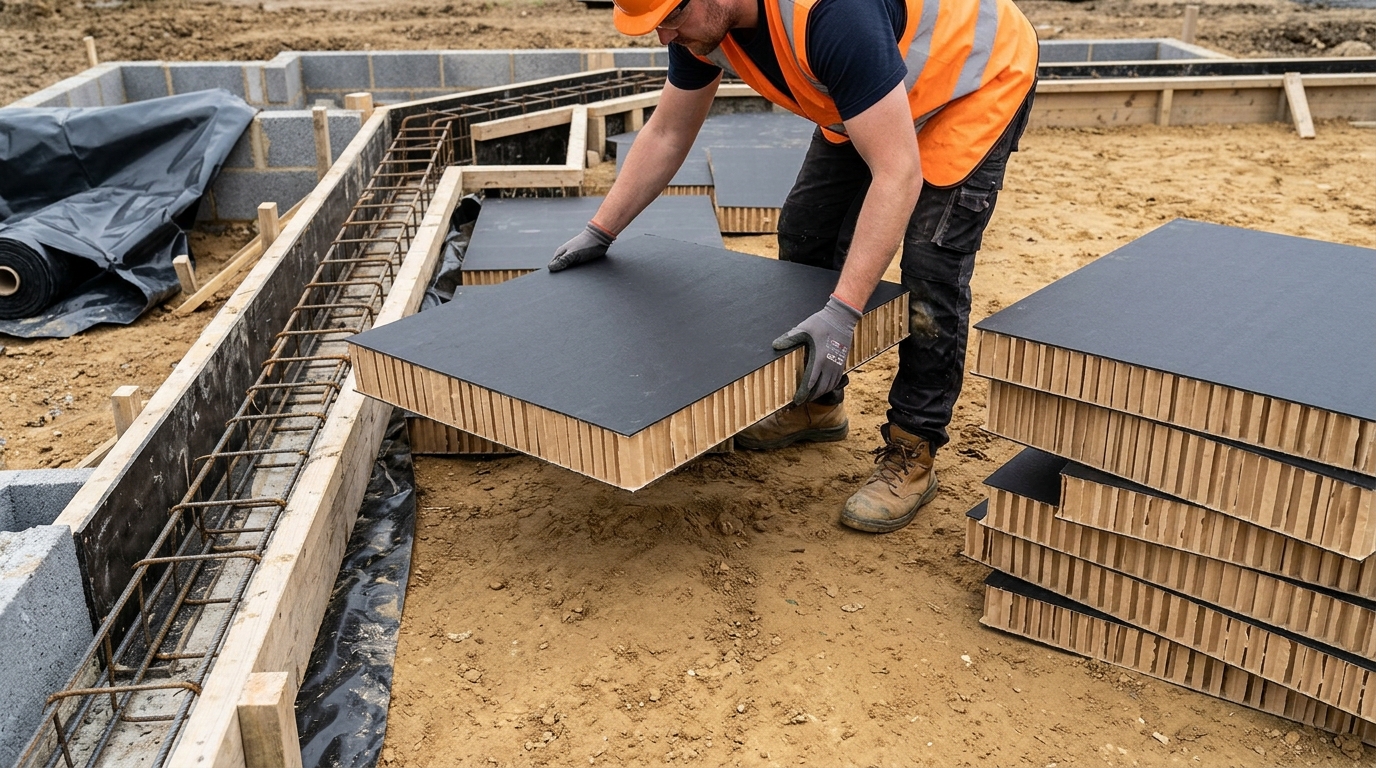
A void former is a compressible panel installed in the gap between the bottom of a concrete ground beam (or suspended slab) and the underlying clay. Its job is to give the clay somewhere to go when it swells, rather than transmitting that force into the structure. That single function is the engineering core of all clay heave protection foundations.
The installation sequence on a typical project:
- Ground investigation identifies the clay heave risk and its severity.
- The structural engineer specifies the void former type, grade, and panel thickness based on the void required for the clay heave protection foundations design.
- During construction, the void former supports fresh concrete loads, foot traffic, and steel reinforcement.
- Once the concrete has set and is self-supporting, water is introduced into the void former core (via the Voidpak system on Clayboard installations).
- The water weakens the paper core, switching off its load-bearing strength so the subsequent upward heave force is absorbed without transmitting load to the concrete above.
That sequence — and specifically what happens at step 4 — is where the structural cost case for clay heave protection foundations is decided. Two void former mechanisms exist, and they behave very differently.
Paper honeycomb vs EPS — the structural cost difference
The single most important question for specifiers evaluating clay heave protection foundations is what happens to the heave load once the void former engages. The answer is not the same for paper honeycomb as it is for expanded polystyrene (EPS).
Paper honeycomb (Clayboard, by Dufaylite): The honeycomb core is engineered to weaken when water is introduced via the Voidpak system after the concrete has set. The mechanism is by design and predictable — the core yields at less than 3 kN/m² when wet (BBA-assessed performance), switching off its load-bearing strength. With the strength switched off, the void absorbs subsequent heave movement with no upward load transmitted to the slab above. The slab does not have to resist heave force. This is the single largest structural advantage of paper honeycomb clay heave protection foundations.
EPS polystyrene (Cordek Cellcore HX and similar): EPS compresses under sustained pressure, but it does so by transferring the heave force into the slab until the polystyrene fails. The slab must be designed and reinforced to resist that full heave force during the transition period. In practice, this means specifiers building EPS-based clay heave protection foundations typically add reinforcement steel and, on heavily loaded slabs, may need a thicker concrete section.
The cost differential is not theoretical. On a major football stadium project in London, specifying Clayboard over a polystyrene alternative saved the project over £1m in reinforcement steel alone — a quantified, single-line benefit attributable to the load-transfer mechanism behind well-designed clay heave protection foundations, not the material itself. For commercial and infrastructure projects where slab reinforcement is a major line item, this is the calculation that matters.
A second cost differential follows from panel thickness. Clayboard panels are 30% thinner than the EPS equivalent for the same void: a 160mm Clayboard panel delivers a 150mm void where 225mm of Cordek Cellcore is needed for the same void. That is 65mm less dig depth across the foundation footprint — translating into less excavation, less spoil to remove, and reduced groundwork programme time. On large-footprint clay heave protection foundations, that thickness saving is recovered in cubic metres.
BBA certification — what specifiers need to confirm
BBA certification is the line in the sand for many UK projects specifying clay heave protection foundations. On commercial schemes — and a growing share of residential schemes — BBA certification is a mandatory specification requirement, not a preference. Building control will not accept an uncertified void former on those projects.
Clayboard KN30 holds BBA Certificate 98/3528, Issue 4 — dated 27 June 2024, originally certificated 29 October 1998. The certificate scope covers:
- England and Wales — Building Regulations 2010, Requirement A2(a)
- Scotland — Building Regulations 2004
- Northern Ireland — Building Regulations 2012
The certificate also confirms compliance with NHBC Standards 2024 (Chapters 4.2, 4.3, and 4.4). For specifiers, the BBA Certificate is the document to reference in the foundation specification clause for clay heave protection foundations.
The competitive context matters here. The dominant alternative to paper honeycomb on BBA-mandated clay heave protection foundations is EPS polystyrene — typically Cordek Cellcore HX, which also holds BBA certification. For specifiers, this means two BBA-certified routes to compliance:
- Clayboard KN30 (paper honeycomb, BBA certified — the core weakens when wet, no load transfer to slab)
- EPS polystyrene (BBA certified — compresses, but the slab must be designed and reinforced to resist the heave force until the polystyrene fails)
You can verify any BBA certificate directly on the BBA register.
Ground investigation and the specification process — what the engineer actually does
Designing clay heave protection foundations starts long before a panel is ordered. It begins with a ground investigation report — typically a Phase 1 desk study followed by a Phase 2 intrusive investigation with boreholes, trial pits, and laboratory tests on recovered samples.
The specifier looks for four pieces of data in the geotechnical report when sizing clay heave protection foundations:
- Plasticity index (PI) and modified plasticity index (PI′): classifies shrink-swell potential. Low (PI′ < 20), Medium (20–40), High (40–60), Very High (>60). High and Very High clays drive the heave assessment.
- Soil moisture content vs plastic limit: identifies whether the clay is currently dry, plastic, or near maximum moisture content. A clay that is currently dry has the most heave headroom.
- Vegetation history: removed trees, hedgerows, or shrub lines on a clay site signal a desiccated profile that will rehydrate and heave once cleared. The 1m-per-tree-height rule of thumb is a starting point — never the answer on its own.
- Predicted heave magnitude: the void depth required is set by the predicted heave plus a working tolerance. Most UK clay heave protection foundations on shrinkable clay sit between 50mm and 150mm void depth, with 75mm and 100mm being the most common specifications.
A common mistake at specification stage: under-sizing the void to save dig depth. The void former is the cheapest line item in the heave protection chain — under-sizing it to recover 25mm of excavation creates uncovered residual heave that loads the slab. Specify the void to the predicted heave, not to the dig depth budget. A second common mistake: omitting the polythene sheeting above and below the panel installation. Polythene is not optional — it manages water ingress until the Voidpak system is intentionally activated, and without it, premature wetting can weaken the core before the slab is structurally ready.
If the geotechnical report leaves heave magnitude implicit rather than stated, ask the geotechnical engineer for an explicit value before sizing the void. Specifying clay heave protection foundations off a vague “moderate heave risk” line is how warranty exposure is built in.
Comparison: Clayboard KN30 vs EPS polystyrene void formers
The table below compares Clayboard KN30 against EPS polystyrene void formers — the two BBA-certified routes a UK structural engineer is most likely to evaluate against the brief “BBA certified void former for clay heave protection foundations.”
| Criterion | Clayboard KN30 | EPS polystyrene (e.g. Cordek Cellcore HX) |
|---|---|---|
| Material | Paper honeycomb | Expanded polystyrene (EPS) |
| BBA certified | ✓ Cert 98/3528, Issue 4 | ✓ |
| Load transfer to slab | ✗ Weakens by design — strength switches off, no load transfer | ✓ Slab must be reinforced to resist heave until EPS fails |
| Additional reinforcement steel required | No | Yes — engineered to resist heave force |
| Panel thickness for 150mm void | 160mm | 225mm |
| Dig depth saving vs EPS for same void | 65mm less | Baseline |
| Recyclable in standard paper streams | ✓ | ✗ |
| Carbon Neutral Britain™ certified | ✓ | ✗ |
| Manufacturing heritage | 70+ years (UK) | Established |
For a clean technical comparison of paper honeycomb against EPS in this application, our deeper read on Clayboard vs alternative void formers walks through the specification differences in more detail.
Choosing the right Clayboard panel thickness for your void requirement
Clayboard panel thickness is selected based on the void depth required by the foundation design. The relationship between panel thickness and void provided is fixed:
| Panel reference | Panel thickness | Void provided | Length × Width |
|---|---|---|---|
| 60mm Clayboard | 60mm | 50mm | 2440mm × 1000mm |
| 85mm Clayboard | 85mm | 75mm | 2440mm × 1000mm |
| 110mm Clayboard | 110mm | 100mm | 2440mm × 1000mm |
| 160mm Clayboard | 160mm | 150mm | 2440mm × 1000mm |
The calculation is straightforward: panel thickness equals void required plus a 10–15mm minimum allowance for the residual material once the core has weakened. This is the building block of every Clayboard-based design for clay heave protection foundations.
A short list of design constraints to confirm at specification stage:
- Maximum installation depth: 2m below finished ground level.
- Must not be installed below the water table.
- Must not be used where soil gas protection is required (radon or methane membranes are a separate specification item).
- Polythene sheeting required above and below the panels to manage water ingress until the Voidpak system is activated.
- Once weakened, the design life is equivalent to the structure — no maintenance.
For a primer on the underlying mechanism — particularly useful if you are introducing the topic to a junior engineer or in a CPD context — see our explainer on what ground heave is and how to prevent it.
Lunch-and-learn — a 30-minute primer on clay heave protection foundations
The fastest way to bring a consultancy team up to speed on clay heave protection foundations is to host an in-person session led by Nigel West, Dufaylite’s Technical Manager for Clayboard. Nigel has been specifying paper honeycomb void formers into UK foundation designs for over a decade and runs a 30–45 minute lunch-and-learn programme tailored to structural engineers, architects, and graduates entering the foundation discipline.
The session is technical, not promotional. It covers:
- The science of clay shrink-swell behaviour and how the UK clay belt drives heave risk
- How to interpret a geotechnical report for heave assessment
- The two void former mechanisms — paper honeycomb vs EPS — and what each does to the slab design
- BBA certification scope, the NHBC Standards 2024 chapters that apply, and how to write a defensible specification clause
- A live walkthrough of the Clayboard panel range, Voidpak system, and installation sequence
We have delivered the session to consultancies across the South East, East Midlands, and East Anglia — the heart of the UK clay belt. The brief is straightforward: 30–45 minutes, lunch on us, your engineers leave with a working understanding of clay heave protection foundations and a defensible spec clause they can drop into the next project. To book, contact the Clayboard team via the link at the foot of this page.
Frequently asked questions
What causes ground heave?
Ground heave is caused by expansive clay soils absorbing moisture and swelling upward. It is the inverse of clay shrinkage (which causes subsidence). Heave is most pronounced after extended wet periods on shrinkable clay — and as Geobear’s Pete Luby noted in New Civil Engineer (March 2026), the ground can heave by as much as 16.5% in cases where prolonged rainfall is followed by rapid drying. The risk is concentrated in the UK clay belt: the South East, East Midlands, and East Anglia — the regions where most UK clay heave protection foundations are specified.
When is a void former required for clay heave protection foundations?
A void former is required wherever a structural engineer or geotechnical assessment identifies a clay heave risk that could damage the foundation if uncompensated. NHBC Standards 2024 (Chapters 4.2 to 4.4) treat heave on shrinkable clay sites as a design constraint that must be addressed. In practice, this means most piled or beam-and-block foundations on clay soils in the UK clay belt will specify a void former beneath the ground beams or suspended slab as part of their clay heave protection foundations design.
Is BBA certification mandatory for void formers?
BBA certification is mandatory on most UK commercial foundation projects and a significant share of residential schemes — particularly any project where the warranty provider, building control body, or specification clause requires it. Clayboard KN30 holds BBA Certificate 98/3528 (Issue 4, June 2024). If your project specifies “BBA certified void former,” only certified products — such as Clayboard KN30 or EPS-based alternatives like Cordek Cellcore HX — can be used in the clay heave protection foundations design.
What thickness of void former do I need?
The panel thickness equals the void required plus a 10–15mm minimum allowance. For a 150mm void, specify a 160mm Clayboard panel. For a 100mm void, specify 110mm. For a 75mm void, 85mm. Clayboard KN30 panels are available in four thicknesses (60mm, 85mm, 110mm, 160mm) — all BBA certified. The thickness selection is driven by the geotechnical assessment and the predicted heave magnitude — not by the load case.
How does Clayboard differ from EPS heave protection?
The structural difference is the load-transfer mechanism. Clayboard’s paper honeycomb core weakens by design when water is introduced after the concrete has set — switching off its load-bearing strength so the void absorbs heave with no upward load transmitted to the slab. EPS void formers compress, but they transfer the full heave force into the slab until the EPS fails. This means EPS-supported slabs typically require additional reinforcement steel and sometimes a thicker concrete section. On a major football stadium project in London, specifying Clayboard over polystyrene saved over £1m in reinforcement steel.
What is the lifespan of a paper honeycomb void former?
Once the core has weakened and the heave has been absorbed, the design life of Clayboard is equivalent to the structure above it. No maintenance is required. The water-introduction step via the Voidpak system after the concrete is set is the final installation activity — the system is then permanent.
How do I write the void former specification clause?
A defensible specification clause for clay heave protection foundations names four things: (1) the void depth in millimetres derived from the geotechnical heave assessment, (2) the panel thickness from the manufacturer’s void-to-thickness table, (3) the BBA certificate number being relied on (e.g. “BBA Certificate 98/3528, Issue 4 — Clayboard KN30”), and (4) the installation requirements including polythene sheeting above and below the panel and the Voidpak water introduction sequence. Avoid naming the void former by manufacturer alone without the BBA certificate reference — building control reviews the certificate, not the brand.
Can I install a void former on a site below the water table?
No. Clayboard and other paper honeycomb void formers must be installed above the water table and must not be exposed to standing water before the Voidpak system is intentionally activated. If the site investigation indicates a high or fluctuating water table, raise this with the geotechnical engineer before specifying clay heave protection foundations — alternative engineering measures may be needed to manage groundwater before a paper honeycomb solution is appropriate. Maximum installation depth is 2m below finished ground level.
Specifying with confidence
Clay heave protection foundations are a structural specification, not a procurement preference. The decision sits with the structural engineer, and the consequences of getting it wrong — slab cracking, foundation distortion, and warranty exposure — are not recoverable cheaply.
For UK projects on shrinkable clay, the specification choice for clay heave protection foundations comes down to what evidence is on the table: the BBA Certificate covering the product, the structural mechanism by which the void former absorbs heave, and the downstream cost implications for reinforcement steel and groundwork dig depth. Clayboard KN30 is BBA-certified, weakens by design when wet so its load-bearing strength switches off, and has the structural cost case behind it. The Carbon Neutral Britain™ certification across the Clayboard range is supporting context — relevant for ESG reporting, but the engineering case for clay heave protection foundations stands on its own.
If you would like the specification team to walk through clay heave protection foundations options with your engineers in person, Nigel West (Technical Manager, Clayboard) runs a 30–45 minute lunch-and-learn session — a technical primer on heave science, mechanism comparison, and BBA specification, with lunch on us. It is the same session we have delivered to consultancies across the South East, East Midlands, and East Anglia. Read more about our wider approach to certifications and verified credentials on our sustainability and certifications page.
Talk to the Clayboard team via our contact page to book the lunch-and-learn or request the BBA Certificate 98/3528 (Issue 4) and the Clayboard technical specification pack — the full evidence base for designing clay heave protection foundations on your next UK project.
