
Written by Ashley Moscrop, Managing Director, Dufaylite Developments Ltd
Reviewed by Paul Gill, Head of Sales, Envirolite and Ultra Board
Last updated: 21 May 2026
Key takeaways
- Paper honeycomb packaging is a structural hexagonal-cell recycled paper core bonded between flat liner facings (recycled paper, or kraft for higher-stiffness applications) — engineered to replace EPS polystyrene, EPE foam and moulded pulp.
- Two products are described as “honeycomb packaging” in the UK market: structural paper honeycomb panels (the focus of this guide — Dufaylite’s Envirolite) and roll-format honeycomb wrap paper (an e-commerce void fill made by other suppliers — Dufaylite does not manufacture this).
- UK regulation has shifted the comparison against EPS materially in 2026: Plastic Packaging Tax sits at £228.82/tonne from 1 April 2026, EPR modulated fees penalise red-rated EPS at 1.2× the base rate (rising to 2.0× by 2028), and Simpler Recycling (effective 31 March 2026) excludes EPS from kerbside paper streams.
- Paper honeycomb packaging is 100% recyclable in standard kerbside paper streams; CarbonQuota DUF01_003 (June 2025) verified Envirolite produces 50–70% lower carbon than EPS in chilled food applications.
- BRCGS AA Global Food Safety Standard is supplier-specific (it certifies the manufacturer’s processes, not the material). Most food packaging suppliers across all materials hold some form of BRCGS — the Dufaylite advantage is that within paper honeycomb, no other manufacturer in the world holds the AA tier.
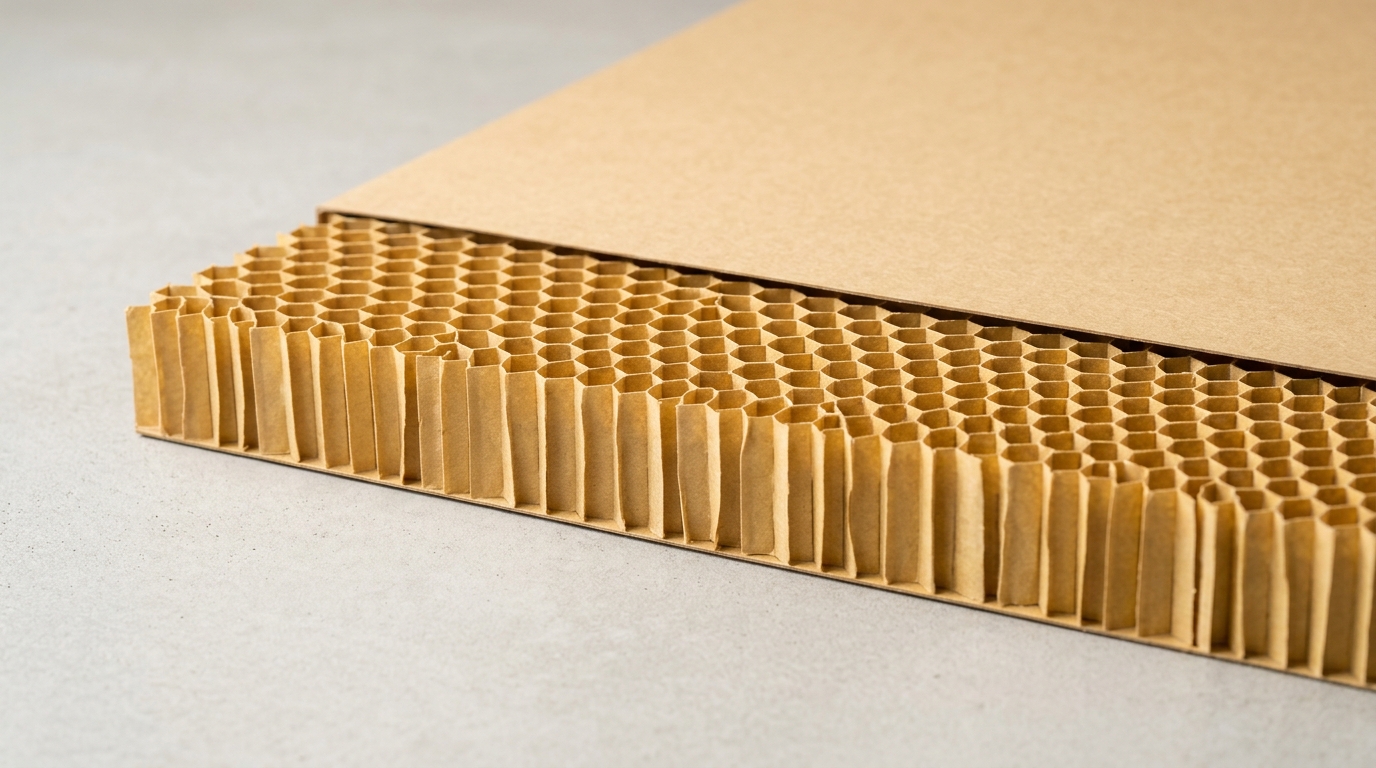
Paper honeycomb packaging is a lightweight, rigid protective material made from a structural hexagonal-cell recycled paper core bonded between flat liner sheets (recycled paper, or kraft for higher-stiffness applications). Engineered to replace polystyrene and foam, paper honeycomb packaging provides equivalent or better cushioning, is 100% recyclable in standard paper streams, and is available from suppliers carrying food safety certification (BRCGS AA) for chilled and dry food applications.
For packaging engineers, designers, and procurement teams, this guide covers what paper honeycomb packaging actually is, how it is made, where it is used, how it performs against polystyrene and foam, the credentials that matter when you specify it, and the bespoke engineering process behind every commercial deployment.
What paper honeycomb packaging is — and isn’t
There are two very different products described as “honeycomb packaging” in the UK market, and the distinction matters before any specification work begins.
The first is honeycomb wrap paper — a roll-format paper that is slit and pulled out to create an expanding void fill for e-commerce. It is a low-cost consumable made by other suppliers (not Dufaylite), useful for light protection but limited in capability. It is fine for protecting books, mugs, and lightweight non-fragile goods inside a postal box. It is not engineered for heavy or high-value protection.
The second — the focus of this guide, and what Dufaylite manufactures — is structural paper honeycomb packaging: rigid panels with a true hexagonal-cell recycled paper core, bonded between flat liner facings, and engineered into bespoke protective inserts. Dufaylite manufactures this product as Envirolite, a paper honeycomb packaging solution used by UK manufacturers to replace expanded polystyrene (EPS), expanded polyethylene (EPE) foam, and moulded pulp.
Structural paper honeycomb packaging is what makes the material viable for white goods, electronics, furniture, automotive, medical, and food applications. The terminology matters because procurement teams sometimes assume “honeycomb” means the roll product — and rule it out for protective use without realising structural panels exist as a distinct, far more capable category.
How a paper honeycomb panel is made
The core starts as multiple sheets of 100% recycled paper. The sheets are glued in a pattern of offset lines using a water-based, VOC-free, PFAS-free adhesive — a chemistry choice that matters specifically for food applications, where solvent residue and PFAS contamination would disqualify the material. When the bonded stack is expanded, the offset glue lines pull each sheet into a uniform hexagonal cell pattern — the same load-bearing geometry found in beehives and aerospace panels.
Once expanded and stabilised, the core is bonded to flat liner facings on the top and bottom. Facing choice depends on the application: recycled paper is the default and lowest-carbon option; kraft is specified when higher stiffness, smoother print surface, or improved abrasion resistance is needed. For specialist applications, white-coated facings or laminated surfaces can be added.
Cell sizes range from 8mm to 47mm and panel thicknesses from 6mm to 100mm. Larger cells with thicker panels give greater cushioning depth; smaller cells deliver higher density and rigidity. Every Envirolite specification is engineered to the customer’s product, weight, and protection requirements — there is no standard catalogue. The honeycomb structure is what gives paper honeycomb packaging its strength-to-weight ratio: most of the panel is air, but the geometry distributes load efficiently across the cell walls, so the material behaves under compression in a way that solid card cannot.
Want to see the structure first-hand? Request samples of Envirolite honeycomb panels and our team will send a cut panel cross-section.
Where paper honeycomb packaging is used
Paper honeycomb packaging covers a wide application range across UK manufacturing. The headline list looks broad, but each sector uses the material differently — the engineering choices change based on product weight, transit conditions, and the protection rating required.
White goods and appliances
Washing machines, fridges, ovens, and dishwashers are heavy, high-value, and easily damaged in transit. EPS mouldings have been the default for decades. Paper honeycomb packaging replaces those mouldings with engineered corner protectors, base pads, and full-perimeter inserts. The honeycomb structure handles compressive loads from stacking in transit and impact loads from drops on the loading dock. Recycled-paper facings are typical; kraft is used where the insert experiences abrasion from product movement during long-distance transit.
Electronics
High-value consumer electronics, components for OEMs, and assembled hardware all use paper honeycomb packaging where EPS or EPE foam would otherwise be specified. The cushioning curve of an engineered honeycomb insert can be tuned to the product’s fragility rating — a server motherboard needs different cushioning than a flat-screen display. Bespoke geometry locates the product precisely within the carton, preventing rotation and lateral movement.
Furniture (flat-pack and assembled)
Furniture packaging deals with sharp corners that puncture thin protection, large flat surfaces that scuff in transit, and assembled items that need locating without movement. Edge protectors made from paper honeycomb packaging absorb corner impact and protect the most vulnerable points of the product. Void-fill inserts prevent components from shifting inside the carton.
Automotive parts
Body panels, glass, interior trim, and assemblies all move between manufacturers and assembly plants in protective packaging. Paper honeycomb packaging works for transit packaging because it is rigid enough to support stacking, light enough to keep transport carbon down, and bespoke enough to handle the awkward geometries of a wing mirror, a bumper, or an instrument cluster.
Medical devices
Medical packaging combines two requirements that other sectors rarely face together: protection of high-value, often fragile devices, and recyclability that satisfies hospital procurement sustainability mandates. Paper honeycomb packaging meets both. Inserts can be specified to suit autoclave-adjacent supply chains where contamination must be controlled.
Food packaging (chilled and dry)
The food sector is where Dufaylite’s BRCGS AA Global Food Safety Standard certification becomes load-bearing. Chilled box thermal liners use paper honeycomb packaging as a structural and insulating layer in food delivery and grocery boxes. Dry food packaging — bakery transit cases, dry mix bulk packs — also uses the material. The water-based, PFAS-free glue chemistry is what makes the food sector application viable. See food packaging for the chilled box specification path.
Format options across all sectors include corner protectors, pallet base pads, box liners, void fillers, and full multi-piece insert systems. Compare the material directly with alternatives in our analysis of polystyrene vs paper honeycomb performance.
Paper honeycomb packaging vs polystyrene, foam, and pulp
For most UK manufacturers, the real question is paper honeycomb packaging vs the incumbent material currently in use. Here is how the four main protective options compare:
| Criterion | Paper honeycomb | EPS polystyrene | EPE foam | Moulded pulp |
|---|---|---|---|---|
| Recyclable in standard paper streams | ✓ | ✗ | ✗ | ✓ |
| Weight per m² (typical) | Low | Very low | Low | Medium |
| Cushioning performance for heavy / high-value goods | High (engineered) | High | Medium | Low–Medium |
| BRCGS AA-certified UK supplier in this category | ✓ Dufaylite — only honeycomb provider in the world | Producer-dependent | Producer-dependent | Producer-dependent |
| UK manufacturing lead time | Short | Variable | Variable | Long (tooling) |
The strongest position is against EPS: equivalent cushioning, full kerbside recyclability, lower Extended Producer Responsibility (EPR) liability under modulated fees because paper enters standard recycling streams, and a verified lower carbon footprint. Independent assessment by CarbonQuota (DUF01_003, June 2025) found Envirolite produces 50–70% lower carbon than EPS across its lifecycle in chilled food applications.
Detailed comparison: EPS polystyrene
EPS — expanded polystyrene — is moulded foam made by expanding polystyrene beads with steam in a tool. It is cheap, light, and absorbs impact well. Its weaknesses are well known: it is not recyclable in domestic waste streams, and three live UK regulatory levers have moved the cost picture against it in 2026.
The UK Plastic Packaging Tax rose to £228.82 per tonne on 1 April 2026 (up from £223.69 in 2025 and £210.82 in 2024). EPR modulated fees rate EPS as red — attracting a 1.2× multiplier on the base rate in 2026, rising to 2.0× by 2028. Simpler Recycling came into force on 31 March 2026, excluding EPS from standardised UK kerbside collection.
EPS also generates highly visible waste at the end of the supply chain — a single washing machine can ship with several kilos of EPS the customer must dispose of via specialist routes. Paper honeycomb packaging produces equivalent cushioning for most use cases at comparable per-unit cost when the full picture — material, Plastic Packaging Tax, EPR liability, brand sustainability obligations — is included.
Detailed comparison: EPE foam
EPE — expanded polyethylene — is a closed-cell plastic foam, denser than EPS, often used where surface contact must not scuff a product. It is more expensive than EPS and equally non-recyclable in domestic streams. Paper honeycomb packaging replaces EPE in most non-abrasive use cases. Where surface protection is critical — high-gloss display panels, polished metalwork — a paper honeycomb insert with a soft non-woven facing layer can replicate the surface contact behaviour without the plastic.
Detailed comparison: moulded pulp
Moulded pulp — egg-tray-style protective shapes — is a recyclable paper-based product made by forming wet paper slurry in a tool. It is excellent for low-weight, regular-shape products (mobile phones, wine bottles, light electronics) but struggles with heavy or high-impact items. The tooling is also a barrier: each new shape requires a custom tool, which is expensive and slow to commission. Paper honeycomb packaging carries no tooling cost — bespoke inserts are cut and assembled from standard panel stock — so prototyping is fast and minimum order quantities are workable for short and medium runs.
Detailed comparison: honeycomb wrap paper
Honeycomb wrap paper (the roll-format e-commerce product made by other suppliers) is not a direct competitor to structural paper honeycomb packaging but is often confused with it. Wrap paper is suitable for packing books, mugs, and small lightweight items into postal boxes. It is not engineered for heavy products, high-value transit, or food contact. If a procurement team asks about “paper honeycomb” they may be thinking of the wrap product when the application calls for structural panels — clarifying the difference at the brief stage saves rework later.
For more on the science of honeycomb board, see our reference post on the science of honeycomb board.
The credentials that matter when sourcing paper honeycomb packaging
Specification decisions depend on what credentials the buyer can show internally. The credentials worth checking on any paper honeycomb packaging supplier are:
- BRCGS AA Global Food Safety Standard — held by suppliers, not by the material itself. Dufaylite is the only paper honeycomb packaging provider in the world to hold this certification. Some EPS and other material suppliers also hold BRCGS certification at the supplier level — what matters is that, in the honeycomb category specifically, no other manufacturer holds it. Without it, food contact and food-adjacent applications are difficult to justify internally. Verify any supplier’s certification at BRCGS.
- Carbon Neutral Britain™ — independently verified business-level carbon neutral status across all Dufaylite product lines.
- FSC certified (C186880) — verifies responsible paper sourcing across recycled and virgin fibres.
- CarbonQuota-verified carbon footprint study — third-party assessment quantifying the lower carbon footprint of Envirolite vs EPS and sheep’s wool insulation, available on the Dufaylite carbon footprint study page.
- Sole UK manufacturer of paper honeycomb itself — Dufaylite manufactures the honeycomb core in St Neots, not just converts bought-in stock. UK lead times, UK supply chain security, and lower transport carbon follow.
These credentials are worth flagging in any internal sustainability report or material substitution case. Full details are on the Dufaylite sustainability page.
How bespoke paper honeycomb packaging is engineered
Most published descriptions of paper honeycomb packaging stop at “we make custom solutions”. Procurement teams need more than that. Here is what the bespoke engineering process actually looks like, from first enquiry to series production.
1. Brief intake. The first conversation captures the product being packed, its weight, its dimensions, its fragility rating (where known), the carton or transit case it ships in, the transport mode (palletised road freight, parcel network, container), and the destination. If the product is replacing an existing EPS or foam insert, sending the current insert as a sample short-cuts the dimensioning step.
2. Concept design. Dufaylite’s in-house engineering team designs the insert geometry — number of pieces, cell size, panel thickness, facing specification, cut paths, fold lines. The concept balances protection performance, packing-line ergonomics (does it drop in cleanly, does it self-locate the product), and material efficiency (no wasted board).
3. Prototype. A first prototype is cut and assembled on the in-house lab line at St Neots. Lead times are typically 1–3 weeks depending on complexity. Prototypes are sent to the customer for fit-check.
4. Test cycle. The customer fit-tests the prototype with the product, ideally including a packing-line trial. Drop tests, vibration tests, and (where relevant) climate-chamber tests confirm the cushioning curve and surface protection meet the product’s transit profile. Iterations refine geometry, cell size, or facing specification.
5. Line trial. Before series production, a short pilot run is produced and run through the customer’s packing line at production speed. This catches packing-line issues — does the insert jam the case erector, does it fold around the product cleanly, does it stack correctly on pallets — that lab testing cannot fully replicate.
6. Series production. Once the line trial passes, the insert moves into series production. Reorders are run from the locked specification.
This process is what differentiates engineered paper honeycomb packaging from a catalogue product. Procurement teams used to buying EPS off-the-shelf sometimes underestimate the engineering effort behind a switch — but the upside is that a properly specified honeycomb insert often outperforms the EPS it replaces, because it has been designed for the specific product rather than picked from a stock-shape catalogue.
Sustainability credentials in detail
The sustainability story behind paper honeycomb packaging matters because procurement teams increasingly need to show the case to internal stakeholders — sustainability managers, ESG reporting teams, brand managers — not just to finance.
Recycled paper feedstock. The honeycomb core uses 100% recycled paper. Facings are recycled paper or kraft. The material enters the standard kerbside paper recycling stream at end of life, in domestic and commercial waste collection alike. There is no specialist disposal route, no return-to-supplier programme, no co-mingling penalty.
BRCGS AA Global Food Safety Standard. In the honeycomb category, Dufaylite is the only manufacturer to hold this. For food brand owners, retailer audits often require BRCGS-certified supply chains across primary, secondary, and tertiary packaging — including any packaging that contacts the chilled box environment.
Carbon Neutral Britain™ certification. This is a business-level certification, applied across all Dufaylite product lines. Customers can reference the certification in their own ESG reporting and procurement frameworks.
FSC certified (C186880). Responsible paper sourcing across both recycled and virgin fibres. The certification scope covers Dufaylite’s full feedstock — buyers can rely on FSC-traceable material in their own chain of custody.
CarbonQuota-verified carbon footprint study (DUF01_003, June 2025). Independent third-party assessment of Envirolite Honeycomb Board against EPS and sheep’s wool insulation in chilled food box applications. Headline finding: Envirolite produces 50–70% lower carbon footprint than EPS across its lifecycle. Full disclosure on the Dufaylite carbon footprint study page.
EPR liability. Under the UK Extended Producer Responsibility (EPR) framework, modulated fees reward materials that recycle into common waste streams and penalise those that do not. Paper honeycomb packaging carries lower EPR liability than EPS for this reason. The exact saving depends on tonnage and product mix, but the directional advantage is consistent across all use cases.
For more on the wider sustainability picture, see our post on carbon reduction strategies.
Frequently asked questions
Is honeycomb packing paper any good?
Yes — for the application it is engineered for. Honeycomb wrap paper (a roll-format expanding void fill made by other suppliers — not Dufaylite) is a useful e-commerce consumable but limited in protective performance. Structural paper honeycomb packaging — Dufaylite’s Envirolite, bonded panels with a recycled paper core and recycled or kraft facings — is engineered to specific cushioning, stacking, and food-safety requirements and routinely replaces EPS in heavy-duty industrial use. The right choice depends entirely on what is being packed and the protection rating required.
How to properly use honeycomb packing paper?
Dufaylite manufactures structural paper honeycomb panels, not roll-format honeycomb wrap (a separate e-commerce product made by other suppliers). For Dufaylite’s structural honeycomb panels: the inserts are pre-engineered to your product dimensions and drop straight into the outer carton or transit case, locating the product securely with consistent contact pressure on all faces. No taping or shaping is required at the packing line.
How to make honeycomb packaging paper?
Structural paper honeycomb is made by bonding multiple sheets of 100% recycled paper with offset glue lines, then expanding the stack so the glue lines pull the paper into uniform hexagonal cells. Flat liner facings — recycled paper, or kraft for higher stiffness — are bonded to the top and bottom to create a rigid panel. Dufaylite manufactures the entire process — paper honeycomb core through to finished bespoke inserts — at its St Neots facility in Cambridgeshire.
What does honeycomb packing paper do?
Structural paper honeycomb packaging (the product Dufaylite manufactures) protects products in transit by absorbing impact, distributing compressive load, and preventing movement inside the outer pack. The hexagonal cell geometry traps air and creates a high strength-to-weight ratio, which is why it is used as a direct replacement for EPS polystyrene and EPE foam in protective packaging across white goods, electronics, furniture, food, and medical sectors. Roll-format honeycomb wrap, a separate product made by other suppliers, serves a different purpose: lightweight e-commerce void fill.
What lead time should I expect for bespoke paper honeycomb packaging?
Prototype turnaround is typically 1–3 weeks from a confirmed brief. Series production lead times depend on volume and current line schedule, but most reorders run on a 2–4 week cycle from order to despatch. Because Dufaylite manufactures the honeycomb core in the UK at St Neots, lead times do not depend on imported stock — there is no transatlantic or European shipping cycle to plan around.
What is the minimum order quantity for paper honeycomb packaging?
There is no fixed catalogue MOQ because every solution is bespoke. In practice, the economics work for runs from a few hundred inserts upwards. Short pilot runs of 50–100 are typical during the trial phase. Procurement teams used to high-MOQ moulded pulp or thermoformed inserts often find paper honeycomb packaging more flexible at the small-to-mid volume end.
How do I request samples or start a specification?
The fastest path is to send a brief description of the product, its weight, the carton it ships in, and (if available) a photograph or sample of any existing protective insert. Dufaylite’s engineering team will respond with a concept and prototype proposal. If you are switching from EPS, sending a sample of the current insert short-cuts the dimensioning conversation. Speak to our packaging engineering team to start the brief.
Is paper honeycomb packaging actually recyclable in domestic waste?
Yes. The material enters the standard kerbside paper recycling stream — the same stream that handles cardboard boxes, paper packaging, and printed paper. There is no specialist disposal route required, no return-to-supplier programme, and no co-mingling restriction. End consumers can recycle paper honeycomb packaging without any guidance beyond what they already do for cardboard.
Is it safe for direct food contact?
For chilled box thermal liner applications and dry food transit cases, yes. The water-based, VOC-free, PFAS-free glue chemistry was specified for food-adjacent use. BRCGS AA Global Food Safety Standard certification is held at the supplier level — Dufaylite is the only paper honeycomb packaging manufacturer in the world to hold it. For specific direct-contact applications, the engineering team will confirm specification suitability against the food category and contact regime.
How to specify the right paper honeycomb packaging for your product
This is not a one-size catalogue product. Cell size, panel thickness, facing specification, and insert geometry are all engineered around what you are packing, the protection rating required, and your packing line process.
If you are evaluating a switch from EPS or foam, our packaging engineering team will work through your product dimensions, weight, transit conditions, and food safety requirements (where applicable) to design and prototype a bespoke paper honeycomb packaging solution. Speak to our packaging engineering team about a bespoke solution — we will respond with sample concepts you can test against your existing protective packaging.
