
Written by Ashley Moscrop, Managing Director, Dufaylite Developments Ltd
Reviewed by Nigel West, Technical Manager, Clayboard
Last updated: 18 June 2026
Key takeaways
- A void former for clay soil foundations is a compressible panel installed beneath ground beams or suspended slabs to absorb the upward pressure of expansive clay as it swells with moisture.
- Two material routes dominate the UK market: paper honeycomb (Clayboard KN30, BBA Certificate 98/3528, Issue 4, June 2024 — weakens when wetted so its strength switches off) and EPS polystyrene (e.g. Cordek Cellcore HX — compresses but transfers heave load into the slab until it fails).
- The 2026 context is a shrink year: the Environment Agency and National Drought Group flagged widespread drought risk after the driest spring in over a century, leaving the South East, East Midlands, and East Anglia clay belt at high shrink-swell risk.
- Clayboard panels are 30% thinner than the EPS equivalent for the same void (160mm Clayboard gives a 150mm void vs 225mm of EPS), cutting dig depth, spoil, and groundwork time.
- The load-transfer difference is a real cost line: EPS-based designs typically need additional reinforcement steel because the slab must resist heave force. On a major commercial project in London, paper honeycomb over polystyrene saved over £1m in reinforcement steel.
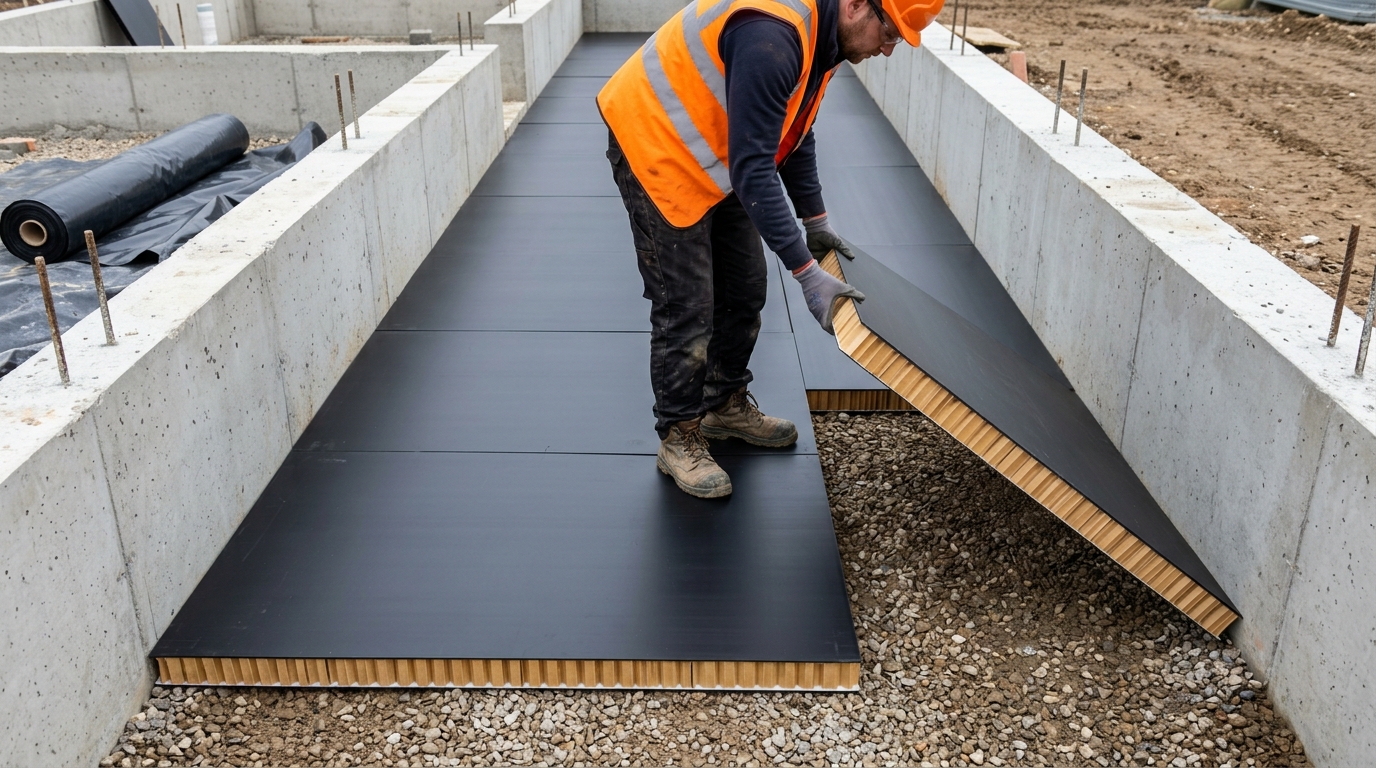
A void former for clay soil foundations is a compressible panel installed beneath ground beams or suspended concrete slabs to absorb the upward pressure of expansive clay as it swells with moisture. Two material routes exist: paper honeycomb (BBA certified — the core weakens when wetted, so its load-bearing strength switches off and no heave load transfers to the slab) and EPS polystyrene (compresses but transfers load into the slab until it fails, typically requiring extra reinforcement steel).
This guide is written for the structural engineers, geotechnical engineers, architects, and groundworks contractors who specify or select the void former for clay soil foundations on a UK clay-soil site. It explains why clay soil needs a void former at all, walks through the foundation selection process step by step, and sets out the structural and groundwork cost difference between the two material routes — with the BBA position made explicit at every stage.
Why clay soil needs a void former — the shrink-swell problem in 2026
Clay soil moves, and in 2026 it is moving in the direction that matters most for foundation design. The Environment Agency and the National Drought Group warned of widespread drought risk across England through the year, following what the Met Office recorded as one of the driest springs in over a century. The clay belt that defines this problem — the South East, East Midlands, and East Anglia — sits squarely in the highest-risk zone. (Source: Environment Agency / National Drought Group / Met Office — confirm the latest published figures before relying on any specific number.)
That backdrop matters because expansive clay does not just shrink in a drought. It swells — and heaves — when it rewets. This is the shrink-swell cycle, and it is the core engineering reason a void former for clay soil foundations exists. When clay dries out in a prolonged dry spell, it contracts and the ground surface drops. When the rain returns, the clay draws moisture back in and expands, exerting upward pressure on anything sitting above it.
A foundation bearing onto, or spanning over, that expanding clay has nowhere to send the force. Without a compressible void beneath it, the heave pressure transmits straight into the concrete — cracking ground beams, distorting suspended slabs, and in severe cases lifting the structure off its bearings. After a dry year, the rebound can be sharp. A site that has been desiccated through a drought summer is primed to heave hard once the moisture deficit closes.
This is why a void former for clay soil foundations is a Building Regulations matter on shrinkable clay, not a sustainability nice-to-have. The void former gives the swelling clay somewhere to go, decoupling the ground movement from the structure above. The NHBC Standards 2024 (Chapters 4.2, 4.3, and 4.4) require specifiers to address heave risk on shrinkable clay sites — and the void former is the engineered component that delivers that protection.
The drought-driven angle sharpens the timing. Specifiers who treated heave as a rare edge case a decade ago now design for it as a default on clay-belt sites. A site cleared of mature trees or hedgerows during a dry year carries a double risk: the clay is already desiccated, and the vegetation that used to draw water out of the ground is gone, so the rehydration — and the heave — will be larger. Every clay-soil foundation on a shrinkable plot in 2026 should be assessed for a void former for clay soil foundations.
What foundation and void former does clay soil require — the engineering
The question many searchers start with is broader than the void former itself: what foundation does clay soil need? On a shrinkable clay site with heave risk, the answer is almost always a piled foundation with ground beams, or a suspended slab, combined with a compressible void former beneath it. The process below sets out how a void former for clay soil foundations is specified from first principles.
1. Ground investigation identifies the expansive clay and heave risk. A Phase 1 desk study followed by a Phase 2 intrusive investigation — boreholes, trial pits, and laboratory testing — establishes the plasticity index, soil moisture state, and predicted heave magnitude. This data drives every downstream decision about the void former for clay soil foundations.
2. The engineer specifies a piled foundation with ground beams or a suspended slab. Spread footings bearing directly onto active clay are vulnerable to heave. On a high-risk clay site, the load is taken to a stable stratum on piles, with ground beams or a suspended slab spanning between them — keeping the structure off the moving clay.
3. A compressible void former is specified beneath the beams or slab. The void former for clay soil foundations occupies the gap between the underside of the concrete and the clay below. Its thickness is set by the predicted heave plus a working tolerance — typically a 50mm to 150mm void on UK shrinkable clay.
4. The void former supports construction loads while it is dry. Before the heave mechanism is engaged, the panel must carry fresh concrete, foot traffic, and reinforcement steel. Clayboard KN30 is rated at 30 kN/m² dry compressive strength — supporting concrete up to 1m thick during the pour. This dual-state behaviour is what separates a true void former for clay soil foundations from a simple spacer.
5. Once the concrete is set, the void former is engaged and its strength switches off. On a Clayboard installation, water is introduced into the paper honeycomb core via the Voidpak system after the slab is self-supporting. The water weakens the core, switching off its load-bearing strength (yielding at less than 3 kN/m² wet) so the void absorbs subsequent heave without transmitting any upward load to the slab above.
That sequence — and specifically what happens at step 5 — is where the structural cost case for a void former for clay soil foundations is decided. The two material routes behave very differently at this point, and the difference shows up directly in the steel schedule.
Paper honeycomb vs EPS void formers for clay soil — the structural cost difference
The single most important question when evaluating a void former for clay soil foundations is what happens to the heave load once the void former engages. The answer is not the same for paper honeycomb as it is for expanded polystyrene (EPS), and the gap between the two has a measurable cost.
Paper honeycomb (Clayboard, by Dufaylite). The honeycomb core is engineered to weaken when water is introduced via the Voidpak system after the concrete has set. The mechanism is predictable and by design: the core yields at less than 3 kN/m² when wet (BBA-assessed), switching off its load-bearing strength. With the strength switched off, the void absorbs the heave movement and transmits no upward load to the slab. The slab does not have to be designed to resist the heave force. This is the defining structural advantage of a paper honeycomb void former for clay soil foundations.
EPS polystyrene (Cordek Cellcore HX and similar). EPS compresses under sustained load, but it does so by transferring the heave force into the slab until the polystyrene fails. The slab must be designed and reinforced to resist that full heave force during the transition. In practice, an EPS-based void former for clay soil foundations typically adds reinforcement steel and, on heavily loaded slabs, can require a thicker concrete section.
The cost differential is not theoretical. On a major commercial project in London, specifying paper honeycomb over a polystyrene alternative saved the project over £1m in reinforcement steel alone — a single-line benefit attributable to the load-transfer mechanism, not the material itself. On commercial and infrastructure schemes where slab reinforcement is a significant cost, this is the calculation that decides the void former for clay soil foundations.
A second cost differential follows from thickness. Clayboard panels are 30% thinner than the EPS equivalent for the same void: a 160mm Clayboard panel delivers a 150mm void where 225mm of EPS is needed for the same result. That is 65mm less dig depth across the foundation footprint — less excavation, less spoil to cart away, and a shorter groundwork programme. On a large clay-soil footprint, a thinner void former for clay soil foundations is recovered in cubic metres of dig.
There is an end-of-life dimension too, though it is supporting rather than leading for this audience. The Clayboard paper core biodegrades in situ in the ground once it has done its job — it is never recovered or extracted. EPS remains in the ground indefinitely. For construction firms reporting against net-zero commitments, Carbon Neutral Britain™ certification on the Clayboard range is a relevant line in the ESG file, but the engineering case for the void former for clay soil foundations stands on the BBA position and the steel saving alone.
BBA certification and panel selection — what specifiers confirm
BBA certification is the compliance gate for a void former for clay soil foundations on most UK commercial schemes and a growing share of residential ones. Where the specification clause, building control body, or warranty provider requires it, an uncertified void former simply cannot be used.
Clayboard KN30 holds BBA Certificate 98/3528, Issue 4 — dated 27 June 2024, originally certificated 29 October 1998. The certificate scope covers:
- England and Wales — Building Regulations 2010, Requirement A2(a)
- Scotland — Building Regulations 2004
- Northern Ireland — Building Regulations 2012
The certificate also confirms compliance with NHBC Standards 2024 (Chapters 4.2, 4.3, and 4.4). You can verify any certificate directly on the BBA register. For a specification clause, the BBA Certificate number — not the brand name — is the document building control reviews when assessing the void former for clay soil foundations.
The competitive context is straightforward. The dominant BBA-certified alternative to paper honeycomb is EPS polystyrene, typically Cordek Cellcore HX, which also holds BBA certification. That gives specifiers two certified routes to compliance for a void former for clay soil foundations: Clayboard KN30 (paper honeycomb — weakens when wet, no load transfer to the slab) and an EPS product (the slab must be reinforced to resist heave until the polystyrene fails).
Panel thickness and void depth
Clayboard panel thickness is selected from the void depth required by the foundation design. The relationship is fixed:
| Panel reference | Panel thickness | Void provided | Length × Width |
|---|---|---|---|
| 60mm Clayboard | 60mm | 50mm | 2440mm × 1000mm |
| 85mm Clayboard | 85mm | 75mm | 2440mm × 1000mm |
| 110mm Clayboard | 110mm | 100mm | 2440mm × 1000mm |
| 160mm Clayboard | 160mm | 150mm | 2440mm × 1000mm |
Panel thickness equals the void required plus a 10–15mm minimum allowance for the residual material once the core has weakened. A 150mm void calls for a 160mm panel; a 100mm void calls for 110mm. That table is the building block of every Clayboard-based void former for clay soil foundations.
A short list of design constraints to confirm at specification stage:
- Maximum installation depth: 2m below finished ground level.
- Must not be installed below the water table.
- Must not be used where soil gas protection is required (radon or methane membranes are a separate specification item).
- Polythene sheeting is required above and below the panels to manage water ingress until the Voidpak system is intentionally activated.
- Must be kept dry until the concrete is set and self-supporting.
For the same reason it appears under screed and slab applications generally, the void former under screed or slab in a heave design is doing one job: keeping the swelling clay decoupled from the structure. A void former for clay soil foundations is selected to the predicted heave, never trimmed to save dig depth — under-sizing leaves residual heave that loads the slab.
Comparison: paper honeycomb vs EPS void former for clay soil
The table below compares the two BBA-certified routes a UK specifier is most likely to evaluate against the brief “void former for clay soil foundations.” It is the comparison most engineers want to see on one screen.
| Criterion | Clayboard KN30 (paper honeycomb) | EPS void former (e.g. Cordek Cellcore HX) |
|---|---|---|
| Material | Paper honeycomb | Expanded polystyrene (EPS) |
| BBA certified | ✓ Certificate 98/3528, Issue 4 | ✓ |
| Mechanism under heave | Weakens when wetted — strength switches off, no load transfer | Compresses but transfers heave load to the slab until it fails |
| Additional reinforcement steel | No | Yes — slab engineered to resist heave force |
| Panel thickness for 150mm void | 160mm | 225mm |
| Dig depth vs EPS for same void | 65mm less | Baseline |
| End of life | Paper biodegrades in situ in the ground | Polystyrene remains in the ground |
| Carbon Neutral Britain™ certified | ✓ | ✗ |
| UK manufacturing heritage | 70+ years | Established |
For a deeper read on how paper honeycomb compares against EPS in this application, our technical piece on Clayboard vs alternative void formers walks through the specification differences in detail. If you are framing the problem from the failure mechanism rather than the soil condition, our companion guide to clay heave protection foundations covers the heave side of the shrink-swell cycle.
How to specify a void former for clay soil foundations — getting the clause right
A defensible specification clause names four things, and the sequence matters when you are writing the void former for clay soil foundations into a foundation specification.
First, state the void depth in millimetres, derived from the geotechnical heave assessment — not from the dig-depth budget. Second, give the panel thickness from the manufacturer’s void-to-thickness table. Third, reference the BBA certificate number being relied on, for example “BBA Certificate 98/3528, Issue 4 — Clayboard KN30.” Fourth, set out the installation requirements: polythene sheeting above and below the panel, and the Voidpak water-introduction sequence after the concrete is set.
Two common mistakes are worth flagging. Naming a void former for clay soil foundations by brand alone, without the BBA certificate reference, leaves the specification weaker than it needs to be — building control reviews the certificate, not the brand. And omitting the polythene sheeting requirement is not a saving; it is a risk, because premature wetting can weaken the core before the slab is structurally ready to carry the load on its own.
Frequently asked questions
What type of foundation is needed for clay soil?
On shrinkable clay with heave risk, the foundation usually needs to keep the structure off the moving ground. That typically means a piled foundation with reinforced ground beams, or a suspended slab spanning between piles, combined with a compressible void former for clay soil foundations beneath the concrete. The void former absorbs the upward heave so the load is carried by the piles into a stable stratum, not by the active clay. The exact design is set by a site-specific ground investigation and the predicted heave magnitude.
What is the best foundation for clay soil UK?
There is no single best foundation for every clay soil site in the UK — it depends on the heave risk, the loads, and the ground conditions in the geotechnical report. On high-risk shrinkable clay in the South East, East Midlands, or East Anglia, a piled foundation with ground beams (or a suspended slab) plus a BBA-certified void former for clay soil foundations is the most common engineered solution. The void former decouples the heave from the structure, and the BBA certificate gives building control the compliance evidence it needs.
What material is used for void formers?
Two materials dominate the void former market for clay soil foundations: paper honeycomb and expanded polystyrene (EPS). Paper honeycomb (such as Clayboard KN30) weakens when water is introduced after the slab sets, switching off its load-bearing strength so the void absorbs heave without transferring load to the slab. EPS compresses under load but transfers heave force into the slab until it fails, typically requiring additional reinforcement steel. Both have BBA-certified options; the difference is the load-transfer mechanism and the resulting steel and dig-depth cost.
What is the best footing for clay soil?
Traditional strip footings bearing directly onto active clay are vulnerable to heave and subsidence as the clay swells and shrinks. On shrinkable clay, a deeper engineered solution — piled foundations with ground beams or a suspended slab over a void former for clay soil foundations — is generally more robust than a shallow footing, because it takes the load off the moving clay. The right footing or foundation — and the right void former for clay soil foundations beneath it — is always determined by the ground investigation, the plasticity of the clay, and the predicted heave, so confirm the design with the structural and geotechnical engineers before committing.
How much does a void former for clay soil foundations cost?
Void former for clay soil foundations cost is best assessed against total groundwork cost, not panel price alone. A paper honeycomb panel is 30% thinner than the EPS equivalent for the same void, so it cuts dig depth, spoil removal, and programme time. It also avoids the additional reinforcement steel an EPS-based design needs to resist heave force until the polystyrene fails — a saving that can run into seven figures on large schemes. The cheapest void former on a unit-price basis is rarely the cheapest once steel, excavation, and ESG reporting are included.
Can a void former be installed below the water table?
No. Clayboard and other paper honeycomb void formers must be installed above the water table and kept dry until the Voidpak system is intentionally activated after the concrete sets. The maximum installation depth is 2m below finished ground level. If the ground investigation indicates a high or fluctuating water table, raise it with the geotechnical engineer before specifying a void former for clay soil foundations — groundwater may need separate engineering measures before a paper honeycomb solution is appropriate.
Specifying with confidence — and booking a lunch-and-learn
A void former for clay soil foundations is a structural specification, not a procurement preference. The decision sits with the engineer, and the consequences of getting it wrong — slab cracking, foundation distortion, warranty exposure — are not recovered cheaply. The decision comes down to the evidence on the table: the BBA certificate, the load-transfer mechanism, and the downstream cost for reinforcement steel and dig depth.
The fastest way to bring a consultancy team up to speed is an in-person session led by Nigel West, Dufaylite’s Technical Manager for Clayboard. Nigel runs a 30–45 minute lunch-and-learn for structural engineers, architects, geotechnical engineers, and graduates — a technical primer on clay shrink-swell behaviour, how to read a geotechnical report for heave, the two void former mechanisms and what each does to the slab design, and how to write a defensible specification clause. The session is technical, not promotional, and we bring the lunch.
Talk to the Clayboard team via our contact page to book the lunch-and-learn, or to request BBA Certificate 98/3528 (Issue 4) and the Clayboard technical specification pack — the full evidence base for designing a void former for clay soil foundations on your next UK project. You can also read more about our verified credentials on our sustainability and certifications page.
