

Written by Ashley Moscrop, Managing Director, Dufaylite Developments Ltd
Reviewed by Paul Gill, Head of Sales, Envirolite and Ultra Board
Last updated: 15 August 2026
Key takeaways
- Honeycomb board is a lightweight, rigid panel made from a hexagonal paper core bonded between two flat facings — exceptionally strong for its weight and 100% recyclable.
- The hexagonal core distributes load evenly in every direction, which is why the board delivers high stiffness using very little material.
- People search for it as “honeycomb board”, “honeycomb cardboard” and “paper honeycomb core” — they all describe the same paper panel, which is distinct from ordinary corrugated cardboard.
- It replaces polystyrene, foam board and timber across packaging, construction and retail display, and enters the standard paper recycling stream at end of life.
- Dufaylite is the only UK manufacturer of paper honeycomb itself, producing honeycomb board in St Neots, Cambridgeshire, and holds Carbon Neutral Britain™ and FSC® (C186880) certification.
Honeycomb board is a lightweight, rigid panel built from a hexagonal paper core sandwiched between two flat paper facings. That simple structure — hundreds of small six-sided cells standing upright between two skins — is what gives the material its unusual mix of low weight and high strength, and it is why the board now replaces polystyrene, foam board and timber across three very different industries.
This guide explains what honeycomb board is, what it is made of, how it differs from ordinary cardboard, and where it is used — so you can decide whether it is the right material for your product, project or display.

What is honeycomb board?
Honeycomb board is an engineered paper panel. At its centre is a honeycomb core — a grid of hexagonal cells, each one a small paper tube standing on its end. Two flat facing sheets are bonded to the top and bottom of that core, capping the cells and creating a stiff, flat board.
The principle is borrowed directly from nature. A bee’s honeycomb uses the hexagon because it encloses the most space with the least material and resists pressure from every direction. Paper honeycomb board works the same way: the cell walls act as thousands of tiny columns, so load applied to the face is spread across the whole structure rather than concentrated in one place. The result is a panel that feels light in the hand but is remarkably difficult to crush.
Because the strength comes from the geometry rather than from solid mass, the board achieves the stiffness of much heavier materials at a fraction of the weight. That single characteristic runs through every use of the material.
The idea is not new. Paper honeycomb was first put to work in aircraft — nose cones and internal bulkheads — precisely because it offered strength without weight, and it moved from there into door cores, lightweight furniture and, eventually, packaging, construction and display. Dufaylite has been manufacturing it in the UK since 1955, so while honeycomb board can look like a modern sustainability story, the engineering behind it has been proven for the best part of a century. What has changed is the demand: as industries move away from polystyrene and foam, a material that was once a specialist aerospace component is now a mainstream, recyclable replacement.
What is honeycomb board made of?
Honeycomb board is made from paper. The paper honeycomb core is 100% recycled paper, expanded into its hexagonal cell structure and bonded into a continuous block before being cut to the thickness required. The two facings are recycled paper or kraft, depending on the application — kraft and white kraft are used where extra stiffness or a better print surface is needed, while recycled paper facings suit most protective uses.
The adhesive that holds the panel together is water based, VOC free and PFAS free, which is what makes the material suitable for food-contact and other sensitive applications. There is no plastic, no foam and no solvent anywhere in the panel — it is paper through and through, which is exactly why it can go into a standard paper recycling stream at the end of its life.
Specifications vary with the job. Cell sizes typically range from small, dense cells for a fine, stiff surface to larger cells for lightweight bulk, and panel thickness is cut to suit everything from a thin printed sheet to a deep structural block. This is why the best results come from specifying the paper honeycomb core, thickness and facing for the specific application rather than buying a generic sheet.
One important distinction: structural honeycomb board (rigid panels) is not the same as honeycomb wrap paper — the roll-format paper that expands into a hexagonal pattern for e-commerce void fill. Those are different products made by different suppliers. Dufaylite manufactures structural paper honeycomb panels, not the wrap.
Is honeycomb board the same as cardboard?
This is the most common question, partly because so many people search for the material as “honeycomb cardboard” or “cardboard honeycomb”. The short answer: honeycomb board is paper-based like cardboard, but it is not the same thing as the corrugated cardboard you see in shipping boxes.
Ordinary corrugated cardboard is made from a wavy fluted paper layer glued between two liners. Those flutes run in one direction, so corrugated board is strong along the flute but weak across it, and it flexes easily. Honeycomb board replaces the single-direction flutes with a full grid of hexagonal cells, so it resists load evenly in all directions and stays rigid where corrugated would bow.
In practice that means the board is far stiffer and more crush-resistant than corrugated cardboard of a similar weight, and it holds its shape under sustained load. So while “honeycomb cardboard” is a perfectly reasonable way to describe it in everyday language, the correct term is paper honeycomb board — and its performance sits much closer to timber or foam board than to a cardboard box.
Honeycomb board vs foam board, timber and MDF
Buyers usually arrive at honeycomb board because they are trying to replace something heavier, less sustainable, or both. Here is how it compares with the materials it most often displaces.
| Material | Weight | Recyclable | Rigidity | Typical issue it solves |
|---|---|---|---|---|
| Paper honeycomb board | Very light | Yes — standard paper stream | High, in all directions | The all-round replacement |
| Foam board / Foamex | Light | No (foam/PVC) | Moderate, warps in humidity | Not recyclable; warps |
| Expanded polystyrene (EPS) | Very light | No (specialist only) | Low structural strength | Poor recyclability; EPR cost |
| Timber / MDF | Heavy | Partly | High | Weight, cost, handling |
Against foam board and Foamex, the panel is comparably light but genuinely recyclable, and it does not warp in humid conditions. Against timber and MDF, it delivers similar rigidity at a fraction of the weight, which cuts handling and transport cost. And against expanded polystyrene, it offers a paper alternative that enters the normal recycling stream and carries a lower Extended Producer Responsibility (EPR) liability, because paper-based packaging is rated more favourably under the modulated fee system.
Why choose honeycomb board?
Beyond the strength-to-weight advantage, the reasons buyers choose the material tend to cluster around sustainability, cost and supply.
It is 100% recyclable in standard paper streams, so there is no specialist collection to arrange and no awkward conversation with a customer about disposal. It is made from recycled paper, keeping fibre in the circular economy. And it is independently verified by CarbonQuota to have a 35–70% lower carbon footprint than expanded polystyrene alternatives — a figure you can put straight into a sustainability report. (See the full carbon footprint study.)
On cost, the honest position is total cost of ownership rather than lowest sticker price. Once you factor in EPR fees on polystyrene, the disposal cost of non-recyclable foam, and the growing commercial pressure from customers and retailers to remove plastic, a recyclable paper panel often works out favourably — and its low weight reduces transport cost on every load.
There is also a supply-chain argument. Dufaylite is the only UK manufacturer of paper honeycomb itself — not a converter buying in the core, and not an importer — which means shorter lead times, lower transport carbon and UK supply security. The material is backed by Carbon Neutral Britain™ and FSC certification (FSC® C186880), and, within the honeycomb category, Dufaylite is the only provider in the world to hold the BRCGS AA Global Food Safety Standard — which is what opens up food-contact packaging.
Common uses for honeycomb board
The material earns its place in three distinct industries, each using the same core in a different form. What ties them together is that in every case the board is doing a job a heavier or less recyclable material used to do — and doing it lighter, cleaner and with a clearer end-of-life story.
Protective and structural packaging. As sustainable packaging, it is engineered into inserts, corner protectors, layer pads and full transit solutions that replace moulded polystyrene and foam. It cushions and supports heavy or high-value goods — furniture, electronics, appliances, automotive and medical parts — and can be moulded to the same shapes as an EPS insert, so switching does not mean compromising on fit or protection.
Construction. In foundations on clay soils, paper honeycomb board is used as a void former beneath ground beams and slabs. It supports the concrete pour when dry, then, when water is introduced after the slab has set, the paper core weakens and switches off its load-bearing strength — creating a void that absorbs clay heave without transferring pressure to the structure above. It is a neat example of the material being engineered to do a job that heavier alternatives do less cleanly.
Retail display and exhibition. As a sustainable display board, it is printed and cut into POS units, signage, exhibition stands and 3D structures. Crucially, it runs on standard flatbed print and cutting equipment, so printers can switch from foam board without buying new kit — and pass a genuine recyclability story on to their retail clients.
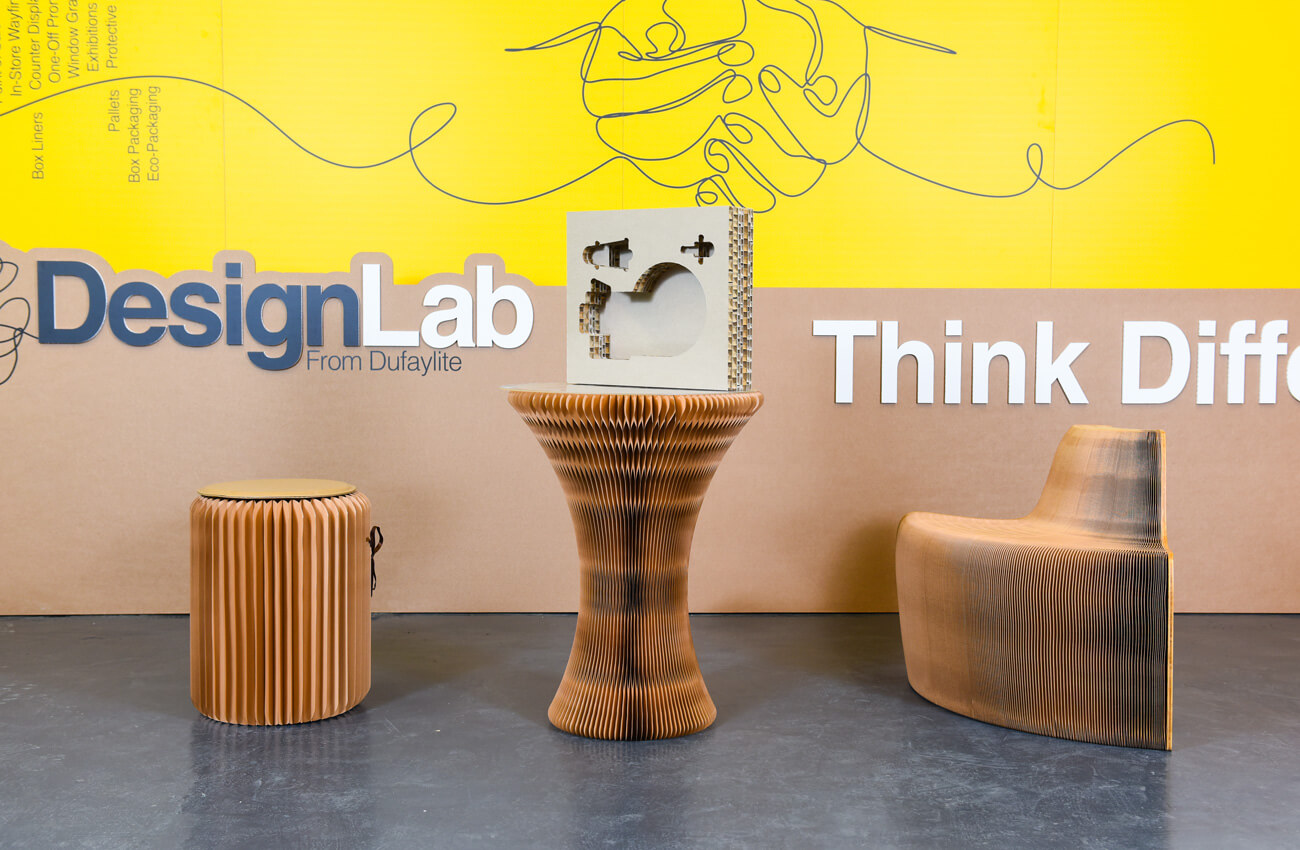
More creative applications for honeycomb board
Because the panel is light, rigid and easy to cut, it turns up well beyond its core markets. It has been used for lightweight furniture and flat-pack tabletops, for large-format 3D sculptures and props, for temporary event architecture, and for internal panels where weight matters — a lineage that goes right back to the material’s early use in aircraft and door cores. Anywhere a designer needs a flat, stiff surface that one person can lift and manoeuvre on their own, paper honeycomb board is worth considering.
A few limitations to consider
Honeycomb board is not the answer to every problem, and it is worth being clear about that. It is a paper product, so it must be kept dry in use unless it is specified with a moisture-managing facing or, as with construction void formers, water is part of the engineered mechanism. For very high point loads or extreme environments, specialist materials may still be the right call.
It is also worth understanding that performance is not fixed — it is designed in. A thin panel with small cells behaves very differently from a deep panel with larger cells, and the facing you choose changes both stiffness and print quality. That flexibility is a strength, but it means a like-for-like comparison against a fixed material such as MDF only really holds once the board has been specified for the job. Because every high-performing application is engineered to the specific requirement, the best results come from specifying it with the manufacturer rather than buying a generic sheet and hoping it fits.
Will honeycomb board become more widely used?
The direction of travel is clear. Regulatory pressure on polystyrene and non-recyclable plastics — EPR modulated fees, the Plastic Packaging Tax, and the shift to simpler kerbside recycling — is pushing packaging, construction and display buyers toward materials that recycle cleanly. Honeycomb board does that while matching or beating the performance of what it replaces, which is a rare combination. As more sectors set net-zero targets and more retailers mandate recyclable substrates, a lightweight, recyclable, UK-made structural panel is well placed to keep taking share from foam, polystyrene and timber. For a fuller comparison against its most common alternative, see polystyrene vs paper honeycomb.
Frequently asked questions
Is honeycomb board the same as honeycomb cardboard?
They describe the same material. “Honeycomb cardboard” and “cardboard honeycomb” are everyday terms for what is properly called paper honeycomb board — a hexagonal paper core between two facings. It is paper-based like cardboard, but far stiffer and more crush-resistant than ordinary corrugated cardboard, and it resists load evenly in every direction rather than just along the flute.
What is honeycomb board made of?
It is made entirely of paper. The paper honeycomb core is 100% recycled paper, and the facings are recycled paper or kraft depending on the application. The adhesive is water based, VOC free and PFAS free, so the whole panel is recyclable in standard paper streams and suitable for food-contact use.
How strong is honeycomb board?
Very strong for its weight. The hexagonal cell structure spreads load across thousands of cell walls, so the panel resists crushing far better than corrugated cardboard and rivals much heavier materials like timber. Actual performance is engineered to the application by varying cell size, panel thickness and facing.
What thicknesses does honeycomb board come in?
Thickness is cut to suit the application, from thin printed sheets for graphics up to deep structural panels for packaging inserts and construction void formers. Cell size is matched to the thickness and the load, which is why solutions are specified rather than bought off the shelf.
Is honeycomb board recyclable?
Yes. Because it is 100% paper with no plastic, foam or solvent, it goes into the standard paper recycling stream — the same collection as cardboard. There is no specialist disposal to arrange, which is a key advantage over foam board and polystyrene.
Where can I buy paper honeycomb board in the UK?
Dufaylite manufactures paper honeycomb board in St Neots, Cambridgeshire — the only company producing the honeycomb itself in the UK. Solutions are engineered to your application across packaging, construction and display.
Ready to specify honeycomb board?
Whether you are replacing polystyrene in packaging, protecting a foundation against clay heave, or printing a recyclable display, the material can almost certainly be engineered for the job. Talk to the team about your application and we will help you specify the right cell size, thickness and facing. Contact Dufaylite to get started.
