
Written by Ashley Moscrop, Managing Director, Dufaylite Developments Ltd
Reviewed by Paul Gill, Head of Sales, Envirolite and Ultra Board
Last updated: 04 June 2026
Key takeaways
- Furniture packaging without polystyrene replaces moulded EPS and EPE foam with engineered paper honeycomb corner protectors, edge protection, surface panels and pallet-base pads — matched to the specific piece by an in-house lab.
- Paper honeycomb is 100% recyclable in standard kerbside paper streams under Simpler Recycling (England-wide since 31 March 2026), so the end consumer recycles it with the cardboard box — no specialist collection, unlike EPS and EPE foam.
- Paper-based packaging carries lower EPR liability than polystyrene because better-recyclability ratings attract lower modulated fees; the modulation gap between Red-rated and Green-rated packaging widens in pEPR Year 2 (2026/27).
- Plastic Packaging Tax sits at £228.82 per tonne from 1 April 2026 and applies wherever a plastic component is present in packaging — a cost pure paper honeycomb does not carry.
- Dufaylite is the only UK manufacturer of paper honeycomb itself — not a converter and not an importer — giving furniture brands shorter lead times, lower transport carbon and UK supply-chain security.
Furniture packaging without polystyrene replaces moulded EPS and EPE foam with engineered paper honeycomb inserts, corner protectors and pallet-base pads. Paper honeycomb delivers equivalent or better cushioning for flat-pack and assembled furniture, is 100% recyclable in standard kerbside paper streams, and carries lower EPR liability than polystyrene — making it the compliant, lower-cost choice for furniture manufacturers shipping at volume.
For furniture manufacturers, the question stopped being “should we drop polystyrene?” a while ago. The brand team has wanted it gone for years. Now procurement wants it gone too, because the numbers on EPS have moved. The real question is the practical one: what actually protects a finished or flat-pack piece in transit, survives the journey, and is genuinely recyclable when the customer is done with the box?
This guide to furniture packaging without polystyrene answers that question head-on. It covers why the commercial case against polystyrene has tightened in 2026, what protection furniture transit actually demands, how the polystyrene-free options compare, and how to switch without compromising the protection your customers expect.
Why furniture manufacturers are choosing furniture packaging without polystyrene in 2026
The decisive shift on furniture packaging without polystyrene in 2026 is financial, not reputational. Three regulatory cost pressures now land on expanded polystyrene at volume, and they hit the procurement line directly. Each one strengthens the case for furniture packaging without polystyrene.
The first is Extended Producer Responsibility (EPR). Under EPR, every producer pays — there is no “EPR-free” material. What changes is how much you pay. Fees are modulated against how recyclable the packaging is, assessed under the Recyclability Assessment Methodology (RAM). Paper-based packaging that enters standard kerbside streams is Green-rated and attracts lower modulated fees; poorly-recyclable formats are Red-rated and pay materially more. This is the first cost lever behind furniture packaging without polystyrene. You can read the current rules in the GOV.UK Extended Producer Responsibility guidance.
There is a timing nuance worth understanding. pEPR Year 1 base fees have effectively been frozen, with the scheme absorbing a large funding shortfall up front. But the modulation gap — the cost difference between Red-rated and Green-rated packaging — opens up in Year 2 (2026/27). That makes now the planning window. The decision in front of furniture brands is simple: decide which side of the Red/Green line you want your packaging to land on before the modulated fees start to bite.
The second pressure is the Plastic Packaging Tax, and it is one of the clearest financial arguments for furniture packaging without polystyrene. It stands at £228.82 per tonne from 1 April 2026 and applies wherever a plastic component is present in packaging that does not meet the recycled-content threshold. EPS and EPE foam are both plastics. Pure paper honeycomb carries no plastic component at all, so it sits outside that liability. The GOV.UK Plastic Packaging Tax guidance sets out who is in scope.
The third pressure is retailer mandate. Major furniture retailers and marketplaces are tightening their requirements on EPS at volume, because EPS is the single most visible “wrong” material in a delivery. When a customer opens a piece of furniture and finds chunks of white polystyrene they cannot put in any bin, that is a complaint waiting to happen — and increasingly a contract condition the retailer enforces on its suppliers.
Sitting underneath all three is Simpler Recycling, which came into force across England on 31 March 2026. It standardises kerbside collection of paper and card, which means a paper honeycomb insert can go straight into the same household stream as the cardboard outer box. EPS cannot. That single fact reframes the end-of-life story for the consumer and, by extension, for the retailer specifying your packaging — and it is why furniture packaging without polystyrene is the simpler answer at the kerbside.
Put together, the commercial case for furniture packaging without polystyrene is no longer a sustainability nice-to-have. It is a total-cost-of-ownership question with EPR liability, Plastic Packaging Tax exposure, damage rates and waste-handling all on the same spreadsheet.
What protection does furniture packaging without polystyrene actually need?
Before comparing materials, it helps to be precise about what furniture transit demands — because “replace the foam” is too blunt an instruction. Furniture is awkward to ship: heavy, large-format, with vulnerable corners, edges and finished surfaces. Any furniture packaging without polystyrene has to match what EPS and EPE foam were doing across several distinct jobs.
Any furniture packaging without polystyrene specification has to cover four distinct protection jobs.
Corner protection. Corners take the worst of the impact in transit and handling. Flat-pack panels and assembled units both need rigid corner protectors that absorb drops and resist crushing under stacked pallets. This is the workhorse job EPS corner blocks have done for decades, and the first one any furniture packaging without polystyrene has to match.
Edge protection. Long edges on table tops, wardrobe panels, headboards and worktops chip and dent if they are not protected along their full length. Edge protection has to be continuous, light and stiff enough to hold its shape under strapping.
Surface protection. Finished furniture — veneers, lacquers, upholstery — needs a surface-protection layer that prevents abrasion and pressure marks without trapping moisture against the finish. Foam surface pads did this; a replacement has to do it without leaving residue or marking the finish.
Pallet-base pads and void fill. Heavy assembled pieces sit on pallets and need base pads that spread load and absorb shock from below. Gaps inside the box need void fill that stops movement without adding significant weight or shipping cost. Furniture packaging without polystyrene has to cover both of these jobs as cleanly as the foam it replaces.
The objection most furniture packaging engineers raise at this point is familiar and fair: “we’ve tried paper alternatives before and they weren’t strong enough.” That objection is almost always about an off-the-shelf paper product asked to do a job it was never engineered for. The answer is not a generic paper sheet. It is engineered paper honeycomb, designed for the specific component, the specific drop height and the specific stacking load. We will come to exactly how that engineering works below.
Furniture packaging without polystyrene: the options compared
There are four credible material routes to furniture packaging without polystyrene. Each has a genuine place, and an honest assessment of each is worth more to you than a sales pitch.
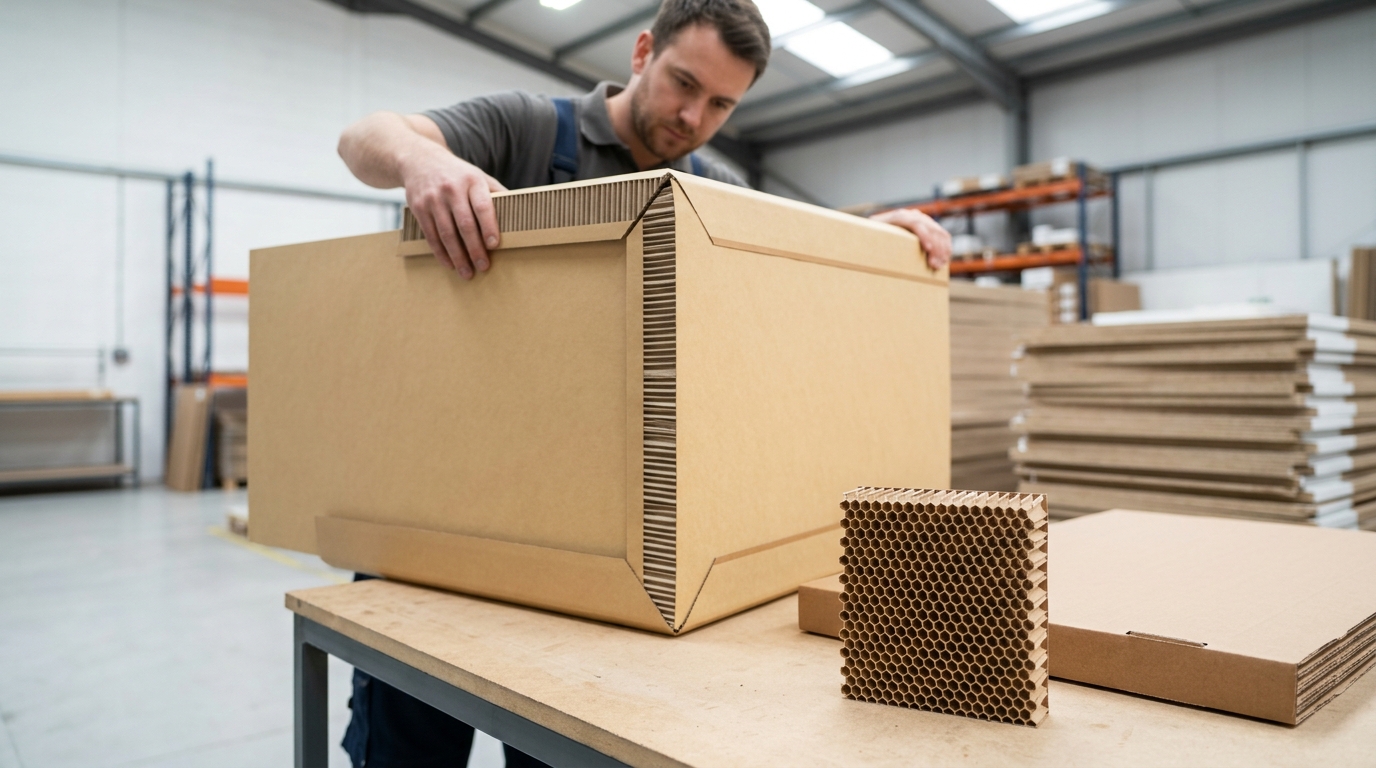
Engineered paper honeycomb (Envirolite). A 100% recycled paper honeycomb core, faced with recycled paper or kraft depending on the application, engineered to the specific furniture component. It is rigid, light and stiff, it cushions to a tested specification, and it goes into the kerbside paper stream at end of life. Because it is bespoke-engineered rather than off-the-shelf, it answers the “paper wasn’t strong enough” objection directly. This is the route this guide recommends for most furniture transit applications, and the rest of the post explains why.
EPE foam. Expanded polyethylene foam is flexible, cuts to shape and handles irregular forms well. But it is a plastic, which is exactly the thing furniture packaging without polystyrene is meant to remove. It is not accepted in most local-authority kerbside streams, it carries Plastic Packaging Tax exposure, and it attracts higher EPR liability than paper. It solves the protection problem while leaving the cost and compliance problem firmly in place.
Moulded pulp. Moulded pulp is paper-based and recyclable, which makes it attractive on paper — literally. Its weaknesses show up with heavy and high-value goods: it can struggle with weight and concentrated impact, it requires expensive tooling and prototyping for each new shape, and minimum order quantities are high. For furniture, where pieces are large, heavy and varied, the tooling cost and weight limits often rule it out.
Corrugated build-ups. Multiple layers of corrugated board folded or laminated into a protective form are recyclable and familiar, and they qualify as furniture packaging without polystyrene. The trade-off is material and labour: achieving equivalent protection takes a lot more board, which adds weight, freight carbon and assembly time on the packing line. For light components it can work; for the demanding corner and edge jobs furniture needs, it is usually the bulkier, heavier answer.
One important clarification before you compare, because it matters for furniture packaging without polystyrene. When people search for “honeycomb packaging” they sometimes mean the roll-format e-commerce wrap paper that expands into a hexagonal pattern when you pull it out of a dispenser. That is a different product made by other suppliers — Dufaylite does not manufacture it. Dufaylite makes structural paper honeycomb panels (Envirolite): rigid, engineered inserts, not expanding void-fill paper. The distinction matters because the two products do completely different jobs, and only the structural panel is built for the corner, edge and pallet loads furniture transit demands.
Comparison table: paper honeycomb vs EPS vs EPE foam vs moulded pulp
The table below compares the four main routes to furniture packaging without polystyrene across the criteria that actually decide a furniture transit specification.
| Criterion | Paper honeycomb (Envirolite) | EPS (polystyrene) | EPE foam | Moulded pulp |
|---|---|---|---|---|
| Cushioning / transit protection | Engineered to spec; strong for corners, edges, heavy pieces | Strong, familiar baseline | Good, flexible | Limited for heavy/high-value items |
| Kerbside recyclable (what consumers actually do) | Yes — standard paper stream | No — specialist collection only | No — not in most LA streams | Yes — paper stream |
| EPR liability direction | Lower (Green-rated, paper) | Higher | Higher (plastic) | Lower (paper) |
| Plastic Packaging Tax exposure | None (no plastic component) | Yes | Yes | None |
| Bespoke engineering / tooling cost | Bespoke, no hard tooling, low MOQ | Tooling for moulded forms | Cut to shape | High tooling cost, high MOQ |
| Weight | Light | Light | Light | Heavier |
| Lead time / UK supply | UK manufactured, short lead times | Varies | Varies | Varies |
The pattern is clear when you are choosing furniture packaging without polystyrene. Paper honeycomb and moulded pulp share the recyclability and EPR advantages; EPS and EPE foam share the plastic-cost and end-of-life problems. Where paper honeycomb separates itself from moulded pulp is on heavy and high-value furniture, on tooling cost, and on the freedom to engineer any geometry without a capital commitment.
Why engineered paper honeycomb is the best furniture packaging without polystyrene
Engineered paper honeycomb is the strongest all-round answer to furniture packaging without polystyrene because it combines tested protection with genuine kerbside recyclability and lower EPR liability — without the tooling cost of pulp or the plastic exposure of foam. Here is what sits behind that, and why it makes the best furniture packaging without polystyrene for most transit applications.
It is engineered, not improvised. This is what separates furniture packaging without polystyrene that works from the paper alternatives that disappointed people in the past. Every Envirolite solution is designed by an in-house lab around the specific furniture component, box and pallet dimensions. The honeycomb core comes in cell sizes of 8mm, 15mm, 27mm and 47mm, and thicknesses from 6mm to 100mm. That range lets the lab tune stiffness and cushioning precisely to the drop height and stacking load your product faces. A corner protector for a heavy assembled wardrobe and an edge protector for a lightweight flat-pack panel are different engineering problems, and they get different solutions. This is the direct answer to “paper wasn’t strong enough before” — because a generic paper sheet and a tuned honeycomb insert are not the same thing.
The material is honest. The core is 100% recycled paper honeycomb. The facings are recycled paper or kraft depending on what the application needs — recycled paper as the default, kraft or white kraft where extra stiffness or print performance matters. The glue is water-based, VOC-free and PFAS-free. There is no plastic anywhere in the structure, which is what keeps it out of Plastic Packaging Tax scope and in the kerbside paper stream.
It is the only paper honeycomb made in the UK. Dufaylite is the sole UK manufacturer of paper honeycomb itself — not a converter who buys honeycomb in and cuts it, and not an importer who ships it from Europe and converts it here. Smurfit Kappa, for example, imports honeycomb from Europe for UK conversion. Manufacturing the honeycomb in the UK means shorter lead times, lower transport carbon and UK supply-chain security that imported alternatives cannot match.
The credentials are verified. Dufaylite is Carbon Neutral Britain™ certified across all product lines. The paper is FSC certified (C186880), covering responsible sourcing across recycled and virgin fibres. On food safety, Dufaylite holds the BRCGS AA Global Food Safety Standard — and it is the only paper honeycomb provider in the world to hold it. That is a supplier-level differentiator within the honeycomb category; BRCGS is determined by the manufacturer’s processes, not by the material, so it sets Dufaylite apart from other honeycomb makers rather than from foam or pulp as a class. For furniture transit specifically, the certifications matter most as proof of process control and as the credentials your sustainability and ESG colleagues can put in a report.
There is also an independently verified carbon position. A CarbonQuota study found Envirolite produces a 35–70% lower carbon footprint than EPS polystyrene alternatives across its lifecycle — a lower-carbon alternative, verified by a third party. The full detail is on the Dufaylite carbon footprint study page. Treat that as a useful supporting fact for furniture work rather than the lead argument: for furniture transit, recyclability, EPR liability and UK manufacture do more of the heavy lifting in a procurement conversation.
If you want to see the range of formats this applies to — corner protectors, edge protection, surface panels, pallet-base pads and void fill — the furniture packaging range sets them out, and the broader sustainable packaging solutions page covers the wider Envirolite line.
How to switch to furniture packaging without polystyrene
Switching to furniture packaging without polystyrene does not mean redesigning your whole packing process. It is a structured, supported transition that runs in five steps, and at no point does your team have to carry the engineering risk alone.
1. Audit your current EPS and EPE foam use by component. Go through each product line and list every place polystyrene or foam currently does a job — corner blocks, edge protectors, surface pads, pallet bases, void fill. This gives you a clear, component-level picture of what needs replacing and where the volume sits.
2. Brief the application and dimensions. For each component, share the furniture piece, its weight, the drop heights and stacking loads it faces in transit, and the box and pallet dimensions. The more specific the brief, the more precisely the solution can be engineered. This is also where the bespoke nature of the bespoke packaging process earns its keep.
3. The lab engineers and prototypes the honeycomb solution. Dufaylite’s in-house lab selects the cell size, thickness and facing for each component and produces prototypes. There is no expensive tooling step and no high minimum order quantity to commit to before you have seen the solution.
4. Test against your current protection. Run the engineered honeycomb against your existing EPS or EPE foam in your own transit tests. The point is to prove equivalent or better protection before anything changes on the line — which is exactly what answers the engineering sign-off question your team will raise.
5. Phase in with line-compatibility checks. Once the protection is proven, phase the new format in, checking it works with your existing packing line, strapping and pallet handling. Most switches are straightforward drop-in replacements that do not disrupt the process.
Run that way, furniture packaging without polystyrene is a managed change, not a leap of faith — and the supplier carries the engineering load, not your team.
Mid-point: see the range and request samples
If your furniture lines are still running on moulded EPS and EPE foam, the practical next step is to put a sample in front of your engineering and procurement teams. You can talk to our packaging team and ask for samples engineered to your own components — the only way to settle the “is it strong enough?” question is to test it on your product.
Frequently asked questions
What is the alternative to polystyrene packaging?
The main alternatives to polystyrene packaging — and the routes to furniture packaging without polystyrene — are engineered paper honeycomb, EPE foam, moulded pulp and corrugated build-ups. For furniture transit, engineered paper honeycomb is usually the best fit: it matches or beats moulded EPS for cushioning, is 100% recyclable in standard kerbside paper streams, carries lower EPR liability, and is bespoke-engineered to the specific component rather than supplied off the shelf. EPE foam and moulded pulp both have a place, but foam is a plastic with the cost and recyclability problems that come with it, and pulp struggles with heavy, high-value pieces.
Are there alternatives to EPS?
Yes — there are several alternatives to EPS (expanded polystyrene), and furniture manufacturers weighing up furniture packaging without polystyrene have more choice than the market sometimes suggests. Engineered paper honeycomb replaces EPS corner blocks, edge protectors, surface pads and pallet-base pads while staying in the paper recycling stream. EPE foam offers flexibility but remains a plastic. Moulded pulp suits lighter items but carries tooling cost and weight penalties. The right alternative depends on the component, the weight and the protection required — which is why a bespoke-engineered honeycomb solution, tested against your current EPS, is the surest route for furniture packaging without polystyrene.
What is an alternative to EPS foam?
The strongest alternative to EPS foam for furniture is engineered paper honeycomb, and it is the backbone of most furniture packaging without polystyrene specifications. Where EPS foam is moulded into corner and edge protectors, paper honeycomb is engineered into the same protective forms from a 100% recycled paper core, then faced with recycled paper or kraft depending on the application. It cushions to a tested specification, is rigid and light, and recycles kerbside with the cardboard outer box. Unlike EPS foam, it carries no Plastic Packaging Tax exposure and attracts lower EPR liability, which is what turns the swap from a sustainability decision into a total-cost-of-ownership one.
What packaging can be used instead of plastic?
For furniture, the packaging used instead of plastic is overwhelmingly paper-based, and furniture packaging without polystyrene relies on it: engineered paper honeycomb for corner, edge, surface and pallet-base protection, and corrugated for outer boxes and lighter components. Paper honeycomb is the plastic-free workhorse for the demanding protection jobs that EPS and EPE foam used to do, because it can be engineered for stiffness and cushioning rather than relying on a generic sheet. Because it contains no plastic, it sits outside Plastic Packaging Tax and goes into the household paper stream at end of life under Simpler Recycling.
Does paper packaging really carry lower EPR liability, or does EPR favour plastics?
Paper packaging carries lower EPR liability than polystyrene because better-recyclability ratings attract lower modulated fees. You may have seen a study suggesting EPR can favour some plastics — that analysis applies specifically to paper-plastic composites with more than around 15% plastic content, where the plastic layer drags the recyclability rating down. It does not apply to pure paper honeycomb, which has no plastic component and stays entirely in the paper stream. For pure paper honeycomb the position is straightforward: lower EPR liability, no Plastic Packaging Tax, and kerbside recyclability. The composite caveat actually sharpens the case for a single-material paper format.
Is large furniture packaging without polystyrene strong enough for heavy assembled pieces?
Yes. Large furniture packaging without polystyrene is engineered specifically for the weight and dimensions of the piece. Heavy assembled furniture is exactly where engineered paper honeycomb earns its place over moulded pulp and corrugated build-ups: the honeycomb core can be specified in thicknesses up to 100mm and cell sizes up to 47mm to handle high stacking loads and concentrated impacts. Pallet-base pads spread load from below, corner and edge protectors absorb drops, and the whole solution is tested against your current protection before you switch. The strength comes from the engineering, not from the material category alone.
The bottom line for furniture manufacturers
Furniture packaging without polystyrene is no longer a trade-off between protection and compliance. Engineered paper honeycomb matches or beats moulded EPS and EPE foam for corner, edge, surface and pallet-base protection, recycles kerbside with the cardboard box, and carries lower EPR liability and no Plastic Packaging Tax exposure — while being made in the UK with shorter lead times than imported alternatives. With the EPR modulation gap opening in Year 2 and Plastic Packaging Tax at £228.82 per tonne, the planning window for furniture brands is now.
The fastest way to settle the protection question is to test furniture packaging without polystyrene on your own product. Talk to our team about a sample pack of Envirolite paper honeycomb engineered for your furniture packaging, and we will run the engineering against your current EPS so the comparison is on your components, not ours.
