
Written by Ashley Moscrop, Managing Director, Dufaylite Developments Ltd Reviewed by Nigel West, Technical Manager, Clayboard Last updated: 06 August 2026
Key takeaways
- A void former for ground beams is a compressible layer laid beneath concrete ground beams and suspended slabs on shrinkable clay, engineered to absorb heave movement before it reaches the structure above.
- The BBA certified paper honeycomb choice is Clayboard KN30, holding BBA Certificate 98/3528, Issue 4 (dated 27 June 2024, originally certificated 29 October 1998), with scope across England and Wales, Scotland, and Northern Ireland.
- Clayboard supports construction loads at 30 kN/m² while dry, then weakens when water is introduced via the Voidpak system after the slab sets — switching off its load-bearing strength (under 3 kN/m² wet) so the void absorbs heave without transferring load to the slab.
- A 160mm Clayboard panel delivers a 150mm void where roughly 225mm of EPS is needed for the same result — around 30% thinner, a quantifiable saving in dig depth, spoil, and groundwork time.
- Expansive clay shrinks through dry summers and swells as it rewets; the British Geological Survey links this shrink-swell cycle to subsidence and heave, with claims typically peaking from late summer into autumn as ground moisture returns.
A void former for ground beams is a compressible layer laid beneath concrete ground beams and suspended floor slabs to absorb clay heave — the upward ground movement that would otherwise force load into the structure. On shrinkable clay, the certified void former for ground beams is Clayboard KN30 (BBA Certificate 98/3528): paper honeycomb that supports construction loads while dry, then weakens when water is introduced after the slab sets — switching off its load-bearing strength to absorb heave at around 30% less dig depth than an equivalent expanded polystyrene (EPS) void former.
This guide is written for the structural engineers, geotechnical engineers, architects, and groundworks contractors who specify or install a void former for ground beams on a UK clay-soil site. It explains what the component actually does, why the mechanism matters, which grade holds BBA certification, how to size it against void depth and dig depth, and how paper honeycomb compares with the EPS alternative — so the specification clause is defensible and the detail is right first time.
What is a void former for ground beams?
A void former for ground beams is a compressible panel installed directly beneath a concrete ground beam or suspended floor slab on expansive clay, creating a controlled gap that absorbs ground heave without passing it into the foundation. On a piled foundation, the piles carry the building load down to a stable stratum, while the ground beams span between the pile caps. The problem is the clay directly beneath those beams: when it swells, it lifts, and without a void it lifts the beam with it.
That is the job the void former does. It sits as a sacrificial, compressible layer between the underside of the beam and the ground, so that when the clay heaves upward, the void former for ground beams takes the movement rather than the concrete. The structure stays where the piles put it; the swelling clay is decoupled from the slab above.
It is worth separating this from two other components that share the “void former” name but do a different job. A formwork void former is a permanent or temporary former used to create a void or a shaped edge during casting — it shapes concrete, it does not manage heave. A structural fill void former is used to build up levels or reduce dead load over weak ground. A void former for ground beams on clay is specifically a heave-management component: its whole reason to exist is the shrink-swell behaviour of the clay beneath the foundation.
Because the requirement is structural, the choice is not a procurement preference — it is an engineering decision that building control and the warranty provider will both scrutinise. That is why the certification question, the mechanism, and the sizing all matter, and why we take each in turn below.
Why ground beams on clay need a void former
Ground beams on shrinkable clay need a void former because expansive clay does not sit still — it shrinks in dry conditions and swells when it rewets, and that movement has to go somewhere. The British Geological Survey identifies clay shrink-swell as one of the most damaging and widespread geohazards in the UK, and it is the direct engineering reason a void former for ground beams is specified in the first place.
The mechanism is seasonal and cyclical. Through a dry summer, clay beneath and around a foundation loses moisture and contracts, opening the soil structure and drawing down the ground. When the moisture deficit closes — typically from late summer into autumn as rainfall returns — the clay rehydrates and swells, and it is this rewetting phase that drives heave. Insurers and the British Geological Survey both note that subsidence and heave claims tend to peak from late summer into early autumn, when desiccated ground begins to take up water again.
A foundation bearing onto, or spanning over, that rehydrating clay has nowhere to send the force unless a compressible void sits beneath it. Without the void, heave pressure transmits straight into the concrete — cracking ground beams, distorting suspended slabs, and in severe cases lifting the structure off its intended bearings. The remediation cost, once that has happened, dwarfs the cost of the void former many times over.
This is the case for designing a void former for ground beams as a default on clay-belt sites rather than an afterthought. If you want the underlying science before the specification detail, our explainer on what ground heave is and how you prevent it sets out the soil behaviour in full — and it is the natural companion to this specification guide.
How a paper honeycomb void former works
A paper honeycomb void former works by doing two opposite jobs at two stages of construction — and getting that transition right is the whole engineering point. A Clayboard panel is a working platform while the concrete is being placed, then becomes a compressible void once the slab can stand on its own. The BBA certificate assesses both states.
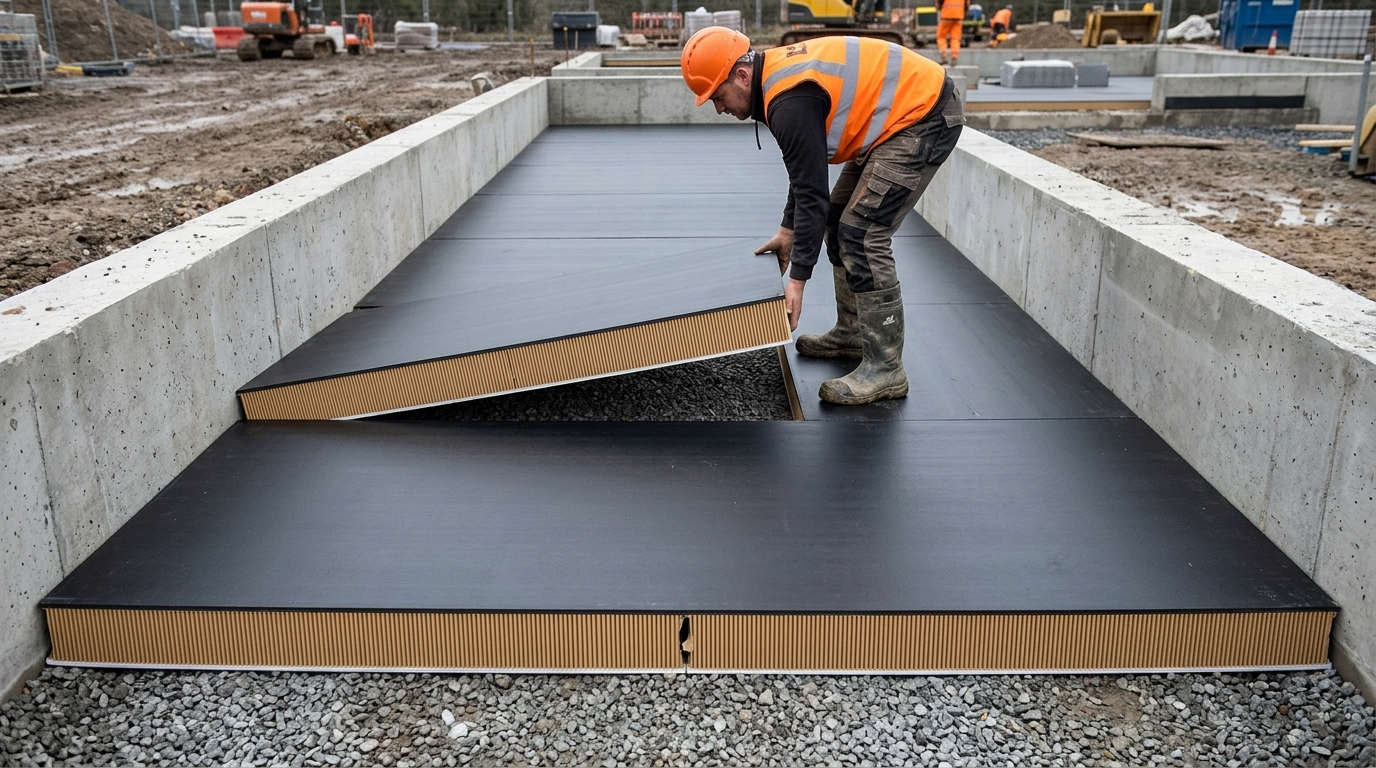
While dry, it carries construction loads. During the pour, the panel must support fresh concrete, foot traffic, and reinforcement steel. Clayboard KN30 is rated at 30 kN/m² dry compressive strength — enough to support concrete up to 1m thick during construction. The black-faced top surface is rated for groundworkers to stand and walk on; the white-faced underside sits against the prepared base. At this stage a void former for ground beams is a load-bearing platform, not yet a void.
Once the slab is self-supporting, its strength switches off. Water is introduced into the paper honeycomb core through the Clayboard Voidpak system after the concrete has set. The water weakens the core, switching off its load-bearing strength — it yields at under 3 kN/m² when wet, as BBA-assessed. With the strength switched off, the void absorbs subsequent clay heave without transmitting any upward load to the slab above. The paper core then biodegrades in situ in the ground over the life of the structure; it is never dug up, recovered, or extracted.
The language here is deliberate, because engineers rely on the distinction: the core weakens and its strength switches off. It does not fail suddenly. The change is controlled, triggered by the Voidpak system at the right moment, and independently assessed — which is precisely why a paper honeycomb void former for ground beams gives a foundation design the predictable behaviour it needs.
The contrast with EPS is structural, not cosmetic. An EPS void former compresses under sustained load, but it does so by transferring the heave force into the slab until the polystyrene yields. The slab must therefore be designed and reinforced to resist that full heave force through the transition. A paper honeycomb void former for ground beams removes that load path, because the strength switches off before any significant load can transfer upward.
BBA certified void former for ground beams — Clayboard KN30
The BBA certified void former for ground beams on clay is Clayboard KN30, manufactured by Dufaylite — the sole UK manufacturer of paper honeycomb. It holds BBA Certificate 98/3528, Issue 4, dated 27 June 2024 and originally certificated on 29 October 1998. That long certification record matters: it is a product independently assessed and re-assessed across more than two decades of UK foundation use, not a recent test report.
BBA certification is not a badge a manufacturer awards itself. The British Board of Agrément independently assesses performance, durability, and fitness for purpose, audits the factory that makes the product, and reviews the certificate over time. You can verify any current certificate on the BBA register. For a void former for ground beams, that assessment covers the dry compressive strength, the wetted behaviour, the void provided, and the installation conditions — the properties an engineer actually designs against.
The certificate scope covers all three UK jurisdictions, so a specifier working across a regional portfolio can rely on a single certified product rather than switching by nation:
- England and Wales — Building Regulations 2010, Requirement A2(a)
- Scotland — Building Regulations 2004
- Northern Ireland — Building Regulations 2012
The certificate also confirms compliance with NHBC Standards 2024 (Chapters 4.2, 4.3, and 4.4), the reference most residential warranty providers point to. In a specification clause it is the certificate number — 98/3528, Issue 4 — not the brand name, that building control reviews. Where a clause, a building control body, or a structural warranty provider requires certification, a product that is “tested but not certified” cannot be used, however good its numbers look. That is why a BBA certified void former for ground beams is the first checkbox a careful specifier settles.
Void former for ground beams sizing — void depth and dig depth
Sizing a void former for ground beams starts from the predicted heave, then reads back to a panel thickness — and the difference between paper honeycomb and EPS shows up as dig depth. Set the required void from the predicted heave magnitude plus a working tolerance, then select the panel that delivers it. Clayboard uses a fixed void-to-thickness relationship, where the panel thickness equals the void required plus a 10–15mm minimum allowance:
| Panel | Void provided | Panel size |
|---|---|---|
| 60mm Clayboard | 50mm void | 2440mm × 1000mm |
| 85mm Clayboard | 75mm void | 2440mm × 1000mm |
| 110mm Clayboard | 100mm void | 2440mm × 1000mm |
| 160mm Clayboard | 150mm void | 2440mm × 1000mm |
The dig-depth saving is where a paper honeycomb void former for ground beams converts to money on a large footprint. A 160mm Clayboard panel delivers a 150mm void where roughly 225mm of EPS is needed for the same void — around 30% thinner. Across a whole foundation that is less excavation, less spoil to cart away, and a shorter groundwork programme. For a groundworks contractor pricing a job, that dig-depth difference is a direct line on the cost sheet, which is often why the question moves from “which void former under slab do we allow” to “which one costs least to install.”
A few design constraints belong in the same conversation. The maximum installation depth is 2m below finished ground level; the panels must not be installed below the water table; and they must be kept dry until the slab is self-supporting, which is why polythene sheeting is specified above and below. A void former for ground beams is also not the right component where soil gas protection is required — radon or methane membranes are a separate specification item. Size to the predicted heave and never trim the void to save dig depth: under-sizing leaves residual movement that loads the slab.
Paper honeycomb vs EPS void former for ground beams — the comparison
The realistic choice for a certified void former for ground beams is between paper honeycomb and expanded polystyrene, so the honest comparison is against the EPS material category rather than any unbranded imitation. The dominant certified EPS product an engineer weighs Clayboard against is Cordek’s Cellcore HX. Both routes clear the certification gate; the decision then turns on the mechanism, the dig depth, and the downstream reinforcement steel.
| Criterion | Clayboard KN30 (paper honeycomb) | EPS void former (e.g. Cordek Cellcore HX) |
|---|---|---|
| Material | Paper honeycomb | Expanded polystyrene (EPS) |
| BBA certified | ✓ Certificate 98/3528, Issue 4 | ✓ |
| Mechanism under heave | Weakens when wetted — strength switches off, no load transfer | Compresses but transfers heave load into the slab until it yields |
| Additional reinforcement steel | No | Yes — slab engineered to resist heave force |
| Panel thickness for a 150mm void | 160mm | ~225mm |
| Dig depth vs EPS for the same void | ~30% less | Baseline |
| Dry compressive strength | 30 kN/m² (supports the pour, foot traffic, reinforcement) | Varies by grade |
| End of life | Paper biodegrades in situ in the ground | Polystyrene remains in the ground |
| Carbon Neutral Britain™ certified | ✓ | ✗ |
| UK manufactured | ✓ (70+ years) | Varies |
The thickness line is the dig-depth story already covered. The steel line is the one that converts on heavily loaded slabs: because an EPS void former for ground beams requires the slab to resist heave force until the polystyrene yields, EPS-based designs typically carry additional reinforcement steel and, on the most heavily loaded slabs, a thicker concrete section. On a major commercial project in London, specifying paper honeycomb over a polystyrene alternative saved the scheme over £1m in reinforcement steel alone — a benefit attributable to the load-transfer mechanism, not the material on its own.
There is a sustainability line worth noting too. Clayboard’s paper honeycomb biodegrades in situ, and Dufaylite is certified under Carbon Neutral Britain™ and holds FSC certification (C186880) for responsible sourcing across recycled and virgin fibres. For a deeper specification-level read, our technical comparison of Clayboard against alternative void formers walks through the differences in more detail than a single table allows.
Does a void former for ground beams need to be non-combustible?
Only where the project specification says so — and this is a point to handle carefully. Some specifications call out a non-combustible void former, usually driven by a fire-strategy requirement rather than the heave function itself. Paper honeycomb is not a non-combustible material, and Clayboard is not marketed or certified as non-combustible, so it should never be specified against a non-combustible requirement.
Where a fire-performance requirement genuinely applies to a void former for ground beams, treat it as a separate specification item and confirm the detail with the technical team before committing a clause. The right answer is a spec discussion, not a fire-rating claim — and it is far better settled at design stage than discovered on site. For most residential and standard commercial clay-belt foundations the requirement is heave management and BBA certification, which is where Clayboard KN30 fits.
How to specify a void former for ground beams
Specifying a void former for ground beams is a five-step sequence that produces a clause building control, the warranty provider, and the contractor can all act on without ambiguity.
1. Confirm the heave risk and clay type from the ground investigation. A desk study and intrusive investigation establish the plasticity index, the soil moisture state, and the predicted heave magnitude. This data drives every downstream decision — including whether a void former is needed at all, and if so, how deep the void must be.
2. Check the specification and warranty BBA requirement. Confirm whether the project specification, building control body, or warranty provider mandates BBA certification. Where they do, the product must carry a current BBA certificate — a batch test report is not a substitute for a certified void former for ground beams.
3. Select the void depth, then the panel. Set the required void from the predicted heave plus a working tolerance, then read the panel thickness from the fixed void-to-thickness table above. Panel thickness equals the void required plus a 10–15mm minimum allowance.
4. Verify the BBA certificate number and issue. Reference the certificate explicitly in the clause — for example, “BBA Certificate 98/3528, Issue 4 — Clayboard KN30.” Naming a void former for ground beams by brand alone, without the certificate reference, leaves the specification weaker than it needs to be, because building control reviews the certificate, not the brand.
5. Confirm the Voidpak detailing and keep-dry sequence. Specify polythene sheeting above and below the panels, the Voidpak water-introduction sequence after the concrete has set, and the requirement to keep the panels dry until the slab is self-supporting. Omitting the polythene is not a saving — premature wetting can weaken the core before the slab is ready to carry its own load.
If you want that detail turned into a defensible clause for a live scheme, talk to the Clayboard technical team and request BBA Certificate 98/3528 (Issue 4) with the technical specification pack.
Frequently asked questions
What is a void former for ground beams?
A void former for ground beams is a compressible layer installed beneath concrete ground beams and suspended slabs on shrinkable clay, engineered to absorb ground heave before it reaches the structure. It supports construction loads while dry, then — for Clayboard KN30 — weakens when water is introduced after the slab sets, switching off its load-bearing strength so the void absorbs heave without transferring load to the slab. It is the component that decouples swelling clay from the foundation above.
What is a void former in construction?
A void former in construction is any product that creates a controlled void beneath or within a concrete element. The type used on clay is a heave void former: a compressible panel beneath ground beams and slabs that absorbs the upward movement of expansive clay. It differs from a formwork void former, which shapes concrete during casting, and from a structural fill void former, which builds up levels or reduces dead load. On clay, the heave-management role is the one that matters.
What is a structural fill void former?
A structural fill void former is used to build up levels, fill over weak or variable ground, or reduce the dead load imposed on the strata below. Its purpose is geometry and load reduction, not heave management. That is the key distinction from a void former for ground beams on clay, whose entire function is to absorb the shrink-swell movement of expansive clay so that heave is not transmitted into the beams and slab above it.
What is a formwork void former?
A formwork void former is a temporary or permanent former used to create a void, rebate, or shaped edge while concrete is cast around it. It is a casting aid — it shapes the concrete and is not designed to manage ground movement. A void former for ground beams on clay does the opposite job: it stays in place beneath the finished beam and provides the compressible void that absorbs heave once the clay rehydrates and swells.
Do ground beams need formwork?
Ground beams are usually cast against trench sides or purpose-made formwork to hold the wet concrete to shape, and a compressible void former is installed beneath the beam and slab to manage heave — the two are different components doing different jobs. The formwork shapes the pour; the void former for ground beams provides the sacrificial gap that absorbs clay movement after the concrete has set. On shrinkable clay both are typically present, but only the void former manages heave.
Is a void former for ground beams the same as a compressible void former?
In practice, yes — a void former for ground beams on shrinkable clay is a compressible void former, because it must compress or weaken to absorb heave. Clayboard KN30 is the paper honeycomb example: it carries construction loads while dry, then weakens when wetted so the void created absorbs movement without loading the slab. The term “compressible void former” describes the behaviour; “void former for ground beams” describes the application. For clay-belt foundations, they refer to the same certified component.
Specifying with confidence
The void former decision is one of the few foundation choices where the right answer is also the documented one. A BBA certified void former for ground beams gives the engineer independent assurance, building control a clean compliance route, and the warranty provider the evidence it expects. On clay-belt sites moving through the shrink-swell cycle, that combination of certification, a strength-switches-off mechanism, and around 30% less dig depth is the case worth putting in front of the design team.
Explore the ground heave solutions range for the full Clayboard specification, or read more about our verified credentials — Carbon Neutral Britain™ certification and FSC responsible sourcing — on our sustainability and certifications page, which sits alongside the Carbon Neutral Britain™ programme. To turn any of this into a specification clause for a live scheme, the Clayboard technical team will support the detail directly.
