
Written by Ashley Moscrop, Managing Director, Dufaylite Developments Ltd Reviewed by Paul Gill, Head of Sales, Envirolite and Ultra Board Last updated: 13 August 2026
Key takeaways
- The strongest moulded pulp alternative for heavy and high-value protective packaging is engineered paper honeycomb — a rigid, structural cushioning material tuned to the exact unit, drop profile and box by an in-house lab.
- Moulded pulp suits light, low-value items such as trays and cup carriers, but can struggle to protect heavy or high-impact goods; engineered paper honeycomb is designed and tested to answer that protection gap.
- Paper honeycomb needs no expensive moulded tooling or prototyping and carries lower minimum order quantities than moulded pulp, so there is no capital commitment before the solution is proven.
- Both moulded pulp and paper honeycomb are paper-based, kerbside recyclable and carry lower Extended Producer Responsibility (EPR) liability than plastics — you keep those shared paper credentials when you switch up to honeycomb.
- Dufaylite is the only UK manufacturer of paper honeycomb itself — not a converter and not an importer — adding Carbon Neutral Britain™, FSC C186880 and the world’s only BRCGS AA honeycomb certification on top.
The strongest moulded pulp alternative packaging for heavy and high-value goods is engineered paper honeycomb. Bespoke honeycomb inserts and cradles match the exact product, need no expensive moulded tooling, carry lower minimum order quantities, and protect against weight and impact where pulp struggles — while staying 100% recyclable in standard kerbside paper streams, exactly as moulded pulp does.
For most packaging engineers, moulded pulp landed on the shortlist for the right reasons. It is paper-based, recyclable and familiar, and it feels like the safe sustainable choice once plastic and expanded polystyrene are off the table. The problem shows up later, on a specific heavy or fragile product, when the question becomes: will a moulded fibre shell actually protect this unit in transit, and can we justify the tooling bill and the minimum order to find out?
This guide to choosing a moulded pulp alternative packaging answers that. It explains what moulded pulp does well and where it falls short, when engineered paper honeycomb is the better moulded pulp alternative packaging, how the two compare across protection, cost and sustainability, and how to make the switch without carrying the engineering risk on your own team.
What is moulded pulp — and where does it fall short?
Before weighing any moulded pulp alternative packaging, it helps to be clear on what moulded pulp is. Moulded pulp is protective packaging made from moulded or formed recycled paper fibre — the same material family as egg boxes, drink-cup carriers, fruit trays and light retail inserts. Recycled paper is pulped into a slurry, pressed into a heated mould in the shape of the product, and dried into a rigid fibre shell. It is paper-based, kerbside recyclable and genuinely useful for the jobs it was designed for, which is why it is a credible starting point for anyone hunting a moulded pulp alternative packaging option only when their product outgrows it.
Its strengths are real and worth stating honestly. Moulded pulp is recyclable in standard paper streams, it is cheap per unit at very high volumes, and it forms cleanly around simple shapes. For a light, low-value, robust item shipped in huge quantities — think a light retail tray or a protective end-cap for something that will not be damaged easily — it is a sensible, sustainable choice, and no moulded pulp alternative packaging is needed.
The limits appear when the product gets heavier, more fragile or more valuable. Three of them matter most.
Weight and impact protection. A moulded fibre shell is a fixed shape that cushions by crushing. On heavy or high-impact goods it can struggle: concentrated loads and hard drops transfer energy through the shell rather than absorbing it in a controlled, engineered way. This is the objection packaging engineers already know from experience — “we tried a paper alternative before and it wasn’t strong enough.” The material was rarely engineered for the actual drop profile; it was a moulded shell doing its best.
Tooling and prototyping cost. Every new moulded pulp shape needs its own mould. Tooling is expensive to design and cut, prototyping iterations add cost and time, and that capital has to be spent up front before a single production part exists. For a varied product range, or a product still changing shape, the tooling bill compounds fast.
Minimum order quantities. Because the tool is a fixed cost, it only makes economic sense across a very high volume. That forces high minimum order quantities to amortise the mould. If your volumes are moderate, or spread across many product variants, the per-unit maths on moulded pulp stops working — which is exactly when a moulded pulp alternative packaging that needs no tooling starts to look far more attractive.
None of this makes moulded pulp a bad material. It makes it a material with a specific sweet spot. The moment your product sits outside that sweet spot — heavy, fragile, high-value, or simply too varied to justify tooling — you need a different paper answer: a moulded pulp alternative packaging engineered to the product rather than pressed into a fixed shell.
When engineered paper honeycomb is the better moulded pulp alternative packaging
Engineered paper honeycomb is the better moulded pulp alternative packaging whenever the product is heavy, fragile or high-value, whenever tooling cost and minimum order quantities are a barrier, or whenever the geometry needs to change without a capital commitment. It answers pulp’s three limits directly, while keeping every paper credential pulp offers.
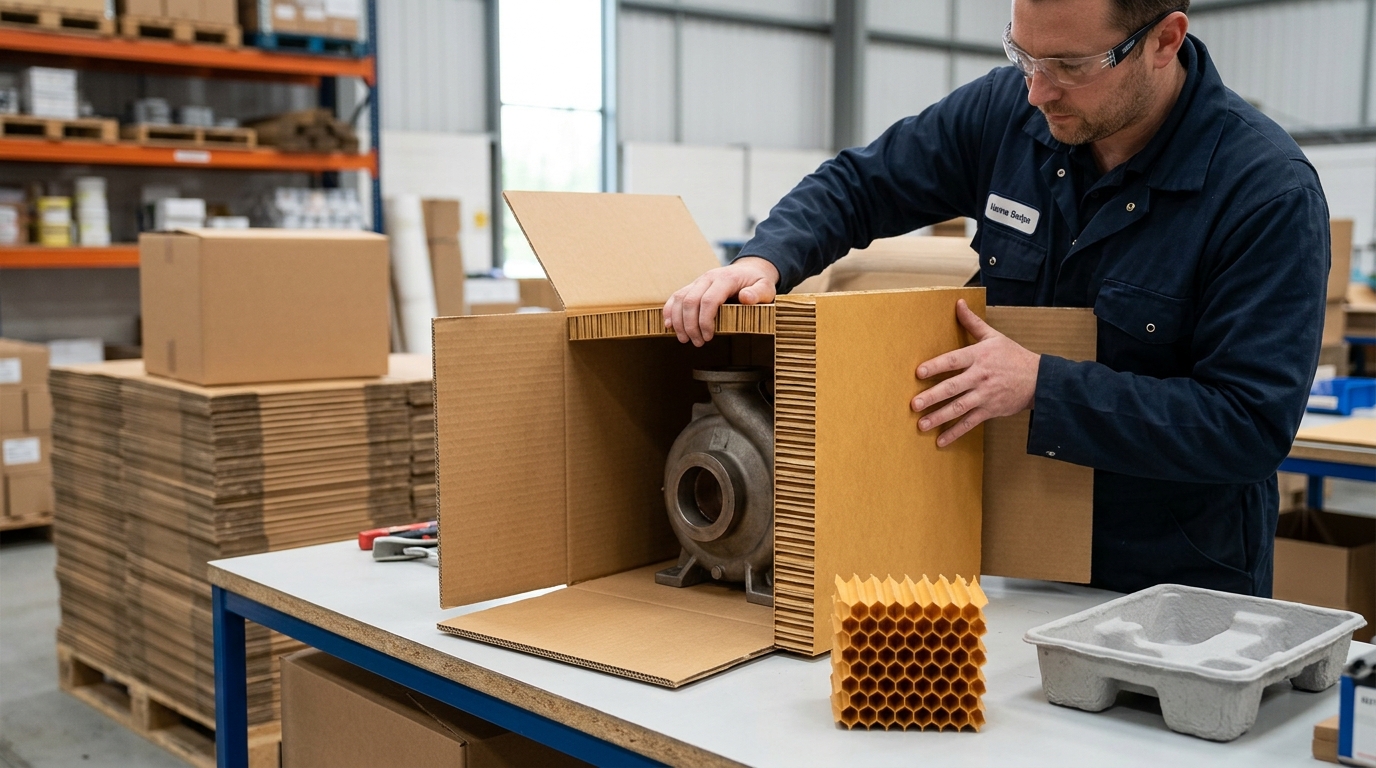
As a moulded pulp alternative packaging, paper honeycomb is not a moulded shell — it is a rigid, structural cushioning material. Envirolite, Dufaylite’s paper honeycomb packaging solution, is built from a 100% recycled paper honeycomb core faced with recycled paper or kraft depending on the application. That honeycomb structure is stiff and light, and it absorbs impact in a controlled, engineered way rather than simply crushing. Inserts, cradles and corner protection are engineered and drop-tested around the exact unit, so the “paper wasn’t strong enough” objection is answered with tested data rather than a hopeful moulded form.
On protection, that is the whole difference. A moulded pulp alternative packaging built from engineered honeycomb can be tuned to the specific drop height and stacking load a heavy or high-value product faces, using cell sizes of 8mm, 15mm, 27mm and 47mm and thicknesses from 6mm to 100mm. A cradle for a heavy appliance component and a corner protector for a delicate finished panel are different engineering problems, and they get different, tested solutions.
On cost, the moulded pulp alternative packaging case is about total cost of ownership, not just unit price. Because paper honeycomb inserts are cut and engineered rather than moulded, there is no hard tooling to pay for and no prototyping mould to commission. That removes the up-front capital commitment, lowers minimum order quantities, and lets the design iterate quickly. You get bespoke engineering without the tooling bill — which is often the deciding factor when procurement runs the numbers against moulded pulp.
On flexibility, a honeycomb moulded pulp alternative packaging can be engineered to any product dimension and any insert geometry. There is no fixed-format constraint, no “we can only do it if you commit to this mould.” For a varied product line, or a product still evolving, that freedom is worth as much as the protection.
Moulded pulp vs paper honeycomb — the comparison
Comparing moulded pulp against engineered paper honeycomb — the leading moulded pulp alternative packaging — comes down to matching each material to the protection job, the cost structure and the sustainability requirement, and being honest about where they are the same. This is the detail that decides a specification, so it is worth walking through before the summary table.
On protection for heavy and high-value goods, engineered paper honeycomb has the clear edge: it is a structural material tuned to the unit, where a moulded pulp shell is a fixed form that can struggle with weight and concentrated impact. On bespoke engineering, honeycomb wins again — the insert is designed to the product, not the product squeezed into a moulded shape.
On tooling and prototyping cost, honeycomb needs none and pulp needs a mould for every shape; on minimum order quantity, honeycomb runs lower because there is no tool to amortise. On weight, honeycomb is typically lighter than an equivalent pulp form, which trims freight cost and carbon.
On kerbside recyclability and EPR liability direction, the two are genuinely comparable — this is the key honesty point. Both are paper-based, both go into the standard household paper stream, and both carry lower EPR liability than plastics such as expanded polystyrene (EPS) and expanded polyethylene (EPE) foam. Switching from moulded pulp to paper honeycomb does not make your packaging “more recyclable” or “lower EPR” — you already had those paper credentials, and you keep them. The moulded pulp alternative packaging case is won on protection, tooling, MOQ and engineering, not on out-recycling another paper material.
Where a recyclability, EPR or carbon advantage genuinely applies, it is against the plastics — not against pulp. Both paper materials are Green-rated relative to Red-rated plastics under the Recyclability Assessment Methodology that modulates EPR fees, and you can read the current scheme in the GOV.UK Extended Producer Responsibility guidance. That is a shared paper strength, and it is one honeycomb retains.
Comparison table: paper honeycomb vs moulded pulp
The table below sets engineered paper honeycomb against moulded pulp across the criteria that decide a protective packaging specification, with EPS and EPE foam included for the wider material context. It is the quickest way to see where a moulded pulp alternative packaging built from honeycomb pulls ahead — and where the two paper materials are simply level.
| Criterion | Paper honeycomb (Envirolite) | Moulded pulp | EPS / EPE foam |
|---|---|---|---|
| Impact / weight protection for heavy & high-value goods | Engineered to spec; strong for cradles, corners, heavy units | Limited for heavy / high-impact items | Good, but a plastic |
| Bespoke engineering to the product | Yes — designed to the exact unit | Fixed moulded shape | Tooled moulded form |
| Tooling / prototyping cost | None — cut and engineered, no hard tooling | High — mould per shape | High — mould per shape |
| Minimum order quantity | Lower — no tool to amortise | High — to amortise the mould | High |
| Kerbside recyclable (paper stream) | Yes ✓ (shared strength) | Yes ✓ (shared strength) | No — specialist collection only |
| EPR liability direction | Lower vs plastics (Green-rated paper) | Lower vs plastics (Green-rated paper) | Higher (Red-rated plastic) |
| Weight | Light | Heavier for equivalent form | Light |
| Lead time / UK supply | UK manufactured, short lead times | Varies | Varies |
| Certifications held | BRCGS AA, Carbon Neutral Britain™, FSC C186880 | Varies by supplier | None of relevance |
The pattern is clear. Paper honeycomb and moulded pulp share the recyclability and EPR advantages that both paper materials have over plastic foam. Where the moulded pulp alternative packaging separates itself is on heavy and high-value protection, on tooling cost, on minimum order quantities, and on the freedom to engineer any geometry without a capital commitment — which is why so many engineers evaluating a moulded pulp alternative packaging land on engineered honeycomb.
Why Envirolite paper honeycomb — the manufacturer advantage
Engineered paper honeycomb is the strongest moulded pulp alternative packaging because it pairs tested, tuned protection with genuine paper recyclability and lower EPR liability than plastics — without the tooling cost of pulp. What sits behind that is Envirolite, and the way it is made and certified.
The material is honest. As a moulded pulp alternative packaging, Envirolite starts from a genuinely paper base: the core is 100% recycled paper honeycomb — always recycled paper, never a plastic or foam substitute. The facings are recycled paper or kraft depending on the application, with recycled paper as the default and kraft or white kraft used where extra stiffness or print performance matters. The glue is water-based, VOC-free and PFAS-free. There is no plastic anywhere in the structure, which keeps it firmly in the kerbside paper stream at end of life — the same paper credential moulded pulp offers, retained in full.
It is engineered, not moulded. Every Envirolite solution is designed by an in-house lab around the specific product, box and pallet dimensions. That is the difference between a moulded pulp alternative packaging that protects a heavy unit and a generic paper form that disappoints. The lab selects cell size, thickness and facing to tune the cushioning to the actual drop and stacking loads, then prototypes and drop-tests — with no tooling step and no high minimum order to commit to first.
It is the only paper honeycomb made in the UK. Dufaylite is the sole UK manufacturer of paper honeycomb itself — not a converter who buys honeycomb in and cuts it, and not an importer who ships it from Europe and converts it here. Smurfit Kappa, for example, imports honeycomb from Europe for UK conversion. Manufacturing the honeycomb here means shorter lead times, lower transport carbon and UK supply-chain security that imported pulp or imported honeycomb cannot match — a real advantage when a product launch needs packaging engineered and delivered to a tight timeline.
The credentials are verified. Dufaylite is Carbon Neutral Britain™ certified across all product lines — a company-level certification independently verified by Carbon Neutral Britain. The paper is FSC certified (C186880), covering responsible sourcing across both recycled and virgin fibres — not one fibre type only. And Dufaylite holds the BRCGS AA Global Food Safety Standard — the only paper honeycomb provider in the world to hold it. BRCGS is determined by a manufacturer’s processes, not by the material, so plenty of pulp and other suppliers hold BRCGS through their own operations; what is unique is that within the paper honeycomb category, Dufaylite alone holds BRCGS AA. It is a supplier-level differentiator, and a useful credential for the sustainability and ESG colleagues who sign off a material change — the full set is set out on the Dufaylite sustainability page.
One clarification matters before you specify. When people search for “honeycomb packaging” they sometimes mean the roll-format e-commerce wrap paper that expands into a hexagonal pattern when pulled from a dispenser for void fill. That is a different product made by other suppliers — Dufaylite does not manufacture it.
Dufaylite makes structural paper honeycomb panels and inserts (Envirolite): rigid, engineered cradles and fitments, not expanding wrap paper. Only the structural panel is built for the cradling, corner and pallet loads that a heavy or high-value moulded pulp alternative packaging has to carry — the expanding wrap paper is not a moulded pulp alternative packaging for protective inserts at all. If you want the material explained from first principles, our guide to what paper honeycomb is covers the structure and how it behaves under load.
Mid-point: see the bespoke capability and request samples
If your protective packaging still runs on moulded pulp trays and fitments, the practical next step is to put an engineered sample in front of your engineering and procurement teams. You can see how we engineer bespoke honeycomb inserts around a specific product, and the wider sustainable packaging solutions range shows the formats — cradles, corner protection, layer pads and void fill — a honeycomb moulded pulp alternative packaging can take. Seeing and handling a moulded pulp alternative packaging engineered to your own product is the fastest way to answer the “is it strong enough?” question.
How to switch from moulded pulp to engineered paper honeycomb
Switching to an engineered moulded pulp alternative packaging is a structured, supported transition, not a redesign of your packing line — and at no point does your team carry the engineering risk alone. Moving from moulded pulp to a honeycomb moulded pulp alternative packaging runs in five steps.
1. Audit your current pulp inserts by weight, fragility and impact risk. Go through each product line and list every place moulded pulp does a job — trays, cradles, end-caps, fitments. Flag the heavy, fragile and high-value units where a moulded shell is most likely to be working at its limit. This gives a clear, product-level picture of where the switch matters most.
2. Brief the unit, drop profile and box dimensions. For each candidate, share the product, its weight, the drop heights and stacking loads it faces in transit, and the box and pallet dimensions. The more specific the brief, the more precisely the honeycomb can be engineered — which is exactly where a designed insert pulls ahead of a fixed moulded form.
3. The lab engineers and prototypes the honeycomb insert. Dufaylite’s in-house lab selects cell size, thickness and facing for each part and produces prototypes. There is no expensive tooling step and no high minimum order quantity to commit to before you have seen and handled the solution — the core cost advantage of this moulded pulp alternative packaging over pulp.
4. Drop-test against your current pulp protection. Run the engineered honeycomb against your existing moulded pulp in your own transit tests. The point is to prove equivalent or better protection on your units before anything changes — the direct answer to the engineering sign-off question your team will raise about any new material.
5. Phase in with line-compatibility and MOQ checks. Once protection is proven, phase the new insert in, confirming it works with your existing packing line, fitment-loading and pallet handling, and set an order quantity that suits your volumes. Most switches are straightforward drop-in replacements that do not disrupt the process. For the underlying material logic, our guides to how to replace polystyrene in packaging and polystyrene vs paper honeycomb both go deeper on the switch process.
Frequently asked questions
Is molded pulp eco-friendly?
Moulded pulp is made from recycled paper fibre and is recyclable in standard kerbside paper streams, so it is a genuinely paper-based, lower-impact choice compared with plastic packaging such as EPS foam. It shares those credentials with engineered paper honeycomb — both are Green-rated relative to plastics under the EPR recyclability methodology, and both carry lower EPR liability than foam. Where moulded pulp is weaker is on protecting heavy or high-value goods and on tooling cost, which is why a moulded pulp alternative packaging built from engineered honeycomb is often the better paper option for demanding transit.
Can molded pulp be recycled with cardboard?
Yes — moulded pulp is paper fibre, so in most areas it goes into the same household paper and card recycling stream as a cardboard box, with no separation step. That is one of its real strengths, and it is a strength engineered paper honeycomb shares: a honeycomb moulded pulp alternative packaging is also 100% recyclable in standard kerbside paper streams under England-wide Simpler Recycling. So on kerbside recyclability the two paper materials are level. The reason to choose a moulded pulp alternative packaging made from honeycomb is protection, tooling cost and minimum order quantity — not recyclability, where pulp is already strong.
What are some innovative alternatives to plastic packaging?
The credible paper-based alternatives to plastic packaging for protective transit are moulded pulp, multi-layer corrugated build-ups, and engineered paper honeycomb. Moulded pulp suits light, high-volume items; corrugated build-ups suit light accessories; and engineered paper honeycomb suits heavy, fragile and high-value goods because it is a rigid, structural cushioning material tuned to the unit. For a product currently protected by moulded pulp that has outgrown it, the natural upgrade is a moulded pulp alternative packaging built from honeycomb — it keeps the paper recyclability while adding tested protection and bespoke engineering without tooling cost.
How to make molded pulp packaging?
Moulded pulp packaging is made by pulping recycled paper into a slurry, pressing it into a heated mould shaped to the product, and drying it into a rigid fibre form. The process needs a bespoke tool for each shape, which is where the cost and minimum order quantity come from. Engineered paper honeycomb is made differently: a recycled paper honeycomb core is faced and then cut and engineered to the product, with no moulded tooling. That manufacturing difference is exactly why a honeycomb moulded pulp alternative packaging carries no tooling bill and lower minimum orders than pulp.
What is the best moulded pulp alternative packaging for heavy or high-value goods?
For heavy or high-value goods, the best moulded pulp alternative packaging is engineered paper honeycomb. Where a moulded pulp shell can struggle with concentrated weight and hard impact, engineered honeycomb is a rigid, structural cushioning material tuned to the exact unit, drop profile and box — cell sizes and thicknesses selected to the loads it will face, then drop-tested. It needs no expensive tooling, carries lower minimum order quantities, and keeps the kerbside recyclability and lower EPR liability that moulded pulp already offers. That combination is why it is the leading choice when pulp protection is in doubt.
The bottom line for packaging engineers
Choosing a moulded pulp alternative packaging is not about giving up on paper — it is about matching the right paper material to the product. Moulded pulp is a sound choice for light, high-volume items. But when the product is heavy, fragile or high-value, or when tooling cost and minimum order quantities do not add up, engineered paper honeycomb is the better answer: tested protection tuned to the unit, no tooling bill, lower minimum orders, and every paper credential pulp already gave you — kerbside recyclable, lower EPR liability than plastics — kept intact, with UK manufacture and verified certifications on top.
The fastest way to settle the protection question is to drop-test the alternative on your own product. Talk to our team about a sample of Envirolite paper honeycomb engineered for your protective packaging, and we will run the engineering against your current moulded pulp so the comparison is on your units, not ours.
