
Written by Ashley Moscrop, Managing Director, Dufaylite Developments Ltd
Reviewed by Paul Gill, Head of Sales, Envirolite and Ultra Board
Last updated: 23 July 2026
Key takeaways
- “Honeycomb cardboard packaging” is a misnomer for paper honeycomb — structural panels of a 100% recycled paper hexagonal core bonded between recycled paper or kraft facings, engineered to replace expanded polystyrene (EPS) and foam.
- Structural paper honeycomb panels are not the same product as e-commerce honeycomb wrap paper (the roll-format expanding void-fill); Dufaylite makes the structural panels and does not manufacture wrap paper.
- Dufaylite is the only UK manufacturer of paper honeycomb itself — not a converter and not an importer — which means shorter lead times, lower transport carbon and UK supply-chain security.
- Paper honeycomb is 100% recyclable in standard kerbside paper streams under Simpler Recycling (England-wide since 31 March 2026) and carries lower EPR liability than polystyrene because better-recyclability ratings attract lower modulated fees.
- Dufaylite holds the BRCGS AA Global Food Safety Standard, Carbon Neutral Britain™ certification and FSC certification (C186880), with a CarbonQuota-verified 35–70% lower carbon footprint than EPS.
Honeycomb cardboard packaging UK buyers research is more accurately paper honeycomb — structural panels of a recycled paper hexagonal core bonded between facings, used to replace EPS and foam. Dufaylite is the only company that manufactures the paper honeycomb itself in the UK, not a converter or importer: bespoke-engineered, 100% recyclable in standard paper streams, and carrying lower EPR liability than polystyrene.
If you have landed here after a search for honeycomb cardboard packaging UK, you are probably weighing up a switch away from polystyrene and trying to work out three things at once. What exactly is the material? Is it genuinely recyclable and strong enough to protect a real product in transit? And who actually makes it in the UK rather than shipping it in? This guide answers all three, and corrects a terminology habit that quietly undersells the material along the way.
The phrase itself is worth pausing on. The word “cardboard” does the material a disservice, and the search results for it are muddled by a roll-format product that is a completely different thing. So before comparing options or suppliers, it helps to be precise about what you are actually buying.
What is honeycomb cardboard packaging (and why it’s really paper honeycomb)?
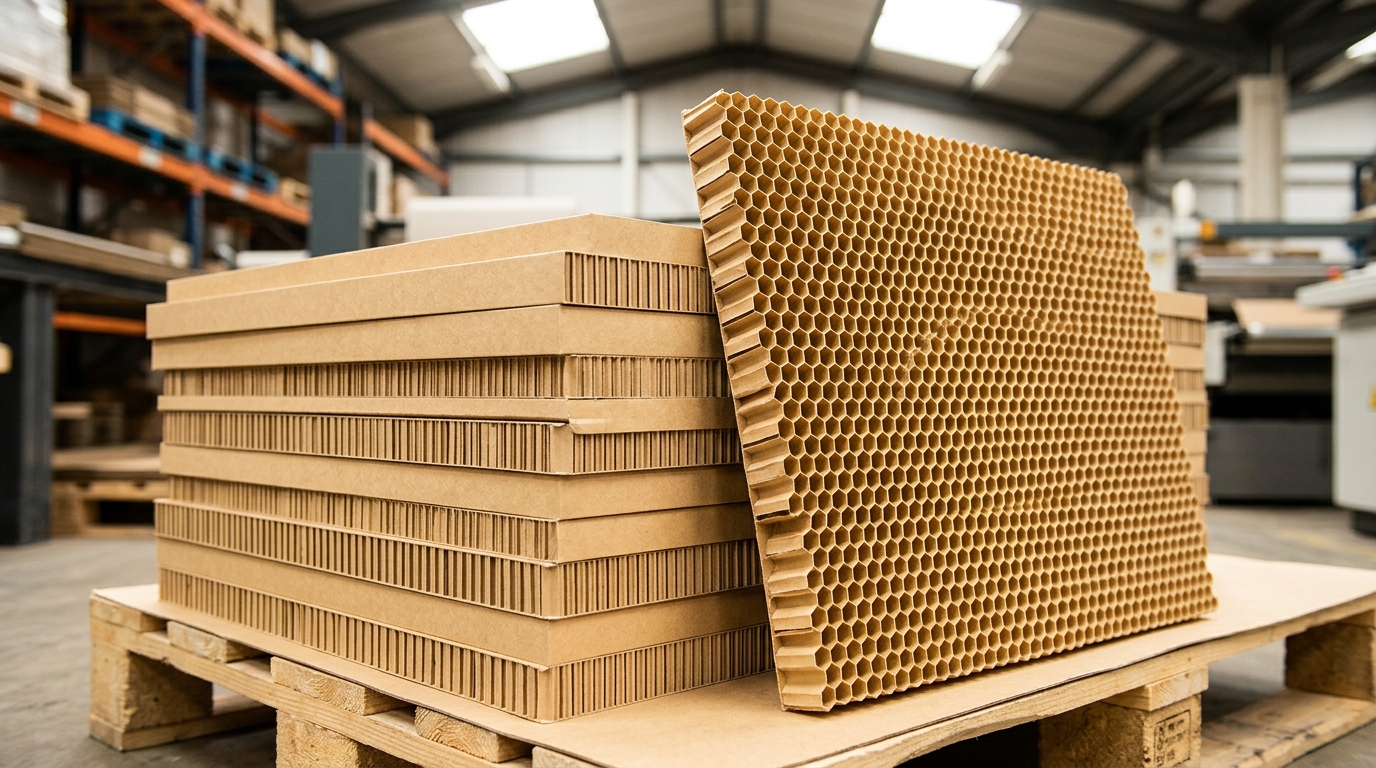
Honeycomb cardboard packaging UK buyers describe is a structural panel: a hexagonal-cell core made from paper, bonded between two flat facing sheets, engineered into protective inserts. The “cardboard” label is a misnomer. The correct technical term is paper honeycomb, and the difference is not pedantry — it changes how you specify, recycle and cost the material.
The core is 100% recycled paper, formed into a dense grid of hexagonal cells. Those cells trap air and give the panel its strength-to-weight ratio: rigid and stiff where it matters, light to ship. The facings bonded to the broad faces are recycled paper or kraft depending on the application — recycled paper as the default, kraft or white kraft where extra stiffness or print performance is needed. The glue is water-based, VOC-free and PFAS-free, which matters for food-contact applications. Calling this “cardboard” suggests a single sheet of corrugated board; it is in fact an engineered sandwich panel.
There is a second, more important confusion to clear up, because it pollutes the search results for honeycomb cardboard packaging UK. When people search for “honeycomb packaging” they sometimes mean honeycomb wrap paper — the roll-format paper-with-slits product that expands into a hexagonal pattern when you pull it out of a dispenser for e-commerce void fill. That is a different product, made by other suppliers. Dufaylite does not manufacture honeycomb wrap paper. Dufaylite manufactures structural paper honeycomb panels (Envirolite) — rigid, engineered inserts, not expanding void-fill paper.
The distinction matters because the two products do completely different jobs. Wrap paper cushions light items and fills space. Structural paper honeycomb is built to carry corner loads, edge impacts and pallet stacking forces on heavy or high-value goods. If your search for honeycomb cardboard packaging UK is really about protecting a product in transit, it is the structural panel you want, and the rest of this guide is about that. For a fuller explainer of the material itself, the what is paper honeycomb page sets out the structure in detail.
So when this guide refers to honeycomb cardboard packaging UK, read it as engineered paper honeycomb — Envirolite, Dufaylite’s paper honeycomb packaging solution — and not as corrugated card or as expanding wrap paper. Throughout the rest of this guide, honeycomb cardboard packaging UK means the structural panel, used as a sustainable packaging material in place of polystyrene.
Is honeycomb cardboard packaging recyclable and strong?
Yes — honeycomb cardboard packaging UK manufacturers produce as structural paper honeycomb is both 100% recyclable in standard paper streams and engineered to match or beat the protection of the EPS and foam it replaces. Those two properties are the reason it has become the default answer for businesses removing polystyrene.
On recyclability, the position is clean for honeycomb cardboard packaging UK consumers handle. Because the panel is paper — a recycled paper core with paper facings, and no plastic component — the end consumer drops it into the same household paper and card collection as the cardboard outer box. There is no separation step, no specialist collection, no retail drop-off. This became simpler still on 31 March 2026, when Simpler Recycling came into force across England and standardised kerbside collection of paper and card. Expanded polystyrene (EPS) cannot follow that route; it requires specialist handling that most consumers never bother with. That single end-of-life fact is what reframes the conversation for any retailer specifying your packaging.
On strength, the honest answer needs a caveat that protects you from a bad experience. The objection most packaging engineers raise is familiar: “we’ve tried paper alternatives before and they weren’t strong enough.” That is almost always true of an off-the-shelf paper product asked to do a job it was never engineered for. It is not true of engineered paper honeycomb, which is a different proposition entirely.
The strength of honeycomb cardboard packaging UK suppliers engineer comes from tuning the structure to the product. The honeycomb core is available in cell sizes of 8mm, 15mm, 27mm and 47mm, and in thicknesses from 6mm to 100mm. A small cell at high thickness behaves very differently from a large cell at low thickness, and an in-house lab selects the combination that matches your specific drop height and stacking load.
A corner protector for a heavy assembled unit and an edge protector for a light flat-pack panel are different engineering problems, and they get different specifications. The strength of honeycomb cardboard packaging UK manufacturers supply is in the engineering, not in the material category alone — which is the direct answer to anyone who has been let down by a generic paper sheet before.
Who makes honeycomb packaging in the UK?
Dufaylite is the sole UK manufacturer of paper honeycomb itself — it makes the honeycomb, rather than buying it in to cut or shipping it from overseas. This is the single most useful thing to understand when you are evaluating honeycomb cardboard packaging UK suppliers, because the market mixes three very different types of company under one search term, and only one of them is a true manufacturer of honeycomb cardboard packaging UK customers can trace end to end.
A manufacturer makes the paper honeycomb from paper, in the UK, end to end. A converter buys finished paper honeycomb core in from a supplier and converts it into packaging — cutting, shaping and assembling, but not making the honeycomb. An importer ships honeycomb in from outside the UK and converts it here. The distinction is invisible on a product page but very real in your supply chain.
To be specific and fair about it: Smurfit Kappa, a major global packaging player, has cutting and conversion facilities in the UK but imports its paper honeycomb from Europe and converts it to specification here — it does not manufacture the honeycomb in the UK. Pallite, a UK-based business, converts bought-in paper honeycomb into packaging solutions rather than manufacturing the core itself. Both are credible companies; neither manufactures the honeycomb in Britain. That is the gap Dufaylite fills as the only company making honeycomb cardboard packaging UK customers can trace to a single UK production line.
Why does manufacturing in the UK matter beyond national pride? Three practical reasons. Lead times are shorter when the material is made down the road rather than shipped across a continent. Transport carbon is lower, which matters when your own customers are auditing Scope 3 emissions. And supply-chain security is stronger — UK manufacture insulates you from the port delays, freight cost spikes and currency swings that imported alternatives carry. For procurement, those three things often matter more than a small difference in cost per sheet. The wider story of 70 years of UK paper honeycomb manufacturing sits behind that capability.
Honeycomb cardboard packaging UK vs foam and EPS
When you compare honeycomb cardboard packaging UK options against the incumbents, the contest is really paper honeycomb versus the two materials it most often replaces: expanded polystyrene (EPS) and expanded polyethylene (EPE) foam. An honest comparison of honeycomb cardboard packaging UK against those materials, across the criteria that actually decide a transit specification, is worth more than a sales pitch.
| Criterion | Paper honeycomb (Envirolite) | EPS (polystyrene) | EPE foam |
|---|---|---|---|
| Cushioning / transit protection | Engineered to spec; strong for corners, edges, heavy and high-value goods | Strong, familiar baseline | Good, flexible for irregular forms |
| Kerbside recyclable (what consumers actually do) | Yes — standard paper stream | No — specialist collection only | No — not in most local-authority streams |
| EPR liability direction | Lower (Green-rated, paper) | Higher | Higher (plastic) |
| Plastic Packaging Tax exposure | None (no plastic component) | Yes | Yes |
| Weight | Light | Light | Light |
| Bespoke engineering / tooling | Bespoke, no hard tooling, low MOQ | Tooling for moulded forms | Cut to shape |
| Lead time / UK supply | UK manufactured, short lead times | Varies | Varies |
| Food-safety certification | BRCGS AA (only honeycomb provider in the world to hold it) | Supplier-dependent | Supplier-dependent |
The pattern is clear when you weigh honeycomb cardboard packaging UK against the foams. Paper honeycomb separates itself from EPS and EPE foam on every line that involves recyclability, regulatory cost and end-of-life. Both foam materials are plastics, which means Plastic Packaging Tax exposure and higher EPR liability, and neither goes into a household kerbside stream. Where EPS and EPE foam still hold a familiarity advantage, engineered paper honeycomb closes it by being tuned to the specific product rather than supplied as a generic block.
A note on the BRCGS line, because it is easy to overstate. BRCGS is supplier-specific, not material-specific — it is determined by the manufacturer’s processes, not by the material, and some EPS and foam suppliers do hold BRCGS certifications. The Dufaylite advantage is that within the paper honeycomb category it is the only provider in the world to hold BRCGS AA. That sets it apart from other honeycomb makers, not from foam as a class. For a deeper side-by-side, polystyrene vs paper honeycomb walks through the comparison in full.
Why Dufaylite’s Envirolite paper honeycomb is the UK benchmark
Envirolite is the benchmark for honeycomb cardboard packaging UK businesses can specify because it combines tested protection with genuine kerbside recyclability, lower EPR liability and a full set of independently verified credentials — all from the only UK manufacturer of the material. No other honeycomb cardboard packaging UK supplier combines all four. Here is what sits behind that claim.
It is engineered, not improvised. Every Envirolite solution is designed by an in-house lab around the specific product, box and pallet dimensions. The cell-size and thickness range described above lets the lab tune stiffness and cushioning to the exact loads your product faces. This is what separates honeycomb cardboard packaging UK that works from the paper alternatives that disappointed people in the past — a tuned insert and a generic sheet are not the same thing.
The material is honest. The core of the honeycomb cardboard packaging UK Dufaylite supplies is 100% recycled paper. The facings are recycled paper or kraft depending on the application. There is no plastic anywhere in the structure, which is what keeps it out of Plastic Packaging Tax scope and in the paper recycling stream. The water-based, VOC-free, PFAS-free glue is part of what makes the food-safety certification achievable.
The credentials are verified. Dufaylite is Carbon Neutral Britain™ certified across all product lines. The paper is FSC certified (C186880), covering responsible sourcing across both recycled and virgin fibres. And Dufaylite holds the BRCGS AA Global Food Safety Standard — the only paper honeycomb provider in the world to hold it. There is also an independently verified carbon position: a CarbonQuota study found Envirolite produces a 35–70% lower carbon footprint than EPS polystyrene alternatives across its lifecycle, a lower-carbon alternative verified by a third party. The full detail is on the carbon footprint study page.
It is bespoke by default. There is no off-the-shelf Envirolite catalogue to compromise around. Each piece of honeycomb cardboard packaging UK customers order is engineered to the product, the budget and the requirement, supported by the in-house lab. That is why the honeycomb cardboard packaging UK manufacturers like Dufaylite supply tends to match or exceed EPS protection in most applications rather than approximating it.
The full Envirolite range — corner protectors, edge protection, box liners, pallet-base pads and void fill — sits on the sustainable packaging solutions page, which is the place to start if you want to see the formats before talking specifics.
How to source honeycomb cardboard packaging in the UK
Sourcing honeycomb cardboard packaging UK suppliers can deliver well comes down to five practical steps, and the most important of them is checking who actually manufactures the honeycomb cardboard packaging UK you are buying rather than just converting it. Run the process in this order and you avoid the two most common mistakes — under-specifying the protection, and assuming every “supplier” makes the honeycomb itself.
1. Define the application and the protection need. List every place EPS or foam currently does a job on your product — corner blocks, edge protectors, surface pads, pallet bases, void fill. Capture the product weight, the drop heights and stacking loads it faces, and the box and pallet dimensions. The more specific this is, the more precisely the solution can be engineered.
2. Confirm your recyclability and EPR goals. Decide which side of the Red/Green recyclability line you want your packaging to land on, and whether removing Plastic Packaging Tax exposure is a target. This shapes the material choice and gives your sustainability colleagues the numbers they need for reporting.
3. Check the supplier manufactures, not just converts, in the UK. Ask the direct question: do you make the paper honeycomb, or buy it in? A true manufacturer gives you shorter lead times, lower transport carbon and UK supply security. A converter or importer cannot. This single check separates honeycomb cardboard packaging UK suppliers more sharply than any other.
4. Brief the lab and request prototypes. Share the application detail with an in-house lab team and ask for prototypes engineered to your components. With a true manufacturer there is no expensive tooling step and no high minimum order quantity to commit to before you have seen the solution. This is where the bespoke packaging process earns its keep.
5. Prototype, test and phase in. Run the engineered honeycomb against your current EPS or foam in your own transit tests, prove equivalent or better protection, then phase it in with line-compatibility checks. Most switches are straightforward drop-in replacements that do not disrupt the packing line.
Run that way, sourcing honeycomb cardboard packaging UK businesses can rely on is a managed, evidence-led decision — and the manufacturer carries the engineering load, not your team.
Mid-point: see the range and request samples
If your product is still running on moulded EPS or EPE foam, the practical next step with honeycomb cardboard packaging UK is to put a sample in front of your engineering and procurement teams. You can talk to our packaging team and ask for samples engineered to your own components — the only way to settle the “is it strong enough?” question is to test it on your product.
Frequently asked questions
What is honeycomb cardboard packaging UK and how does it work?
Honeycomb cardboard packaging UK buyers research is more accurately called paper honeycomb: a structural panel made of a 100% recycled paper hexagonal core bonded between recycled paper or kraft facings. In practice, honeycomb cardboard packaging UK manufacturers supply is engineered into protective inserts rather than sold as plain sheet. The hexagonal cells trap air, giving the panel a high strength-to-weight ratio — rigid where it matters, light to ship. It works by being engineered into protective forms (corner protectors, edge protection, pallet-base pads) tuned to a specific product’s weight and transit loads, replacing the moulded EPS and foam that did those jobs. It is not corrugated card and not e-commerce wrap paper.
Is honeycomb cardboard recyclable?
Yes. Honeycomb cardboard packaging — paper honeycomb — is 100% recyclable in standard paper streams. Because it is made from a recycled paper core and paper facings with no plastic component, the end consumer recycles it kerbside alongside the cardboard outer box, with no separation step or specialist collection. Simpler Recycling, in force across England since 31 March 2026, standardised kerbside paper and card collection, so the route is now consistent nationally. This is a clear advantage over expanded polystyrene (EPS), which requires specialist handling that most consumers never use.
Who makes honeycomb packaging in the UK?
Dufaylite is the only UK manufacturer of paper honeycomb itself — it makes the honeycomb from paper in Britain rather than converting bought-in core or importing it. Other companies in the market either convert paper honeycomb they buy in (for example Pallite) or import the honeycomb from Europe and convert it in the UK (for example Smurfit Kappa). When sourcing honeycomb cardboard packaging UK suppliers, the manufacturer-versus-converter distinction is the one to check: a true manufacturer gives shorter lead times, lower transport carbon and UK supply-chain security that converters and importers cannot match.
Is honeycomb cardboard stronger than foam?
Engineered paper honeycomb can match or exceed EPS and EPE foam for transit protection, but the strength comes from the engineering rather than the material category. The honeycomb core is specified in cell sizes from 8mm to 47mm and thicknesses from 6mm to 100mm, then tuned by an in-house lab to the specific drop height and stacking load your product faces. A generic paper sheet is not strong enough — which is why “we tried paper before” disappointments are almost always about an off-the-shelf product, not an engineered honeycomb insert. Tested against your own EPS, a bespoke honeycomb solution proves the point on your components.
Honeycomb cardboard vs paper honeycomb — what’s the difference?
There is no material difference — “honeycomb cardboard” is simply a common but inaccurate name for paper honeycomb. The word “cardboard” undersells an engineered sandwich panel as if it were a single sheet of corrugated board. Paper honeycomb is the correct technical term: a recycled paper hexagonal core bonded between facings, engineered into structural protective inserts. The one real distinction to keep clear is that structural paper honeycomb panels are different from honeycomb wrap paper, the roll-format expanding void-fill product — Dufaylite makes the structural panels, not the wrap paper.
The bottom line for packaging buyers
Honeycomb cardboard packaging UK businesses are searching for is, properly understood, engineered paper honeycomb: a 100% recycled paper structural panel that matches or beats EPS and foam for protection, recycles kerbside with the cardboard box, and carries lower EPR liability with no Plastic Packaging Tax exposure. Read that way, honeycomb cardboard packaging UK is a total-cost-of-ownership decision, not just a sustainability one. The one distinction worth holding on to is who makes it — Dufaylite is the only company that manufactures the paper honeycomb itself in the UK, not a converter and not an importer, which is where the lead-time, carbon and supply-security advantages come from.
The fastest way to settle whether it is right for your product is to test it. Talk to the UK manufacturer about a sample pack of Envirolite paper honeycomb engineered for your application, and we will run the comparison against your current EPS or foam so the evidence is on your components, not ours.
