
Eco-friendly boards for printing: the 5 best options, compared by a UK board maker
Prepared by Ashley Moscrop, Managing Director, Dufaylite Developments Ltd
Reviewed by Sophie Bayes, Ultra Board® and Envirolite® food box liners
Last updated: 28 September 2026
Key takeaways
- Five eco-friendly boards for printing are worth comparing: paper honeycomb board, corrugated display board, fluted-core paperboard, closed-cell fibreboard and PVC-free recyclable plastic sheet.
- The four paper-based boards are sold as recyclable with paper; plastic sheet needs a separate plastics route, and foam board, Foamex and MDF cannot go in the paper stream.
- Ultra Board® publishes its print surface data: CIE whiteness 120 (ISO 11475), gloss 65% at 75° (ISO 8254-1), smoothness PPS 1.3 (ISO 8791-4) and opacity 99% (T 425).
- Ultra Board® 3D at 16mm has a bend stiffness of 325 Nm in the machine direction and 178 Nm in the cross direction (ISO 5628), from an 8mm paper honeycomb cell.
- Dufaylite Developments Ltd makes Ultra Board® in St Neots as the sole UK paper honeycomb manufacturer, and holds FSC® C186880, Carbon Neutral Britain™, ISO 9001 and ISO 14001.
The main eco-friendly boards for printing are paper honeycomb board, corrugated display board, fluted-core paperboard, closed-cell fibreboard and recyclable plastic sheet. The four paper-based boards are sold as recyclable with paper; plastic sheet needs a separate plastics route. For rigid printed displays that replace foam board, paper honeycomb pairs a smooth white print face with a stiff, light core.
These boards are not interchangeable once they’re on your flatbed or cutting table. This guide compares eco-friendly boards for printing on print face, rigidity, end of life and origin, and publishes the numbers behind Ultra Board®, Dufaylite’s paper honeycomb display board, so you can check the claims.
What makes a board eco-friendly for printing?
A board earns the label by passing five practical tests, not because a datasheet says “eco”. These are the tests a client’s sustainability team applies to eco-friendly boards for printing when they ask for something better than foam board.
- It goes in the paper recycling stream. A board made entirely of paper can go in with paper and card waste when the display comes down. Foam composites and plastic sheet need separating or a different route.
- It is PVC-free. Polyvinyl chloride (PVC) foam sheet is still common in signage, and more briefs now rule it out.
- Its fibre sourcing is documented. Forest Stewardship Council (FSC) chain of custody shows where the paper came from.
- It runs on the kit you already own. A board that needs new printers or cutters is a hard sell.
- It is made close to where it’s used. For a UK printer, a UK-made board travels fewer miles than one shipped from South Africa or Sweden.
Few boards pass all five. Choosing between eco-friendly boards for printing usually comes down to how many tests a board passes for the job in front of you, and whether its maker can show evidence for each.
Dufaylite Developments Ltd holds FSC® certification (C186880), Carbon Neutral Britain™ certification, ISO 9001 and ISO 14001, and our sustainability credentials set them out in full. They are company certifications, covering how we source, make and manage every board we produce.
The 5 best eco-friendly boards for printing
These are the five eco-friendly boards for printing that UK print companies compare most often.
1. Paper honeycomb board (open-cell), such as Ultra Board®
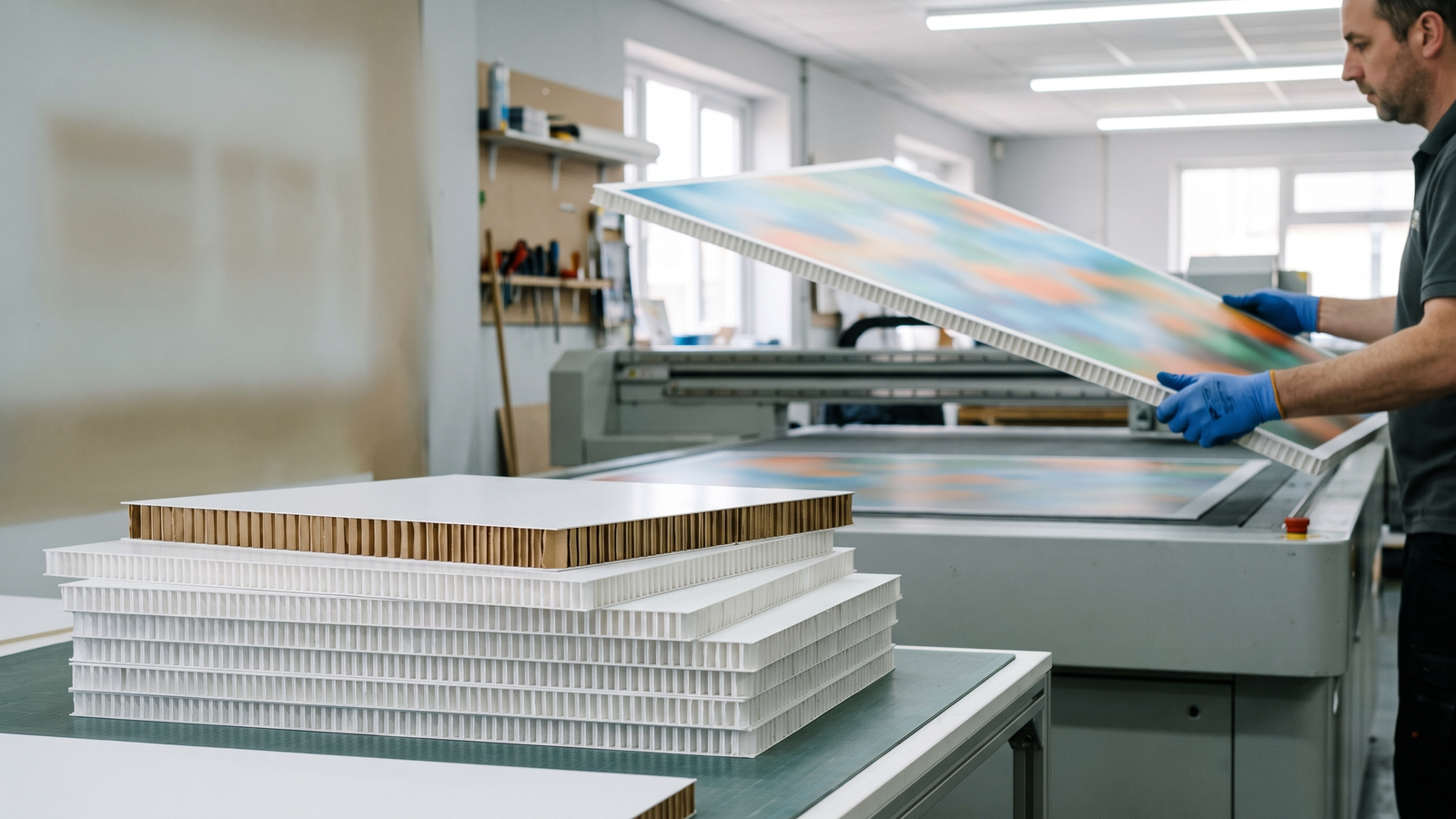
Paper honeycomb board is the stiffest, lightest paper-based option for printed displays. It bonds printable paper facings to an open-cell paper honeycomb core, so most of the board is air held in shape by paper walls.
Ultra Board® has a 100% recycled paper honeycomb core, with FSC-certified virgin fibre facings. It is recyclable and repulpable in standard paper streams, and Dufaylite makes it in St Neots. The small 8mm cell in the 3D variants gives freestanding units their stiffness, which is why a paper honeycomb display board is the structural pick among eco-friendly boards for printing. For honeycomb board printing, the white facings take ink like a quality poster paper.
2. Corrugated display board
Of all the eco-friendly boards for printing, corrugated display board is the most familiar low-cost paper option for short-run point-of-sale (POS) work. It prints well enough for many campaigns and recycles with paper.
Its weakness is direction. Corrugated board is strong along its flutes and weaker across them, so tall freestanding display units (FSDUs) can dent and lean when shoppers knock them. It suits flat or lightly loaded work better than a tall structure.
3. Fluted-core rigid paperboard, such as Reboard
Fluted-core paperboard is a rigid paper display board built around a corrugated core. Reboard, made in Sweden, is the best-known example, and Swedeboard also makes fibre-based display board. Both have white print faces and are sold as recyclable.
The difference from Ultra Board® is the core. Corrugated and open-cell honeycomb cores behave differently in bending, weight and cut-edge finish, and Ultra Board® is made in the UK rather than imported.
4. Closed-cell fibreboard, such as Xanita board
Closed-cell fibreboard is one of the rigid eco-friendly boards for printing, with a denser core than honeycomb. Xanita, made in South Africa, is the name most printers know, and Xanita board is sold as recyclable for display and structural work.
The comparison is weight and distance. Open-cell honeycomb is lighter than Xanita’s closed-cell board, which matters when a large exhibition structure has to be carried, hung or shipped, and Ultra Board® is made far closer to a UK print room.
5. Recyclable plastic sheet (PVC-free)
Among eco-friendly boards for printing, PVC-free plastic sheet is the durable choice for longer-life and outdoor signs. It prints well, tolerates damp and survives handling that would mark paper.
The catch is the end of life. Plastic sheet is recyclable only where a plastics route exists, and never in the paper stream. For short-life indoor displays, a paper-based board gives the client a simpler story at closedown.
Eco-friendly boards for printing compared
Eco-friendly boards for printing differ most on core, print face and where they go when a campaign ends. The table puts all five side by side, with the boards printers are moving away from for reference.
Table: eco-friendly boards for printing compared by core, print face, recycling route and origin
| Board | Core | Print face | Best for | Paper recycling stream | Made in the UK | Example we can name |
|---|---|---|---|---|---|---|
| Paper honeycomb board | Open-cell paper honeycomb (100% recycled paper) | White (CIE 120, opacity 99%) or natural kraft | Flat signage to 3D structures | ✓ | ✓ | Ultra Board® |
| Corrugated display board | Fluted paper | Printable liner (varies) | Short-run POS, FSDUs | ✓ | Varies | — |
| Fluted-core paperboard | Corrugated paper | White | Display, exhibition | ✓ (sold as recyclable) | ✗ | Reboard (Sweden) |
| Closed-cell fibreboard | Closed-cell paper | White | Display, structural | ✓ (sold as recyclable) | ✗ | Xanita (South Africa) |
| Recyclable plastic sheet | PVC-free plastic | Printable | Longer-life and outdoor signs | ✗ (plastics route) | Varies | — |
| Foam board / Foamex (being replaced) | Polystyrene or PVC foam | Printable | Signage | ✗ | Varies | — |
| MDF (being replaced) | Wood fibre and resin binder | Printable when prepared | Heavy structures | ✗ | Varies | — |
Ultra Board® 3D is up to 45% lighter than corrugated-centred alternatives, and open-cell honeycomb is lighter than Xanita’s closed-cell board. “Sold as recyclable” means the maker says so; if a client needs proof, ask each supplier for evidence, as you would ask us.
Want to compare eco-friendly boards for printing in your hand? Request a printer’s sample pack: small pieces of the Ultra Board® range to see, feel and show your clients.
Ultra Board® print and structural specs
Ultra Board® publishes its print surface and structural data, so you can judge it against other eco-friendly boards for printing on numbers. Every variant with a printable facing shares the same print surface.
| Print surface property | Value | Standard |
|---|---|---|
| CIE whiteness (D65–10°) | 120 | ISO 11475 |
| Gloss 75° | 65% | ISO 8254-1 |
| Smoothness PPS S10µm | 1.3 | ISO 8791-4 |
| Opacity | 99% | T 425 |
Ultra Board® suits flatbed direct-to-media printers and works with standard print-industry cutting and routing equipment. Ultra Board® Universal has a natural kraft face for digital or screen printing in its natural state.
The range has six variants: Ultra Board® 2D, Ultra Board® 2D White, Ultra Board® 3D, Ultra Board® 3D White, Ultra Board® Graphic and Ultra Board® Universal. “White” in a name means the honeycomb core is white as well as the facings. Standard sheets are 2440 × 1220mm, with 3000 × 1600mm on 3D, 3D White and thicker Graphic boards, and 3000 × 1520mm on thicker Universal boards.
Ultra Board® 2D weighs 1.06 kg/m² at 6mm. Ultra Board® 3D weighs 1.6 kg/m² at 16mm and has a bend stiffness of 325 Nm in the machine direction and 178 Nm in the cross direction (ISO 5628). The reason is the cell: 3D uses an 8mm cell against 15mm on the flat variants, so there are more cell walls per square metre. Tolerances are ±2mm on length and width and ±0.5mm on thickness.
Ultra Board® 3D White saves a production step. Its core is white, so cut edges look finished straight off the cutting table and there’s no need to cover the edges. That is a labour saving before it’s a looks point.
Is MDF board eco-friendly? (And foam board, Foamex and PVC)
MDF (medium-density fibreboard) is made from wood fibre bonded with a resin binder, so it is heavy and cannot go in the paper recycling stream. It is sometimes described as using waste wood, but its end of life is the problem for short-life printed displays.
That is why printers switching to eco-friendly boards for printing usually start by replacing three familiar substrates.
Foam board. Foam board sandwiches a polystyrene foam core between paper facings. It is light and easy to cut, but as a foam and paper composite it can’t go in standard paper recycling, and it warps if it isn’t stored flat and dry. Our guide to a recyclable foam board alternative covers the switch.
Foamex and PVC foam sheet. Foamex is a rigid, weather-tolerant PVC foam sheet, common in signage. PVC can’t go in the paper stream, and many brand briefs now exclude it. See our Foamex alternative for UK printers for how paper honeycomb compares.
None of this criticises printers still using these boards; they were the standard for years. The shift comes from clients asking where the display goes when the campaign ends.
Will eco-friendly boards for printing run on your existing kit?
Yes. The paper-based eco-friendly boards for printing run on the flatbed printers and cutting tables most UK print rooms already have, and Ultra Board® was made for that workflow.
Printing. Ultra Board® suits flatbed direct-to-media printers. Its white facings give a bright, smooth, opaque surface for clean colour. The Universal board takes digital or screen print on its natural kraft face.
Cutting and routing. Standard print-industry cutting and routing equipment handles Ultra Board®. On a digital cutting table there’s no bespoke cutting tool to buy, and slot-together builds need no tools to assemble the cut parts.
Flatness and storage. Warping is a common complaint about foam board. Ultra Board® uses matched paper facings on both sides, which helps a paper panel stay balanced, but no paper board is immune to moisture. The next section explains why, and what to do about it.
Edges and finishing. Ultra Board® 3D White removes the edging step on exposed edges. Where a job still needs a finish, display edging, corner protectors, magnets, clips and hooks all work on honeycomb board.
Eco-friendly boards for printing should change what your client can say about the display, not how your production floor runs.
Do eco-friendly boards for printing stay flat?
Not always, and that is true of every paper board, ours included. Paper honeycomb, corrugated, fluted-core and solid paper display boards are all made from paper, a natural material that takes on moisture from the air and gives it back again. When one face takes on more moisture than the other, the board can bow.
It is tempting to assume that a rigid board stays flat because it is strong. Strength and flatness are different things. A stiff board resists a knock or a load, but it still moves with the humidity around it. Most suppliers of eco-friendly boards for printing don’t say this. We’d rather you plan for it than discover it on install day.
Flatness depends as much on where the board lives as on the board itself:
- In the print room. Boards that arrive from a cold van or a damp warehouse need time to settle to the room before they go on the bed.
- In storage. Keep boards flat, fully supported and wrapped until you use them, off the floor and away from doors and heaters.
- In the store. A display beside an automatic door, above a chiller cabinet or in a sunny window lives in a very different climate from one in the middle of an aisle. Ask your client where it will stand, and plan the build around it.
None of this makes paper the wrong choice among eco-friendly boards for printing. It’s simply how paper behaves, and a display planned around it performs as it should. If you’d like to talk a job through before it goes to print, our team is happy to help.
Where printers use eco-friendly display boards
Printers use eco-friendly display boards wherever a printed display has a short life and a client who cares what happens next.
Retail and POS campaigns. Header boards, shelf-edge signage and freestanding units. For a POS brief, our guide to sustainable POS display materials covers how each material behaves at store closedown.
Events and exhibitions. Lighter panels are easier to carry, hang and ship, and a sustainable display board answers the “what happens after the show?” question. See our article on recyclable exhibition stand boards.
Wayfinding, seasonal displays and book retail. Printed boards that look professional for a season or a launch and go in with paper afterwards.
For 3D builds, the Design Lab for printers offers structural support, mock-up development and prototyping advice, so you can pitch a structure made from eco-friendly boards for printing with confidence.
Dufaylite’s partnership with Premier Paper Group
To make Ultra Board® accessible to printers across the UK, we’ve partnered for many years with Premier Paper Group and their specialist team at Premier Display. Together, we’re helping the industry transition toward cleaner, more responsible materials without sacrificing quality or creativity.
- 100% recyclable
- UK manufactured
- FSC certified
- Available with next-day delivery via Premier Display
Frequently asked questions
Is MDF board eco-friendly?
MDF is made from wood fibre bonded with a resin binder, which makes it heavy and keeps it out of the paper recycling stream. It is sometimes described as using waste wood, but for printed displays that come down after a few weeks, its end of life is the weak point. Printers replacing MDF usually move to one of the rigid eco-friendly boards for printing, such as paper honeycomb, which is lighter and recyclable with paper.
What is the most eco-friendly printing method?
For display boards, the substrate usually decides the end of life more than the print process. Print direct to a paper-based board rather than mounting a printed vinyl, and avoid laminating the face with plastic film, so the display stays a single material that can go in with paper. If you are weighing up eco-friendly print media and laminating sheets, the simplest rule is fewer layers and no plastic.
Are eco-friendly boards for printing recyclable?
The paper-based eco-friendly boards for printing are sold as recyclable with paper: paper honeycomb, corrugated, fluted-core paperboard and closed-cell fibreboard. PVC-free plastic sheet is recyclable only where a plastics route exists. Ultra Board® is recyclable and repulpable in standard paper streams. Keep the display paper-only, without plastic laminates or mounted vinyl, so it can actually go in the paper stream.
Can Ultra Board® be printed on a flatbed printer?
Yes. Ultra Board® suits flatbed direct-to-media printers, and its white printable facings measure CIE whiteness 120, opacity 99%, gloss 65% and smoothness PPS 1.3. It works with standard print-industry cutting and routing equipment, including digital cutting tables, so it fits an existing workflow. Ultra Board® Universal has a natural kraft face for digital or screen printing.
Are eco-friendly boards for printing strong enough for freestanding displays?
Paper honeycomb is the strongest paper-based choice for freestanding displays because of its core. Ultra Board® 3D uses a small 8mm cell, giving a 16mm board a bend stiffness of 325 Nm in the machine direction and 178 Nm in the cross direction (ISO 5628). Corrugated board is weaker across its flutes, which is why tall corrugated units can lean when knocked. Every paper board, honeycomb included, can also move with moisture, so plan storage and in-store placement too. For a structural build, talk to us before you cut.
Do eco-friendly boards for printing cost more than foam board?
It depends on the job, so compare total cost rather than sheet price alone. Lighter boards cost less to carry and ship, paper-based boards can go in the paper stream at closedown, and a recyclable substrate helps you win briefs that ask for one. For many printers, that last point decides it. Tell us about your next print job and we’ll quote for it.
Choosing eco-friendly boards for printing: next steps
The right eco-friendly boards for printing depend on the job: flat or structural, indoor or outdoor, weeks or years. For short-life printed displays that must be rigid, light and recyclable with paper, test paper honeycomb first among eco-friendly boards for printing. Request a printer’s sample pack to see and feel the Ultra Board® range, or talk to our team about your next print job. We may check in afterwards to see whether we can help.
