
Written by Ashley Moscrop, Managing Director, Dufaylite Developments Ltd
Reviewed by Sophie Bayes, Sales (Food Box market), Envirolite and Ultra Board
Last updated: 7 May 2026
Key takeaways
- The EPS alternative food packaging market in 2026 is built on four materials only: paper honeycomb (Envirolite), lambs wool (WoolCool-style), EPS polystyrene, and multi-layered corrugated cardboard.
- Paper honeycomb has the lowest verified carbon footprint at 0.16–0.26 kg CO2e per delivery box (CarbonQuota DUF01_003, June 2025) — 35–60% lower than lambs wool and 50–70% lower than EPS.
- UK regulation has re-priced EPS: Plastic Packaging Tax sits at £228.82/tonne from 1 April 2026; EPR modulated fees rate EPS as red (1.2× base fee in 2026, rising to 2.0× by 2028); Simpler Recycling (31 March 2026) excludes EPS from kerbside collection.
- Lambs wool carries roughly 2× the carbon footprint AND roughly 2× the EPR liability of paper honeycomb per box, plus Plastic Packaging Tax liability on the plastic outer bag.
- For chilled food at volume, paper honeycomb wins on combined criteria: BRCGS AA food safety (Dufaylite is the only honeycomb provider in the world to hold AA), automation-ready rigid form factor, kerbside-recyclable consumer end-of-life that consumers actually follow through on.
EPS alternative food packaging now means choosing between three credible alternatives in the food box thermal liner market: paper honeycomb (lowest verified carbon, BRCGS AA food safety, kerbside recyclable in practice), lambs wool (premium, animal-derived, return-only recycling that consumers rarely follow through on) and multi-layered corrugated cardboard (recyclable but bulky, heavy and slow to assemble on the packing line). The food box thermal liner market is built on these three alternatives plus the EPS incumbent — four materials in total. For chilled food boxes, paper honeycomb is the best EPS alternative food packaging on cost, carbon, packing line efficiency and consumer recyclability.
That short answer covers the headline. The detail — what each material actually does in transit, what it costs across its lifecycle once UK regulation is layered on, and which one will hold up to a retailer audit — is what this guide is for. It is written for packaging engineers and procurement managers at UK food brands, meal kit companies and grocery delivery businesses currently shipping in expanded polystyrene (EPS), lambs wool or multi-layered corrugated.
Why EPS food packaging is being replaced in 2026
Demand for an EPS alternative food packaging option is no longer a sustainability conversation in 2026 — it is a procurement cost conversation. Three regulatory levers have moved at once, and together they have re-priced expanded polystyrene out of the comfortable default position it held for two decades.
The UK Plastic Packaging Tax rose to £228.82 per tonne on 1 April 2026, pushing the per-box cost of EPS upward before any disposal charge is added. The tax has compounded year on year: it sat at £210.82 in 2024, climbed to £223.69 in 2025, and now sits at £228.82 from April 2026. For a meal kit operator shipping a million boxes a year with an average EPS liner weight of 80–100g, that compounding tax line is now a six-figure annual cost on its own — before EPR and before the cost of the polystyrene itself.
Layered on top, Extended Producer Responsibility (EPR) modulated fees are now live. Modulation works through a Recyclability Assessment Methodology (RAM) score that grades each packaging component Red, Amber or Green. Red-rated packaging — and EPS sits firmly in Red — attracts a fee multiplier of 1.2× the base rate in 2026, rising to 2.0× by 2028. Paper-based alternatives sit in Green, attracting the base rate. The migration from Red to Green is not theoretical: it is the single fastest way to reduce a packaging line’s EPR exposure, and the first invoices land in H2 2026, which is why packaging procurement teams are running EPS alternative food packaging comparison work now rather than later.
The third lever is consumer-facing. Simpler Recycling came into force on 31 March 2026, standardising what UK households can put out at the kerb. EPS is not on the list. Multi-layer card and paper honeycomb are. For a food brand whose end customer opens the box on the doorstep, the recycling instruction printed on the liner has become a brand reputation signal as well as a regulatory one. A consumer who has to look up where to dispose of a polystyrene insert is a consumer who associates the brand with friction — and the cleanest answer is to switch to an EPS alternative food packaging format that drops into the same kerbside paper stream the consumer already uses.
Retailers are reading the same tea leaves. Several major UK supermarkets now require EPS-free supplier packaging by named deadlines — most concentrated in the 2026–2027 window. The engineering question — will the alternative actually keep the product cold and undamaged? — is still the right one to ask. The answer depends on which EPS alternative food packaging is on the table, and how it is engineered around the specific product.
The three credible EPS alternative food packaging options
There are three materials in serious commercial use today as an EPS alternative food packaging option in the food box thermal liner market: paper honeycomb, lambs wool, and multi-layered corrugated cardboard. Each has a clear application range and a clear set of trade-offs. The right choice for any given food brand depends on the product, the transit profile, the volume, the packing line setup, and the retailer audit requirements that sit behind the buyer.
Paper honeycomb thermal liner
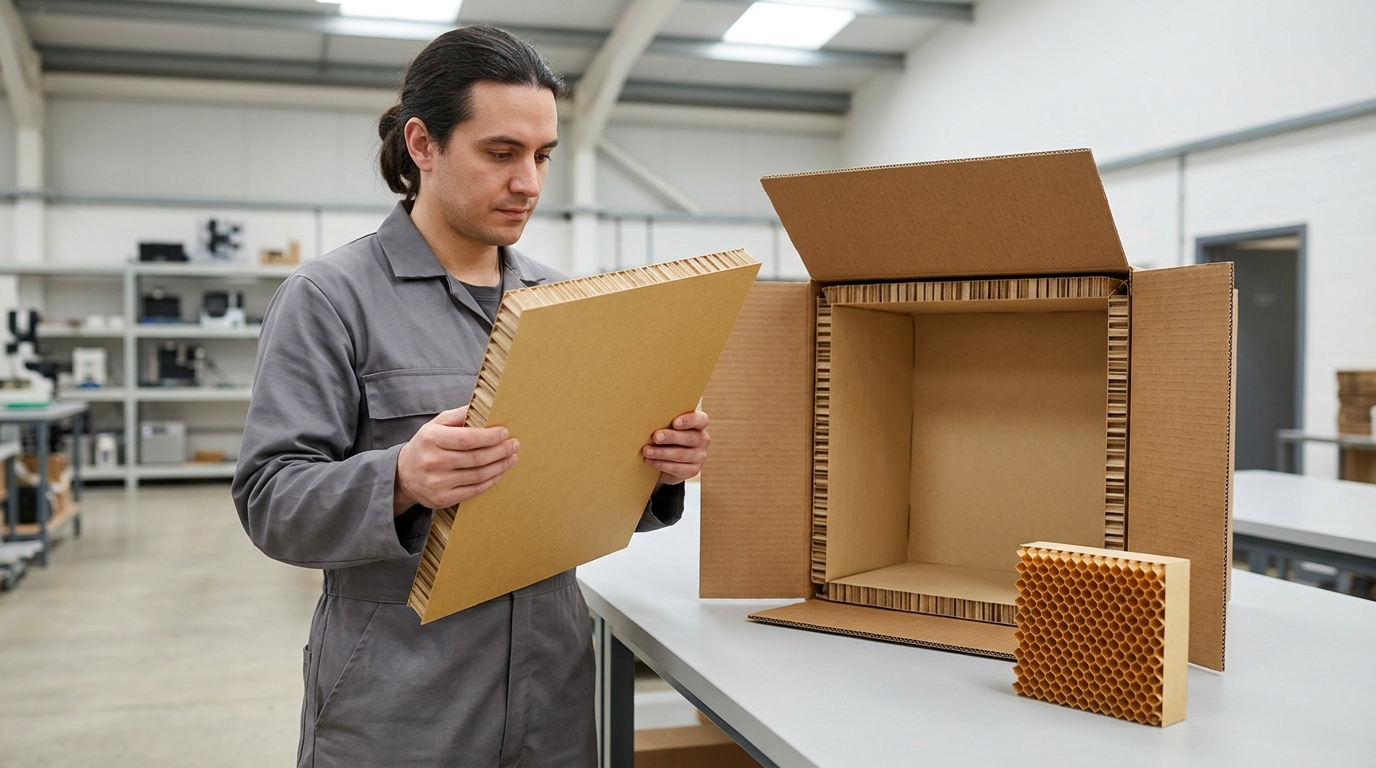
Paper honeycomb is an engineered material — hexagonal paper cells bonded between paper facings — that traps air inside its cell structure. Trapped air is one of the most effective insulators available, which is what makes a paper honeycomb panel a credible thermal liner inside a chilled food box. It is rigid, lightweight, and recyclable in standard kerbside paper streams.
The honeycomb core itself is manufactured from 100% recycled paper. The facings — the smooth liner sheets bonded to the top and bottom of the core — are produced from recycled paper or kraft, depending on the application. For chilled food, the facing choice influences print quality and surface durability rather than thermal performance, so most food box liners use a recycled-paper facing.
Envirolite, Dufaylite’s paper honeycomb packaging solution, holds the BRCGS AA Global Food Safety Standard — Dufaylite is the only paper honeycomb provider in the world to hold this certification. BRCGS is supplier-specific (it is determined by the manufacturer’s processes, not the material), and the vast majority of food packaging suppliers across all materials hold some form of BRCGS certification. The Dufaylite advantage sits within the honeycomb category: among honeycomb providers globally, only Dufaylite holds AA.
The glue is water-based, VOC-free and PFAS-free. For chilled food, meal kit and grocery delivery applications, paper honeycomb sits in the engineering sweet spot of any EPS alternative food packaging shortlist: thermal performance comparable to EPS, lightest format of all alternatives because the cells trap air rather than mass, kerbside-recyclable end-of-life that consumers actually follow through on, and food safety credentials no other honeycomb supplier can match.
Best for: Chilled and frozen meal kit boxes, grocery delivery, food box thermal liners, fresh produce shipments where temperature maintenance matters and consumer kerbside recyclability is required. Particularly strong fit for brands shipping at volume and running automated packing cells, and the most commonly chosen EPS alternative food packaging in the chilled segment.
No size or format limitations: Dufaylite’s manufacturing equipment adjusts size, cell structure, facing type and liner geometry freely. Any food box dimension, any thermal requirement, any insert geometry can be engineered to spec — there is no standard catalogue constraint to design around, and bespoke runs scale from prototype through to volume without re-tooling delay.
Lambs wool insulation
Lambs wool insulation, supplied in the UK most prominently by WoolCool, is a genuine premium option in the EPS alternative food packaging category. It is biodegradable in the strict sense, B Corp credentialled, and well established with high-end food brands. Wool’s natural fibre structure provides effective thermal insulation comparable to honeycomb, and the brand story translates well for premium chilled meal kits, organic produce boxes and farm-to-door operators.
The trade-offs are operational, environmental and end-of-life — and they matter for any food brand running an EPS alternative food packaging procurement comparison. The CarbonQuota DUF01_003 study (June 2025) measured lambs wool at 0.42 kg CO2e per delivery box compared to paper honeycomb at 0.16–0.26 kg CO2e — lambs wool carries roughly double the carbon footprint of paper honeycomb per box. Our internal EPR analysis shows the same multiple in cost terms: lambs wool also carries roughly double the EPR liability of a paper honeycomb liner per box. For an EPS alternative food packaging buyer evaluating total cost of ownership, that is a material difference once modulated EPR fees compound through 2026–2028.
The consumer recycling story for lambs wool is the bit that procurement teams underestimate — and it is the single biggest separator from any paper-based EPS alternative food packaging option. In theory the wool is recyclable. In practice the consumer has to (a) separate the wool from the plastic bag it ships in, (b) take the plastic bag to a retail store soft-plastics collection because it is not accepted kerbside, and (c) compost the wool, put it on the flower beds, or send it back via the manufacturer’s return programme.
The vast majority of consumers do none of this. Separation plus retail drop-off is too time-consuming. Composting wool is unfamiliar to most households. Return programmes have both a time cost and typically a credited-cost implication for the consumer. The wool and plastic bag end up in the general waste bin together.
On top of that, the plastic bag itself is subject to the UK Plastic Packaging Tax (£228.82/tonne as of 1 April 2026), which the producer pays — a tax line paper honeycomb alternatives do not incur because there is no plastic bag.
The form factor is also floppy rather than rigid, which makes lambs wool largely incompatible with automated food-box packing cells; producers scaling beyond hand-pack typically need a rigid alternative once their volume crosses a threshold. Wool is also animal-derived, which excludes vegan-positioned brands.
Best for: Premium chilled food brands hand-packing low-to-mid volumes where the wool sustainability narrative is part of the brand story and the operator is happy to pay a premium for that EPS alternative food packaging position.
Trade-offs: Roughly 2× the carbon and 2× the EPR liability of paper honeycomb; consumer kerbside recycling does not happen in practice; plastic bag attracts Plastic Packaging Tax; animal-derived (vegan-incompatible); not automation-ready.
Multi-layered corrugated cardboard
Multi-layered corrugated liners — typically 4 to 5 layers of corrugated or solid cardboard built up to create a thermal barrier — are recyclable, paper-based and familiar to packaging buyers. For light, short-transit chilled applications they can work as an EPS alternative food packaging layer.
The constraint is operational and material-economic, and it is the part of the EPS alternative food packaging conversation that operations directors care about most. Packing line assembly time is the first issue: multi-layered corrugated liners take significantly longer to fold and assemble into the box than a rigid honeycomb liner that drops in as a single engineered insert. For a food box producer running thousands of boxes per shift, the per-unit time cost of folding multi-layer card compounds fast against an automated honeycomb drop-in, and is one of the biggest operational reasons producers migrate away from corrugated builds at scale toward a rigid EPS alternative food packaging format.
Material waste is the second issue, and the one that defines multi-layered corrugated against any honeycomb-based EPS alternative food packaging format. Achieving thermal performance equivalent to honeycomb requires multiple layers of cardboard built up — far more paper per box than a honeycomb liner uses. Honeycomb cells trap air, and that trapped air is what provides the insulation; the structure delivers thermal performance with dramatically less raw material. Paper is the best end-of-life recycling outcome of any food box thermal liner material, but the underlying sustainability principle is to use the least material needed to do the job. A 4-to-5-layer corrugated build-up violates that principle: it adds weight, adds bulk, reduces usable product volume inside the box, increases shipping carbon per unit, and adds end-of-life volume to the recycling stream. The layered structure can also separate in transit or in humid conditions, which compromises both thermal performance and the consumer unboxing experience.
Best for: Short-transit, lower-margin chilled or ambient applications where weight, box size, and packing line throughput are not critical and the EPS alternative food packaging brief prioritises material familiarity over engineered efficiency.
Trade-offs: Slowest of the three alternatives to fold and assemble on the packing line; uses dramatically more paper for equivalent thermal performance (least material principle violated); heaviest format; bulky; layer separation risk in transit.
Comparison: EPS vs the three credible EPS alternative food packaging options
| Criterion | EPS (incumbent) | Paper honeycomb (Envirolite) | Lambs wool (WoolCool-style) | Multi-layered corrugated |
|---|---|---|---|---|
| Thermal performance for chilled food | High | High (engineered) | High | Medium (bulkier) |
| Kerbside recyclable in practice | No | Yes — paper goes straight into household paper stream | No — separation + retail drop-off too time-consuming, most goes to general waste | Yes |
| BRCGS food safety certification | Supplier-dependent (most hold this) | Supplier-dependent (most hold this) — Dufaylite is the only honeycomb provider in the world to hold the AA tier specifically | Supplier-dependent (most hold this) | Supplier-dependent (most hold this) |
| Verified carbon footprint per delivery box | 0.56 kg CO2e (CarbonQuota 2025) | 0.16–0.26 kg CO2e (CarbonQuota 2025) | 0.42 kg CO2e (CarbonQuota 2025) — roughly 2× honeycomb | No verified data |
| EPR liability (2026) | Red-rated, 1.2× base fee, rising to 2.0× by 2028 | Paper rate (Green), base fee | Roughly 2× paper honeycomb (Dufaylite analysis) — plus plastic bag PPT liability | Paper rate (Green) |
| Plastic Packaging Tax exposure | £228.82/tonne on EPS | None | £228.82/tonne on the wool’s plastic carrier bag | None |
| Packing line assembly speed | Rigid drop-in | Rigid drop-in | Floppy — hand-pack only | Slow — multiple layers must be folded and assembled per box |
| Material efficiency (sustainability principle: use least material for job) | Low recyclability cancels light weight | High — air in cells delivers insulation, less paper per box | Heavy fibre + plastic bag | Worst — 4–5 layers of cardboard for equivalent thermal performance |
| Automation-ready (rigid form factor) | Yes | Yes | No (floppy) | No (fold and assemble) |
| Vegan-compatible | Yes | Yes | No (animal-derived) | Yes |
| UK manufacturing | Various | Yes — sole UK manufacturer of paper honeycomb | UK-supplied | Various |
The pattern in the table is what makes paper honeycomb the chilled-food best fit within any EPS alternative food packaging shortlist: it is the only option that wins on thermal performance, kerbside recyclability in practice, verified lower carbon, EPR position, packing line speed, material efficiency, automation readiness and vegan compatibility simultaneously. No other material clears all eight.
How verified carbon data changes the picture
For most of the EPS alternative food packaging conversation over the last five years, carbon claims have been competing assertions. That changed in June 2025 when CarbonQuota published study DUF01_003 — an independently verified, like-for-like cradle-to-grave comparison of paper honeycomb, sheep’s wool and EPS as food box insulation.
The study measured carbon emissions per delivery box across the full lifecycle, covering raw material sourcing, manufacturing, transport, end-of-life and recycling pathway. Envirolite paper honeycomb came in at 0.16–0.26 kg CO2e per box. Sheep’s wool came in at 0.42 kg CO2e. EPS came in at 0.56 kg CO2e. That works out as a 50–70% lower carbon footprint than EPS and a 35–60% lower carbon footprint than sheep’s wool, verified by CarbonQuota. The advantage holds across all tested scenarios, including low-density EPS variants. Read the full CarbonQuota case study for the methodology.
The reason this matters for any EPS alternative food packaging procurement decision is that a verified figure carries weight in supplier audits, in customer ESG reports and in retailer compliance documentation in a way that a marketing claim does not. Procurement teams putting numbers into corporate sustainability reports need third-party verification to defend the figure to auditors. There is no equivalent third-party verified carbon study for any lambs wool or multi-layered corrugated food box insulation provider in the UK. For more on how the figures compare across the wider EPS replacement landscape, see our breakdown of polystyrene vs paper honeycomb.
The carbon advantage also stacks with the regulatory advantage. A red-rated EPS liner facing a 2.0× EPR multiplier by 2028 sits on a fundamentally different cost curve to a green-rated paper honeycomb liner attracting the base fee. Layer in the £228.82/tonne Plastic Packaging Tax that paper-based alternatives do not pay, and the combined regulatory cost differential — before any carbon reporting consideration — is now the dominant variable in the total cost of ownership calculation for any food brand running the EPS alternative food packaging numbers.
Why paper honeycomb is the chilled-food best fit
Three credentials, taken together, make paper honeycomb the chilled-food best fit among EPS alternative food packaging options. None of the four alternatives is the right answer for every food brand, but for chilled meal kits, grocery delivery and fresh produce — the highest-volume segments of the UK food box market — the case for paper honeycomb is the strongest on combined criteria.
The first credential is BRCGS AA Global Food Safety Standard. BRCGS itself is supplier-specific (it certifies the manufacturer’s processes, not the material) and the vast majority of food packaging suppliers across all materials hold some form of BRCGS. Within paper honeycomb specifically, Dufaylite is the only provider in the world to hold the AA tier.
For a food brand whose retailer customer runs supply chain audits, the AA tier is the highest standard available — and selecting a honeycomb supplier without it leaves an audit gap that other honeycomb suppliers cannot close. The certification covers the manufacturing site, the production processes, the glue, and the traceability of the materials — which is the level of detail that retailer technical teams ask about when they sign off a supplier.
The second credential is verified carbon data — the CarbonQuota DUF01_003 study covered above. A verified 50–70% lower carbon footprint than EPS, with the disclosure chain intact, is something a sustainability or ESG manager can put directly into their reporting. The study sits alongside Dufaylite’s Carbon Neutral Britain™ certification and FSC chain of custody (C186880) to give the procurement and ESG sides of the buyer organisation the documentation they need on the same evidence base.
The third credential is UK manufacturing. Dufaylite is the only UK manufacturer of paper honeycomb itself — not a UK converter buying core from overseas, not an importer cutting and finishing imported board. End-to-end manufacture under one roof in St Neots, Cambridgeshire. Shorter lead times, lower transport carbon, UK supply chain security. For a procurement team comparing EPS alternative food packaging suppliers on supply chain risk, the difference between a domestic manufacturer and an importer materially changes the resilience profile. For more on what this means in practice, see our overview of the Dufaylite sustainability and certifications story.
Layered on top, the engineering matters. Envirolite is bespoke. Cell sizes from 8mm to 47mm, thicknesses from 6mm to 100mm, panels engineered around the customer’s specific box dimensions and transit profile. The glue is water-based, VOC-free and PFAS-free. The rigid form factor drops cleanly into automated packing cells where wool cannot. For deeper application detail on chilled food applications, see our guide to more effective thermal boxes for chilled goods delivery.
Application examples — which EPS alternative food packaging fits which food sector
Different food sectors have different transit profiles, temperature targets, and retailer requirements. Choosing the right EPS alternative food packaging starts with matching the alternative to the application rather than picking a single material as a universal answer.
Chilled meal kit boxes. Multi-day delivery routes, mixed-temperature contents, retailer or DTC dispatch, frequent automation. Paper honeycomb is the strongest fit — engineered thermal performance, BRCGS AA, kerbside-recyclable consumer end-of-life, and the rigid form factor that drops into automated packing cells. Wool can work for premium hand-packed brands but typically falls over once volume pushes operations toward automation.
Ready meal delivery (chilled and frozen). Tight temperature tolerances, often shorter transit windows, food safety audit critical. Paper honeycomb again is the strongest fit thanks to BRCGS AA at supplier level and engineered thermal performance per millimetre of liner thickness. Multi-layer card can supplement honeycomb for outer cushioning but is rarely sufficient on its own for the temperature targets.
Fresh produce and horticulture deliveries. Fruit boxes, vegetable boxes, salad subscription services. Temperature maintenance matters but the windows are typically shorter and the tolerances slightly looser than for chilled meal kits. Paper honeycomb works well; multi-layer card can work for short-transit, lighter-weight produce.
Dairy and meat direct-to-consumer. High-risk food categories where BRCGS AA at supplier level is effectively a non-negotiable for the retailer audit chain. Paper honeycomb is the realistic EPS alternative food packaging choice here — multi-layered corrugated builds are bulky and slow to assemble at the volume these operators run, and lambs wool’s animal-derived nature creates positioning friction for some meat brands and is structurally incompatible with the volume-and-automation profile typical of these operators.
Ambient food and protective inserts (biscuits, baked goods, tea, coffee). No temperature requirement, lower regulatory pressure, lighter weight. Multi-layered corrugated cardboard works for ambient cushioning where speed of assembly is less critical and the box is light. Paper honeycomb is also a strong EPS alternative food packaging fit for ambient lines, particularly when the brand wants a single-supplier engineered solution across chilled and ambient SKUs.
How to switch from EPS to paper honeycomb — the engineering process
For a packaging engineer or procurement manager evaluating an EPS alternative food packaging switch, the process is more structured than a swap-and-go material change. The lab work that sits behind the switch is what protects the product in transit and what gives engineering sign-off the confidence to greenlight the change.
Step 1 — Define the brief. Box dimensions, product weight, transit duration, target temperature at point of delivery, ambient transit conditions (chilled vehicle, courier ambient, last-mile), and any seasonal variation. Bring an existing EPS spec if one exists — that is the engineering benchmark for the EPS alternative food packaging swap to match or beat.
Step 2 — Sample request. A bespoke paper honeycomb supplier engineers a first-pass liner spec around the brief. Cell size, panel thickness and facing material are selected based on the thermal target and the structural requirement. Samples are produced and shipped to the customer for evaluation.
Step 3 — Bench testing. Customer fits the sample liners into their actual boxes with the actual product, runs them through internal cold-chain testing or third-party transit simulation, and measures the temperature profile against the target. Adjustments — cell size, thickness, multi-layer construction — are made based on the test results.
Step 4 — Line trial. A small production run is packed on the customer’s actual line, with the actual operators and the actual automation if applicable. This is the moment the rigid form factor of paper honeycomb pays out: the liner drops into the packing cell cleanly without the manual handling that wool requires. Any operator-friction issues surface here.
Step 5 — Commercial roll-out. Spec is locked, supply agreement signed, full-volume EPS alternative food packaging manufacturing scheduled. Lead times for an established bespoke spec are typically 2–4 weeks once tooling is set up. Subsequent re-orders run faster.
The total elapsed time from initial brief to commercial supply is typically 8–16 weeks depending on the depth of testing the customer requires and the complexity of the box geometry. For a fuller view of the EPS alternative food packaging product range built on this engineering process, see our eco-friendly food packaging page.
How to evaluate an EPS alternative food packaging supplier
Before signing a supply agreement for any EPS alternative food packaging, run the proposed supplier through these five checks. They are the questions a packaging engineer needs answered to make the engineering sign-off, and the same questions a procurement manager needs to defend a switch internally.
1. BRCGS AA Global Food Safety Standard — yes or no?
BRCGS is supplier-specific (it certifies the manufacturer’s processes, not the material), and the vast majority of food packaging suppliers across all materials hold some form of BRCGS — so the question is not whether a supplier holds BRCGS at all, but specifically which tier and whether it covers the food-contact site. AA is the highest tier. For retailer-audited supply chains, AA at the manufacturing site is the standard worth holding out for. Within the paper honeycomb category, Dufaylite is the only provider in the world holding the AA tier.
2. Verified third-party carbon data — yes or no?
Marketing claims are not verified data. Ask for the study, the methodology and the disclosure URL. If the supplier cannot point to a study by name, reference number and date, treat the carbon claim as unsubstantiated. For ESG reporting purposes a third-party verified figure is the only one defensible to an auditor.
3. UK manufactured, converted or imported?
There is a meaningful difference between manufacturing the paper honeycomb in the UK, buying imported honeycomb and converting it, and importing a finished product. UK manufacture means shorter lead times, lower transport carbon and supply chain security. If you cannot get a clear answer to this question, that itself is the answer.
4. Bespoke engineering — or off-the-shelf?
For chilled food, off-the-shelf rarely works. The thermal target, transit duration, box dimensions and product weight are all specific to your product. A supplier that engineers to your specification is not the same as a supplier that sells you a stock sheet.
5. Kerbside recyclable consumer end-of-life — yes or no?
The end consumer should be able to put the liner out with their normal paper recycling. If the answer involves a return programme, a specialist collection or a “compostable in industrial facilities only” footnote, factor that into your customer experience plan and your EPR modulation score. Kerbside-recyclable consumer end-of-life is a defining EPS alternative food packaging criterion under Simpler Recycling.
Frequently asked questions
What are the alternatives to EPS packaging?
The three credible alternatives to EPS in the food box thermal liner market in 2026 are paper honeycomb, lambs wool, and multi-layered corrugated cardboard. For chilled food specifically, paper honeycomb is the best EPS alternative food packaging on combined criteria — verified lower carbon footprint (CarbonQuota 2025), kerbside recyclable in practice, automation-ready rigid form factor, engineered thermal performance, and BRCGS AA food safety from a manufacturer that is the only honeycomb provider in the world to hold the AA tier.
Lambs wool is a credible premium option for hand-packed low-volume brands but carries roughly 2× the carbon footprint and roughly 2× the EPR liability per box. Multi-layered corrugated works for lighter or shorter-transit applications but loses on packing line assembly time and material waste.
Is EPS being phased out?
EPS is not formally banned in the UK but is being priced and regulated out of competitive use. The Plastic Packaging Tax sits at £228.82 per tonne from 1 April 2026. EPR modulated fees rate EPS as red, charging 1.2× the base fee in 2026 and rising to 2.0× by 2028. EPS is excluded from kerbside collection under Simpler Recycling. Several major UK retailers have set deadlines requiring suppliers to remove EPS from their packaging. The combined effect is an effective phase-out, which is why packaging procurement teams are running EPS alternative food packaging comparisons now.
Is there an alternative to EPS?
Yes — for almost every food box thermal liner application currently using EPS, there is at least one credible EPS alternative food packaging option. For chilled food packaging, paper honeycomb is the best fit on combined performance, recyclability, food safety and verified carbon criteria. For ambient food packaging or short-transit chilled, multi-layered corrugated cardboard works where assembly time and material weight are not constraints. For premium hand-packed brands, lambs wool remains a credible option for the brand story even though it carries roughly 2× the carbon and EPR cost of paper honeycomb. The right choice depends on the application — but the era of “no alternative exists” is over.
Is EPS just Styrofoam?
EPS and Styrofoam are related but not the same thing. EPS stands for expanded polystyrene — the white, lightweight, beaded foam used in food box liners and protective packaging. Styrofoam is a Dow Chemical brand name for extruded polystyrene (XPS), which is denser and used mainly in construction insulation. In everyday use the term “Styrofoam” is often applied loosely to both. From a recycling and EPR perspective they are treated similarly under UK regulation — neither is kerbside recyclable, and both create the same EPS alternative food packaging conversation for any food brand looking to reduce their packaging compliance cost.
How much does EPS alternative food packaging cost compared to EPS?
The unit cost of an EPS alternative food packaging liner — paper honeycomb in particular — is typically modestly higher than the equivalent EPS insert on its own. The total cost of ownership tells a different story. Once Plastic Packaging Tax (£228.82/tonne in 2026), EPR modulated fees (1.2× the base rate for red-rated EPS, rising to 2.0× by 2028), waste handling and retailer compliance cost are all factored in, the gap closes substantially and in many cases reverses. A supplier worth engaging will run the total cost of ownership calculation for your specific volume and box spec rather than quoting a per-unit price in isolation.
Will an EPS alternative food packaging liner keep food at the right temperature in transit?
Yes — provided the EPS alternative food packaging liner is engineered for the application. A bespoke paper honeycomb liner is sized to the box dimensions, the product weight, the transit duration and the target delivery temperature. Generic off-the-shelf inserts rarely match the thermal performance of a tailored EPS liner; a properly engineered honeycomb liner does, and in side-by-side bench testing typically matches or exceeds the EPS benchmark. The engineering process — sampling, bench testing, line trial — is the standard route to validate the spec before commercial roll-out.
Is paper honeycomb actually recyclable in standard household recycling?
Yes. Paper honeycomb made from 100% recycled paper enters standard kerbside paper streams across the UK. Under Simpler Recycling rules (effective 31 March 2026), paper and cardboard are part of the standardised household kerbside collection. The liner can be folded flat and put out with normal paper recycling — no return programme, no specialist disposal, no consumer friction. This is a meaningful differentiator within the EPS alternative food packaging set versus sheep’s wool, which requires a manufacturer return programme to recycle.
Does an EPS alternative food packaging switch require new packing line equipment?
Usually not, if the chosen alternative is rigid. Paper honeycomb liners — like EPS liners — have a rigid form factor that drops into existing automated packing cells without modification. The line trial step in the switching process exists to confirm this rather than to redesign the line. Sheep’s wool insulation is the exception within the EPS alternative food packaging set: its floppy form factor is largely incompatible with packing automation and typically requires hand-packing, which is why operators scaling beyond a certain volume threshold tend to migrate from wool to a rigid alternative.
Talk to Dufaylite
If you are evaluating EPS alternative food packaging for a chilled or ambient food box and want to see how an engineered Envirolite paper honeycomb liner — the strongest EPS alternative food packaging on combined criteria — would perform against your specific transit profile, our in-house lab team can run the comparison. Get in touch via the Dufaylite contact page and we will engineer a sample pack to your product, your box dimensions and your temperature target — and include the verified carbon data, BRCGS AA certificate and EPR position alongside it.
Talk to the team. We will tell you exactly what would work for your specific box, what an EPS alternative food packaging switch would cost across its lifecycle, what evidence we can put in front of your retailer customer, and how an engineered EPS alternative food packaging spec compares to your current liner on every measurable criterion.
