
Written by Ashley Moscrop, Managing Director, Dufaylite Developments Ltd
Reviewed by Paul Gill, Head of Sales, Envirolite and Ultra Board
Last updated: 25 June 2026
Key takeaways
- Recyclable exhibition stand boards are display substrates that enter the standard paper recycling stream at end of life — paper honeycomb, closed-cell corrugated paper-core boards and corrugated all qualify; foam board and Foamex do not.
- Ultra Board, made by Dufaylite at St Neots, is the only UK-manufactured true open-cell paper honeycomb display board — lighter for equivalent rigidity than the imported closed-cell corrugated paper-core alternatives the trade evaluates.
- The imported boards exhibition builders compare against — Xanita, Reboard and Swedeboard SB Fibre — are all closed-cell corrugated paper core, manufactured in South Africa or Sweden, carrying higher Scope 3 transport carbon than a UK board.
- Ultra Board is Carbon Neutral Britain™ certified and FSC certified (C186880) — no competitor in this set holds Carbon Neutral Britain™ — and is 100% recyclable and repulpable into standard paper streams.
- Ultra Board 3D is engineered for self-supporting structures — gorilla sculptures, plinths, podiums and full stands — and is up to 45% lighter than corrugated-centred alternatives, while running on standard flatbed printing, cutting and routing equipment.
Recyclable exhibition stand boards are display substrates that go into standard paper recycling at end of life — replacing foam board and Foamex, which do not. The most structurally efficient option is paper honeycomb board: Ultra Board, made by Dufaylite at St Neots, is the only UK-manufactured open-cell paper honeycomb display board, is Carbon Neutral Britain™ certified, and is 100% recyclable, with a 3D variant engineered for self-supporting exhibition structures.
If you build exhibition stands, retail displays or POS units, the brief has changed. Clients increasingly ask for something more sustainable than foam board, and they want proof — not a vague claim. The catch is that the board still has to run on your existing kit and hold up in a 3D structural build. This guide compares the recyclable exhibition stand boards on the market from the builder’s perspective: which board, why, where it’s made, and how it’s actually recycled. By the end you will know how the leading recyclable exhibition stand boards differ on structure, weight, carbon and supply — and which one to specify for the build in front of you.
What makes an exhibition stand board recyclable?
A board is genuinely recyclable when an end user can put it into the standard paper recycling stream without separation, special collection or a return scheme. That is the test that matters. Plenty of materials are described as “eco” without meeting it.
Paper-based display substrates pass. Recyclable exhibition stand boards — paper honeycomb, closed-cell corrugated paper-core boards and plain corrugated — are repulpable and re-enter the paper stream alongside cardboard. At end of life the panel is paper, so it goes where paper goes. The strongest recyclable exhibition stand boards also carry independent sourcing certification such as FSC chain of custody, so the recyclability claim is backed by verifiable evidence rather than assertion.
Foam board and Foamex fail the test. Foam board is a polystyrene foam core sandwiched between paper or plastic liners; Foamex is a solid PVC sheet. Neither is accepted in standard paper recycling, both carry disposal cost, and foam board is prone to warping in humid environments — a familiar frustration on the shop floor. When a client asks for recyclable display materials, these are the materials you are being asked to move away from.
So the real decision is not “paper versus foam” — that is already settled by the brief. The decision is which of the recyclable exhibition stand boards performs best for the build in front of you. That is where the differences between paper honeycomb and the alternatives start to matter.
The recyclable exhibition stand boards compared
Not all recyclable exhibition stand boards are equal. They differ in core structure, weight, where they are made, and how they behave in a self-supporting 3D build. Here is how the main options stack up.
Paper honeycomb (Ultra Board) — open-cell, UK-made
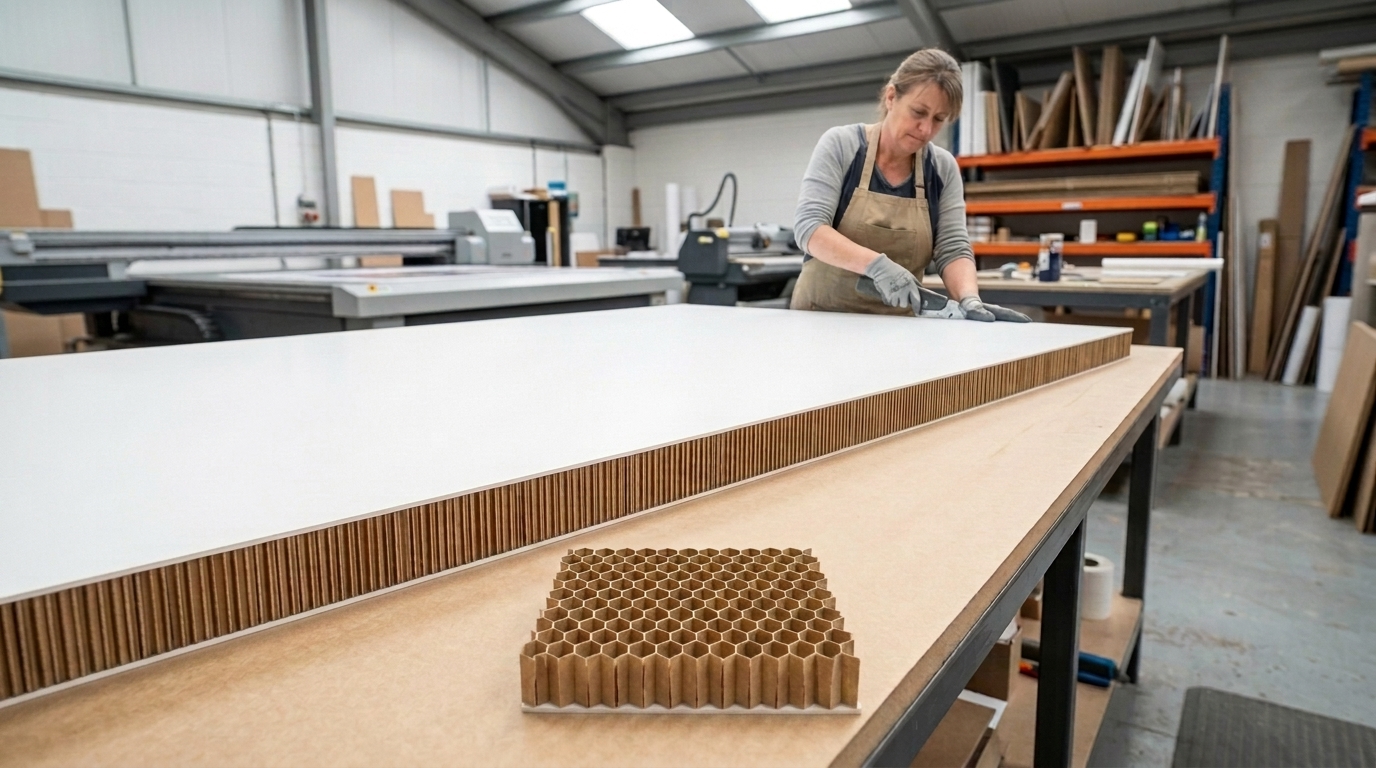
Ultra Board is a lightweight, rigid, printable paper honeycomb board used to produce retail displays, POS units, exhibition stands, signage and 3D structural elements. It uses an open-cell paper honeycomb core bonded between paper facings. That open-cell structure is the headline difference: it makes the board lighter than the closed-cell alternatives for equivalent rigidity.
It is the only UK-manufactured paper honeycomb display board, manufactured by Dufaylite at St Neots. It is Carbon Neutral Britain™ certified, FSC certified, and 100% recyclable and repulpable. The range spans flat 2D graphic boards through to Ultra Board 3D for structural builds — so you can specify the right variant for the job rather than forcing one board to do everything.
Closed-cell corrugated paper-core boards (Xanita, Reboard, Swedeboard SB Fibre) — imported
These are the boards the print and display trade most often evaluates against paper honeycomb. Xanita (manufactured in South Africa), Reboard and Swedeboard SB Fibre (both manufactured in Sweden) are all closed-cell corrugated paper core boards. They share the same fundamental construction: a corrugated paper core bonded between flat liner facings.
They are recyclable and paper-based, which is genuine, and they belong firmly in the set of recyclable exhibition stand boards a builder can consider. But the closed-cell corrugated core is heavier and denser than open-cell honeycomb for the same rigidity, and every sheet ships into the UK from overseas — adding transport carbon and lead time that a UK-made board avoids.
Corrugated board
Standard corrugated is cheap, widely available and fully recyclable, and it is one of the most familiar recyclable exhibition stand boards on the shop floor. It works for short-run flat graphics and lightweight stands. But it lacks the rigidity and surface flatness for large self-supporting 3D structures, and it dents and crushes more easily — so for an exhibition build that has to look sharp and stand up on its own, it is rarely the right substrate.
Foam board and Foamex — what they can’t do
Foam board and Foamex print well and cut easily, which is why they have been the trade default for years. But they are not recyclable in standard paper streams, they carry disposal cost, and foam board warps. As clients tighten their sustainability requirements, these materials increasingly fail the brief outright — which is exactly why the move to recyclable exhibition stand boards is happening now.
Recyclable exhibition stand boards: comparison table
The table below sets the recyclable exhibition stand boards against foam board across the criteria that matter to a stand builder — recyclability, core structure, weight, where it is made, certification, kit compatibility and suitability for a 3D build. Use it as a quick reference when shortlisting recyclable exhibition stand boards for a client spec.
| Criteria | Ultra Board (paper honeycomb) | Foam board / Foamex | Corrugated | Imported closed-cell corrugated paper-core (Xanita / Reboard / Swedeboard SB Fibre) |
|---|---|---|---|---|
| Recyclable in standard paper stream | Yes — 100% recyclable, repulpable | No | Yes | Yes |
| Core structure | Open-cell paper honeycomb | Polystyrene foam / solid PVC | Single corrugated flute | Closed-cell corrugated paper core |
| Weight for equivalent rigidity | Lightest — open-cell | Light but not recyclable | Light, low rigidity | Heavier — denser closed-cell core |
| UK-made / Scope 3 carbon | UK-made — lowest transport carbon | Varies | Varies | Imported (South Africa / Sweden) |
| Carbon Neutral Britain™ | Yes | No | No | No |
| Prints / cuts on standard kit | Yes — standard flatbed and routing | Yes | Yes | Yes |
| Suited to 3D structural builds | Yes — Ultra Board 3D engineered for it | Limited — warps | Limited | Yes, but heavier |
The pattern is clear. Among the recyclable exhibition stand boards, paper honeycomb is the most structurally efficient — and Ultra Board is the only option in the set that is UK-made and Carbon Neutral Britain™ certified, which is what makes it stand out from the other recyclable exhibition stand boards in the comparison.
See Ultra Board design solutions for exhibition and display builds — explore the Ultra Board design solutions and structural builds the board has already been used for.
Why open-cell paper honeycomb is the structural best fit for 3D builds
The single most important difference between Ultra Board and the imported boards is the core, and it is what sets it apart from the other recyclable exhibition stand boards. Ultra Board uses a true open-cell paper honeycomb core — hexagonal cells, like a beehive comb, bonded between paper facings. The imported alternatives use a closed-cell corrugated paper core. That is not a marketing distinction; it changes how the board performs.
An open-cell honeycomb core is less dense than a closed-cell corrugated core. For the same rigidity, you get a lighter board. On a flat graphic that barely registers. On a large self-supporting exhibition structure — a stand wall, a plinth, a sculptural element — it is the difference between a build you can lift, install and rig safely and one that fights you on weight.
Ultra Board 3D is the variant engineered for exactly this. It is built for 3D exhibition stand construction, structural display elements, large-format 3D structures, plinths and podiums — and the well-known gorilla sculptures that show what a paper honeycomb board can carry. It is up to 45% lighter than corrugated-centred alternatives, which is the weight saving that makes ambitious freestanding builds practical.
Crucially, none of this requires new equipment. Unlike some recyclable exhibition stand boards that need a specialist process, Ultra Board is compatible with standard flatbed direct-to-media printers and standard print-industry cutting and routing equipment. The “it needs to run on our existing kit” objection — the one that kills most material switches before they start — does not apply here. You design and produce the same way you do now, on a recyclable substrate.
For the flat work, Ultra Board 2D and Ultra Board Graphic give you a printable display board with a clean print surface, while Ultra Board Universal covers multi-purpose and lamination work. The point is range: you specify the variant that fits the job rather than compromising on one board for everything. If you want the structural reasoning in full, our explainer on the science behind Ultra Board breaks down how the honeycomb core delivers rigidity at low weight.
Where Ultra Board is made and how it’s recycled
Where a board is made is a carbon question, and increasingly a client question — and it is the point where Ultra Board separates from the other recyclable exhibition stand boards. Ultra Board is the only UK-manufactured paper honeycomb display board, made at St Neots in Cambridgeshire. Manufacturing in the UK gives it the lowest Scope 3 transport carbon in the recyclable set — the imported alternatives ship from South Africa or Sweden, carrying that freight footprint into every sheet.
On top of UK manufacture, Ultra Board is Carbon Neutral Britain™ certified at company level — a certification no other board in this comparison holds. It is FSC certified (C186880), which covers responsible paper sourcing across recycled and virgin fibres, and the glue is water-based, VOC-free and PFAS-free. These are the specific, verifiable credentials a client’s sustainability team can put in a report — not vague claims.
End of life is the simplest part of the story. Ultra Board is paper. It is 100% recyclable and repulpable, so a used panel goes into the standard paper recycling stream alongside cardboard — no separation, no special collection, no return scheme. That is what “recyclable” should mean, and it is the answer end users actually follow through on.
There is a commercial edge to UK manufacture as well. Large bespoke orders are fulfilled in days from St Neots rather than weeks from overseas, and custom sheet sizing for large campaigns optimises material for the project — reducing waste and improving the unit price. For large recyclable exhibition stand boards on a tight install deadline, that lead-time advantage matters as much as the carbon one. Ultra Board is available in the UK trade through Premier Paper Group.
If you are building the wider sustainability case for a client pitch, our sustainability credentials page sets out the full certification picture, and our guide to eco-friendly displays for printers covers how to position recyclable substrates with retail clients.
Frequently asked questions
What is the most sustainable material for an exhibition stand?
For most exhibition builds, paper honeycomb board is the most sustainable practical material among the recyclable exhibition stand boards available. It is 100% recyclable in standard paper streams, lightweight for its rigidity, and — in the case of Ultra Board — UK-made with the lowest transport carbon in the recyclable set, plus Carbon Neutral Britain™ certification. It outperforms foam board (not recyclable) and imported closed-cell boards (higher Scope 3 carbon) on the combination of recyclability, structural efficiency and verified credentials, which is what a sustainability brief usually requires.
Are exhibition stand boards recyclable?
Some are, some are not. Recyclable exhibition stand boards — paper honeycomb, closed-cell corrugated paper-core boards and plain corrugated — are paper-based and re-enter the standard paper recycling stream at end of life, which is what qualifies them as recyclable exhibition stand boards in the first place. Foam board and Foamex are not recyclable in those streams: foam board has a polystyrene core and Foamex is solid PVC. If recyclability is in the brief, specify a paper-based board such as Ultra Board, which is 100% recyclable and repulpable with no separation or return scheme needed.
What can I use instead of foam board for a display?
Use a recyclable paper-based board. Ultra Board paper honeycomb is the closest like-for-like replacement for foam board: it prints and cuts on the same standard flatbed and routing equipment, it is rigid and flat, and it is 100% recyclable — but unlike foam board it will not warp and carries no disposal cost. For flat graphics, Ultra Board 2D or Ultra Board Graphic replaces foam board directly; for 3D structures, Ultra Board 3D gives you the rigidity foam board cannot provide in a freestanding build.
Where is Ultra Board made?
Ultra Board is made in the UK, at Dufaylite’s manufacturing site at St Neots in Cambridgeshire. It is the only UK-manufactured paper honeycomb display board on the market — the closed-cell alternatives the trade evaluates are imported from South Africa or Sweden. UK manufacture gives Ultra Board the lowest Scope 3 transport carbon in the recyclable set and the fastest lead times: large bespoke orders are fulfilled in days rather than weeks. It is available in the UK trade through Premier Paper Group.
Is paper honeycomb board strong enough for a 3D exhibition build?
Yes. Paper honeycomb board is engineered for structural display work. Ultra Board 3D is built specifically for 3D exhibition stand construction, structural display elements, plinths, podiums and large-format structures — including freestanding sculptural builds. The open-cell honeycomb core gives high rigidity at low weight, making it up to 45% lighter than corrugated-centred alternatives. That weight saving is what makes large self-supporting structures practical to build, install and rig, while keeping the whole structure 100% recyclable.
Are there large recyclable exhibition stand boards available?
Yes. Ultra Board is produced in large sheet sizes and, because it is manufactured in the UK, can be supplied in custom sheet sizing for large campaigns. That means large recyclable exhibition stand boards can be optimised to the project — reducing offcut waste and improving the unit price compared with cutting down imported standard stock. The 3D variant covers large-format structural builds, while the graphic variants handle large flat display panels and signage. Lead times for large bespoke orders are measured in days from St Neots.
What to specify, and what to do next
Among the recyclable exhibition stand boards on the market, the decision comes down to structural efficiency, carbon and supply. Across all the recyclable exhibition stand boards we have compared, paper honeycomb wins on structure because the open-cell core is lighter for equivalent rigidity than the imported closed-cell alternatives. Ultra Board wins on carbon because it is the only UK-made, Carbon Neutral Britain™ certified board in the set. And it wins on supply because UK manufacture means days, not weeks, with custom sizing that cuts waste.
The honest caveat: match the variant to the job. Ultra Board 3D for self-supporting structures; the graphic and 2D variants for flat display work. One board does not do everything, and specifying the right one is what separates a clean build from a compromise.
The best way to judge a board is to handle it. Request an Ultra Board sample — feel the open-cell honeycomb difference for yourself and see how it behaves on your cutting kit. Talk to our team about your next exhibition or display build, or explore the full sustainable display materials range to see which variant fits your work.
